
Imagine a bank that promises never to lose a single dollar.
You deposit $1,000. The bank takes your money, runs it through an extremely complicated machine, and returns exactly $1,000.
Wonderful.
There is just one small detail. You can now spend only $12 of it.
The other $988 still exists. The bank has not lost a cent. It has simply converted almost all your purchasing power into an impressive collection of receipts.
You would probably describe this as the worst bank in history.
Thermodynamics calls it Tuesday.
Because the universe has a similarly irritating accounting system. Energy is conserved, but its ability to do useful work can be squandered. The total number of joules survives. Their career prospects do not.
Welcome to 1000whats, where today we meet the quantity that tells us how much useful work energy can still perform before it retires to the ambient temperature and starts talking about gardening.
Its name is exergy.
And once you understand it, a surprising number of energy technologies start looking less like magic and more like financial decisions made by someone who never checked the exchange rate.
The first law is an accountant. The second law is a career counselor.
The first law of thermodynamics says that energy is conserved. It can cross boundaries and change form, but it cannot simply vanish from an isolated system.
Take an electric heater. Feed it 1 kilowatt-hour (kWh) of electricity. Almost all that electrical energy eventually becomes heat in the room, with tiny amounts briefly taking detours through light or sound.
From an energy-accounting perspective, the heater is practically a straight-A student.
One kWh in. One kWh out.
The accountant applauds. The laws of physics stamp the invoice PAID.
Now take that same kWh of room-temperature heat and try to turn it back into a kWh of electricity.
Suddenly the machine needs a temperature difference, a heat engine, a place to reject heat, and a great deal of luck. If the heat and the surroundings are already at the same temperature, there is no thermal gradient to exploit. You cannot run a conventional heat engine on the promise that the room feels vaguely cozy.
Nothing happened to the energy quantity. What disappeared was its potential to produce work relative to the surroundings.
The first law tracks how much energy you have. The second law asks how much of it is still useful for a particular kind of conversion.
And the second law is considerably less impressed by your receipts.
So what is exergy, exactly?
Exergy is the maximum useful work that a system could deliver as it comes into equilibrium with a specified environment, assuming an ideal reversible process.
That last part matters. Exergy is a ceiling, not a warranty. If a system contains 20 kWh of exergy, it does not mean you can buy a machine tomorrow that extracts exactly 20 kWh of electricity. It means physics will not let you extract more useful work than that under the stated conditions.
Think of energy as the balance in your account and exergy as the amount you could actually spend after thermodynamics has checked the exchange rate.
The environment is part of the calculation. A hot object in a cold room has an opportunity to do something. The same object in an equally hot room has far less thermal opportunity.
Exergy therefore depends not only on what you have, but also on what surrounds it.
This is why engineers sometimes call exergy available work or availability. It is also why exergy sounds suspiciously like a philosophical question: useful compared with what?
Compared with a chosen reference environment. Physics, for once, insists that you specify the small print.
A kilowatt-hour is a kilowatt-hour. Until you ask it to get a job.
Let’s put three things on a table:
- One kWh of electricity.
- One kWh of heat delivered from a source held at 80°C (176°F).
- One kWh of heat delivered from a source held at 40°C (104°F).
All three contain the same quantity of transferred energy. A meter that only counts kWh can report the same number for each.
But electricity can, in principle, be converted almost entirely into work. The thermal streams cannot. To turn heat into work, you need a colder place to send some of it.
This is the fundamental indignity of heat engines: they must reject part of the heat even when the engineers have been very polite.
At an ambient reference temperature of 20°C (68°F), the theoretical maximum work fraction for heat supplied at a constant temperature is:
Exergy fraction = 1 − T₀ / T
Here T₀ is the reference environment temperature and T is the heat-supply temperature. Both must be in kelvin, not Celsius.
Put 80 and 20 directly into the formula and you will obtain nonsense with impressive confidence. Thermodynamics has enough problems without spreadsheet-induced ones.
For 80°C heat and 20°C surroundings:
1 − 293.15 / 353.15 ≈ 0.170
So 1 kWh of heat transferred from an ideal source maintained at 80°C carries at most about 0.17 kWh of work potential relative to that environment.
The remaining 0.83 kWh is not missing energy. It is energy that cannot be converted to work in this ideal heat-engine setup.
For comparison:
| Heat-supply temperature | Thermal exergy fraction, with 20°C surroundings | Maximum work from 1 kWh of heat |
|---|---|---|
| 40°C (104°F) | 6.4% | 0.064 kWh |
| 80°C (176°F) | 17.0% | 0.170 kWh |
| 200°C (392°F) | 38.0% | 0.380 kWh |
| 600°C (1,112°F) | 66.4% | 0.664 kWh |
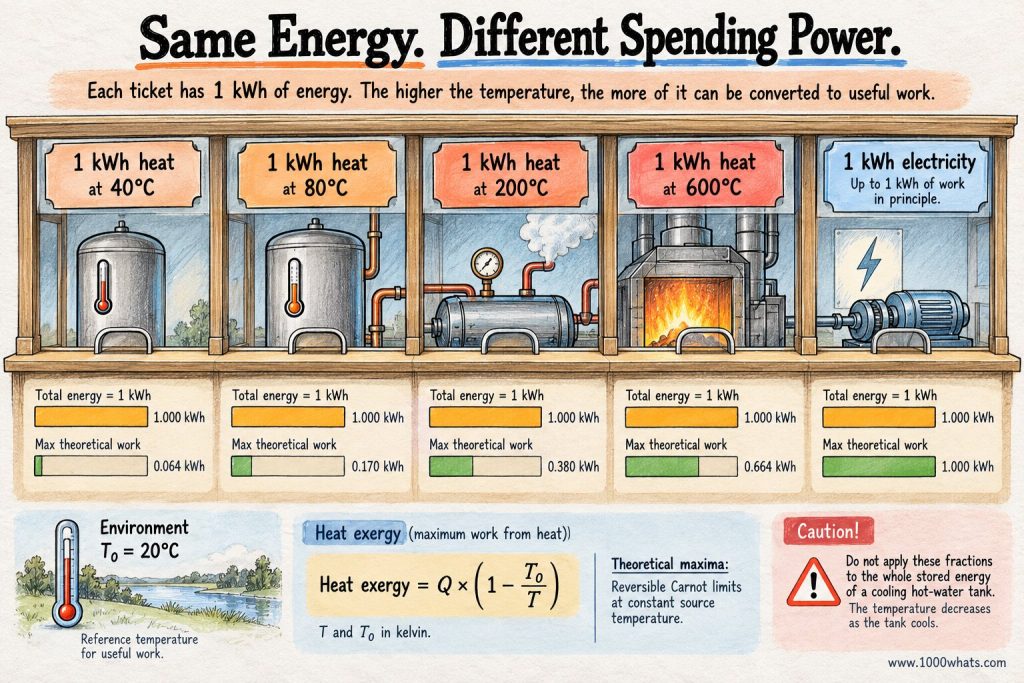
These are ideal Carnot limits for heat transferred at the stated constant temperature, not promises about real turbines, hot-water tanks, or investment returns. A finite tank cooling from 80°C to 20°C changes temperature continuously, so calculating its total exergy requires accounting for that cooling path rather than multiplying all its stored heat by 17%.
The pattern is what matters: the hotter the source relative to the surroundings, the more work potential each unit of transferred heat carries.
One kWh can arrive in economy class or first class. The airline still weighs both passengers the same.
The environment is not a footnote. It is the other half of the machine.
Suppose you have a cup of hot coffee.
In a chilly mountain cabin, it loses heat to the room. In a sauna at roughly the same temperature as the coffee, that thermal difference may almost disappear.
Same coffee. Different surroundings. Different opportunities.
That is the slightly rude beauty of exergy: it refuses to let you describe a resource without saying what you intend to do with it and what reference environment you are using.
The reference environment is usually modeled as a very large reservoir with specified temperature, pressure, and chemical composition. Engineers sometimes call the final equilibrium condition the dead state.
This is an unfortunate marketing choice.
The dead state is not a state in which energy is dead, atoms have stopped moving, or the system has become a Victorian ghost. It means the system has no further work potential relative to the chosen environment through the interactions included in the model.
Room-temperature water still contains internal energy. A tremendous amount, in fact. But a tank of water at the same temperature and pressure as the room does not offer a useful thermal or pressure gradient just because you stare at it with entrepreneurial determination.
Change the surroundings or add another resource, and the opportunities can change.
The second law’s exchange fee is called entropy generation
Energy has a remarkable privilege: it cannot be destroyed in ordinary thermodynamic accounting.
Exergy does not enjoy that protection.
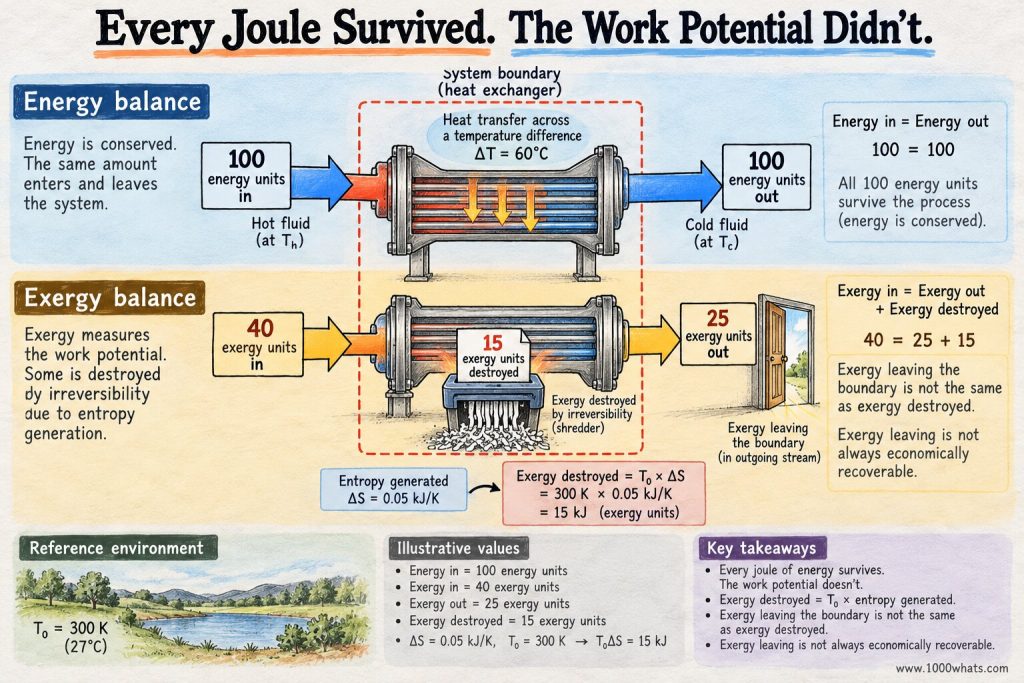
When real processes involve friction, mixing, electrical resistance, uncontrolled expansion, or heat transfer across a finite temperature difference, they generate entropy. That generation destroys some of the system’s capacity to perform useful work.
A famous relationship, often called the Gouy–Stodola theorem, expresses the connection:
Exergy destroyed = T₀ × entropy generated
For a consistent exergy balance, T₀ is the absolute reference temperature and the entropy generation must refer to the relevant process and system boundary.
This is not an accounting trick. It is the physical price of irreversibility.
Rub your hands together. Motion turns into heat through friction. The energy is still there. But try collecting that gentle warmth and turning all of it back into the exact hand motion you started with.
Good luck. Your palms have successfully converted organized mechanical work into less useful thermal energy, and the universe does not operate a generous returns department.
The U.S. Department of Energy’s chemical-industry energy analysis uses exergy precisely because ordinary energy balances can miss these losses in energy quality. The machine can conserve every joule and still destroy a large share of the work potential. MIT’s advanced thermodynamics materials make the same distinction mathematically.
The energy books balance. The exergy account has been quietly mugged by entropy.
Where does exergy go when it disappears?
There are two importantly different ways for a useful opportunity to leave your equipment.
Exergy destruction happens inside a process because it is irreversible. Think of friction in a pump, mixing hot and cold streams, or sending heat across an unnecessarily large temperature difference.
Exergy loss often means exergy carried out of the chosen system boundary, for example by a hot exhaust stream that goes into the atmosphere.
Those are not identical.
If a factory releases 200°C exhaust gas, some work potential leaves the factory with the gas. It may be recoverable before the exhaust cools. If the factory instead destroys work potential through a poor heat-exchanger arrangement, you cannot simply install a pipe downstream and ask for it back.
One is money leaving through the loading dock. The other is money shredded in the office.
Both hurt. Only one can potentially be intercepted outside the door.
The spectacularly inefficient way to make a room pleasantly warm
Imagine a furnace producing very high-temperature heat to keep an office at 21°C.
The office is comfortable. The heating bill may even be reasonable. Nobody is proposing that you replace the radiators with a philosophical seminar.
But from an exergy perspective, something strange has happened. You used a high-quality resource with substantial work potential to deliver a low-temperature service.
It is rather like hiring a concert pianist to press the elevator button.
The pianist can do it. The button gets pressed. Everyone arrives on the fourth floor. But perhaps we could have found a less extravagant way to achieve the same result.
That does not mean combustion heating is always a bad decision. Equipment cost, fuel availability, electricity prices, building insulation, reliability, emissions, and local conditions all matter. Exergy is not a substitute for engineering or economics.
It simply exposes a mismatch: a high-grade energy resource is being consumed to provide a low-grade thermal service.
And once you see the mismatch, the next technology becomes much easier to appreciate.
Heat pumps: the exchange-rate specialists
A heat pump does not usually create all the heat it delivers. It moves heat from a colder source to a warmer destination, using work to make that transfer happen.
For example, a heat pump might consume 1 kWh of electricity and deliver 4 kWh of heat to a building.
The missing 3 kWh is not a gift from a generous appliance manufacturer. It is heat extracted from the source, such as outdoor air or the ground.
This is why a heat pump can have a coefficient of performance (COP) of 4 without breaking the first law. The IEA explains the mechanism in its heat-pump technology overview.
Now add the exergy perspective.
A heat pump uses high-grade electricity to move a larger quantity of low-temperature heat. That can be an excellent match for the actual service required: keeping a house warm, not producing shaft power.
But the machine still pays an irreversibility bill. Compressors, throttling valves, motors, and heat exchangers are not exempt from thermodynamics because they have attractive green brochures.
A simple illustration: if the hot side operates at 35°C and the cold source at 5°C, the ideal reversible heating COP between those two constant-temperature reservoirs is:
COP₍Carnot, heating₎ = Tₕ / (Tₕ − T꜀) = 308.15 / (308.15 − 278.15) ≈ 10.3
A real COP of 4 is therefore impressive compared with resistance heating, but still well below that ideal limit. Actual heat-pump performance depends on source and delivery temperatures, equipment design, cycling, defrosting, and other losses.
The lesson is not that heat pumps have found a loophole. They have found a better job description for the electricity.
Why 100% energy efficiency can still be a terrible exergy score
Consider two machines:
Machine A: an electric resistance heater that converts almost all its electricity into heat.
Machine B: an electric motor that converts most of its electricity into useful mechanical shaft work.
Both may look highly efficient on a conventional energy basis. But they are not providing the same kind of output.
Mechanical work has high exergy. Low-temperature heating has much less potential to become work again.
A resistance heater that turns 1 kWh of electricity into 1 kWh of heat at a modest temperature has preserved the energy but substantially reduced its work potential.
If the purpose is to heat a room, that heat is absolutely useful. The residents do not care whether their radiator could run a steam turbine. They care whether their feet are cold.
This is why you must define the useful product and the system boundary before interpreting any efficiency number.
A device can have excellent first-law energy efficiency and poor second-law exergy efficiency. That does not automatically make it economically irrational, and it certainly does not mean the delivered service has no value.
It means the two efficiency measures are answering different questions.
| Question | Energy analysis | Exergy analysis |
|---|---|---|
| What is being tracked? | Quantity of energy | Maximum useful work potential relative to an environment |
| Can it be destroyed? | No, not in an isolated system | Yes, through irreversibility |
| Does temperature matter? | A kWh is counted equally regardless of source temperature | Very much, relative to the reference environment |
| What does a high score tell us? | Little energy quantity was lost across the chosen boundary | Little work potential was wasted relative to the defined useful output |
| What does it not tell us? | Whether energy quality was degraded | Whether the project is profitable, low-carbon, or practical |
Think of the first column as counting how many employees showed up. The second asks how much useful work the office actually accomplished. Neither one tells you whether the company should be selling its product for $9.99.
The factory that keeps paying first-class fares for economy-class heat
Picture a food-processing plant.
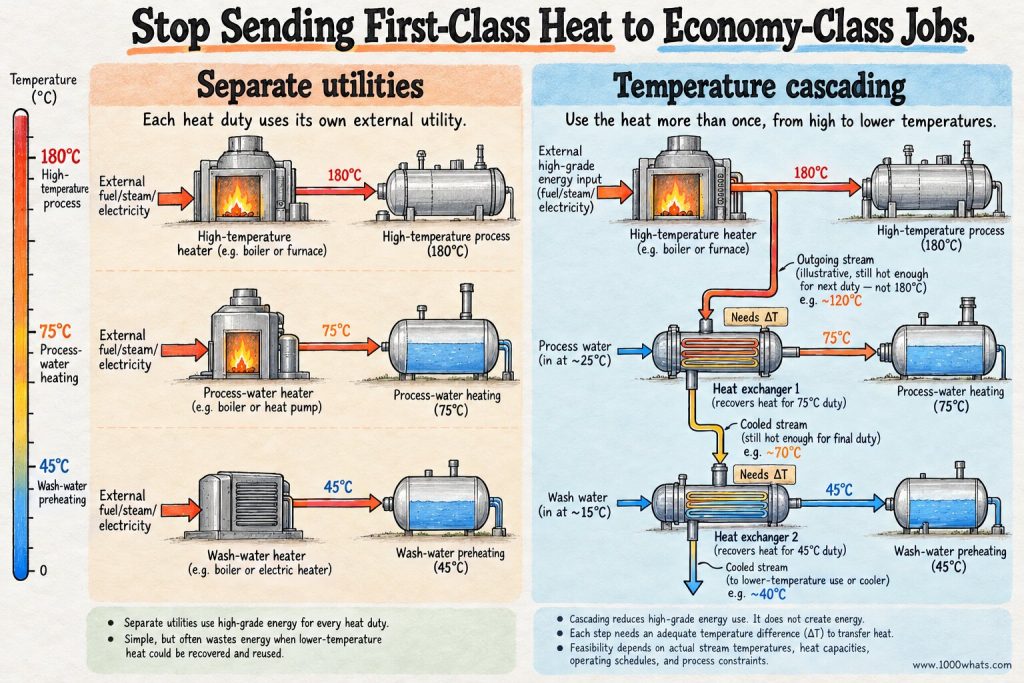
One process needs heat at 180°C. Another needs hot water at 75°C. The building’s washrooms need water at 45°C. Someone has been running separate heaters for everything, because separate heaters have an excellent lobby in industrial purchasing departments.
Now suppose the high-temperature process rejects a stream hot enough to help supply the 75°C duty. The 75°C system may then reject heat that can preheat the 45°C water.
Instead of buying fresh high-grade energy for every job, the plant cascades heat from higher temperatures to lower ones.
The energy is used more than once, at successively less demanding temperatures. You do not get the same heat back at the original temperature for free. Each exchange requires a suitable temperature difference and introduces losses.
But you can avoid spending expensive high-quality energy on a job that a lower-grade stream can already perform.
This is one reason temperature matching matters so much in industrial heat and waste heat recovery.
The engineering details matter: available heat rate, temperature profiles, exchanger approach temperatures, pressure drops, operating schedules, fouling, and process constraints.
Exergy does not build the heat exchanger. It tells you why asking the exchanger to do the right job is worth the trouble.
An innocent-looking heat exchanger can commit a thermodynamic misdemeanor
Suppose a hot stream at 180°C transfers heat to a process that needs 60°C.
Heat will flow. The energy balance may look beautiful. The plant might even congratulate itself for recovering heat that previously went up a chimney.
But transferring heat across a very large temperature difference generates entropy. That destroys exergy.
Would it be better to use some of that high-temperature stream for a hotter process first, and only then use the remaining heat for the 60°C duty?
Often, yes. The answer depends on the actual temperature profiles and process network, not on an inspirational poster reading THINK HOTTER.
This is the logic behind temperature-aware process integration and techniques such as pinch analysis. Engineers map where heat is available, where it is needed, and at which temperatures.
A conventional energy balance can tell you that the heat exchanger moved 100 kWh. Exergy analysis helps explain whether it squandered an unusually valuable temperature difference to do so.
Both numbers are true. One is just much better at identifying bad matchmaking.
A power plant is an exergy conversion business
A thermal power plant does not make electricity by discovering a secret reservoir of electrons inside coal, gas, uranium, or hot rocks.
It creates a temperature and pressure arrangement from which machinery can extract useful work.
In a steam turbine, high-energy steam expands through the turbine. Part of its capacity to perform work becomes shaft power and then electricity. The remaining energy leaves in exhaust steam, cooling water, and other streams.
The colder sink matters because heat engines need somewhere to reject heat. Higher source temperatures and lower sink temperatures generally improve the theoretical opportunity for work, subject to real material and design limits.
This is not permission to crank a boiler to 9,000°C. Turbine blades have opinions, and most of them are strongly opposed to melting.
Exergy analysis lets engineers distinguish the work potential supplied by the hot source from the portion destroyed in combustion, heat transfer, expansion, pressure losses, and other processes.
An energy balance tells you where the megawatt-hours went. An exergy balance tells you which parts of the plant spent the most opportunity getting there.
The small calculation that changes how you see waste heat
Let’s revisit our 80°C source, but this time imagine a facility can deliver 100 kWh of heat at a constant 80°C while the reference environment is 20°C.
The maximum theoretical work available from that heat transfer is:
100 × (1 − 293.15 / 353.15) ≈ 17 kWh
So why not install a generator and collect 17 kWh?
Because 17 kWh is the reversible upper bound, not an equipment specification. Real small heat engines face temperature-approach losses, pumping requirements, heat-exchanger costs, parasitic electricity consumption, and the considerable inconvenience of being made of actual materials.
A real system would produce less net work, possibly much less. At some scales, the economics can be dreadful.
But perhaps the facility next door needs water heated to 60°C.
Then the 80°C heat may be far more useful as heat, provided the exchanger can transfer it with a suitable temperature difference. You are not obliged to turn every useful resource into electricity just because electricity has excellent public relations.
This is the central practical lesson: the best use of an energy stream depends on both its quantity and its quality, and on the service you actually need.
The right destination for warm water is often another pipe, not a miniature power station built to impress a spreadsheet.
Exergy is not the same as temperature
At this point you might conclude that exergy is just a fancy word for hot.
It isn’t.
A compressed-air tank can contain useful work potential because its pressure exceeds the surroundings. A spinning flywheel contains kinetic energy that can be converted into work. A charged battery stores chemical potential that can drive an electric current.
Exergy can arise from temperature, pressure, motion, elevation, chemical composition, and other departures from environmental equilibrium.
A cold reservoir can also possess useful thermal exergy relative to a warmer environment. Refrigeration and cooling are services too. The direction of the temperature difference changes the problem, but it does not automatically make the opportunity disappear.
That is why engineers use broader exergy balances for real equipment rather than attaching a single Carnot percentage to everything with a thermometer.
Electricity and ideal mechanical work are high-grade forms because, in principle, they can be converted completely into other work. Chemical exergy is more complicated and depends on the chemical reference environment; it is not simply identical to a fuel’s heating value.
The thermodynamic bank has multiple currencies. Temperature is just the exchange desk with the longest line.
Energy storage has a quality problem too
Suppose you store 100 kWh as electricity in a battery and 100 kWh as moderately warm water in an insulated tank.
The labels both say 100 kWh. The storage systems are not interchangeable.
The battery can deliver electricity to a motor, computer, or heat pump, subject to conversion losses and operating limits. The hot-water tank can deliver heat to a suitable load. Turning that low-temperature heat back into electricity is much harder.
Does that make the tank a bad battery?
Only if you needed electricity.
If the customer wants hot water tomorrow morning, storing hot water may be exactly the right decision. Why pay for a sophisticated electrochemical device to preserve high-grade electricity, then spend it turning water warm?
Our guide to thermal energy storage explores that trade-off. Exergy adds a useful warning label: do not compare storage technologies by kWh alone when their outputs provide different services.
It is like comparing a refrigerator full of groceries with a bank account because both cost $300. One is excellent at making dinner. The other is considerably better at paying the plumber.
What exergy efficiency actually means
You will sometimes see exergy efficiency, also called second-law efficiency.
In general, it compares the exergy of a defined useful product with the exergy consumed to produce it. For a work-producing machine, it can also be expressed as actual useful work divided by the maximum reversible work available under comparable conditions.
The details matter. A heat pump, turbine, boiler, heat exchanger, and chemical reactor do not all have the same useful product. Different legitimate definitions and system boundaries can yield different exergy-efficiency figures.
A ratio without a definition is not engineering. It is a percentage wearing a lab coat.
When someone claims that a system is 85% exergy-efficient, ask three questions:
- What exactly counts as the useful product?
- What environment and system boundary were used?
- Which exergy inputs and outputs are included?
Only then can you compare technologies fairly.
This is especially important in combined heat and power systems, where electricity and useful heat are produced together. Adding their kWh totals is easy; judging the quality of each output is more subtle.
Can exergy be renewable?
Not in quite the way we label solar, wind, or geothermal resources.
Exergy is a property of a system relative to its environment, not a fuel category or a green certificate.
Sunlight has substantial work potential because it arrives as radiation from a very high-temperature source. Wind carries organized kinetic energy. A geothermal resource may offer thermal exergy because its temperature differs from the surroundings.
Whether a technology is renewable, low-carbon, economical, or environmentally benign is a different question.
A fossil-fuel flame can have plenty of exergy. That does not give it a sustainability medal.
Likewise, a low-temperature renewable heat source may have modest exergy per kWh and still be extremely valuable for district heating or industrial preheating.
Thermodynamics grades the work potential. Climate policy grades something else. Confusing the two is how a perfectly good physics concept ends up in a very bad PowerPoint.
The three questions exergy makes engineers ask
You do not need to calculate chemical potentials before breakfast to think like an exergy engineer. Start with three practical questions.
First: What quality of energy does the job actually require?
A data center needs electricity for computation, but a nearby building needs low-temperature heat. Those are different services. Pretending they require identical energy quality is an expensive hobby.
Second: Where are we destroying useful differences?
Look for friction, throttling, mixing, combustion irreversibilities, and especially heat moving across unnecessarily large temperature gaps.
Third: Could a lower-grade resource do this job instead?
Perhaps waste heat can preheat incoming water. Perhaps a heat pump can lift ambient heat to the required temperature. Perhaps a hot process can serve several successively cooler loads.
These questions do not automatically produce a profitable project. You still need temperatures, flow rates, operating hours, costs, carbon factors, reliability, and a process engineer who will answer the phone.
But they often reveal the opportunities that a plain kWh total conceals.
The limits: exergy cannot tell you what to build
There is a temptation to treat exergy as the secret master metric of civilization. It is not.
Exergy does not tell you the market price of electricity. It does not tell you whether a heat-recovery project has a three-year payback or a thirty-year one. It does not know whether your factory shuts down every weekend, whether a neighbor wants your hot water, or whether the permitting authority has developed a personal grudge against pipework.
It also does not measure carbon emissions by itself. Two energy sources with similar exergy may have very different environmental impacts.
And theoretical maximum work is not necessarily the service anyone wants. You can have a low-exergy heat stream that is wonderfully suited to warming a greenhouse. Calling it low quality is not calling it worthless.
Exergy is best understood as an additional lens: it reveals the degradation of useful work potential that ordinary energy accounting cannot show.
The best energy decisions usually need both laws of thermodynamics, a real engineering design, and a calculator that understands money.
Preferably in that order.
Final thoughts
Energy is an unusually loyal employee. No matter how many machines it passes through, it never resigns from the universe.
Exergy is different. It is the employee’s ability to get meaningful work done. Send it through enough friction, poor temperature matches, and irreversible processes, and the work potential disappears even though every joule is still on the payroll.
That is why an electric kilowatt-hour and a kilowatt-hour of lukewarm heat are not interchangeable, why heat pumps are so clever, why factories should match temperatures instead of merely counting megawatt-hours, and why a power plant needs a cold place as much as it needs a hot one.
The first law says the money is still in the bank.
The second law quietly slides the statement across the desk and asks whether you can actually spend it.
And exergy is the number that tells you the answer.
Until next time, stay curious! 😎
Discover more from 1000whats
Subscribe to get the latest posts sent to your email.