You switch on a light.
The bulb uses electricity.
Simple enough.
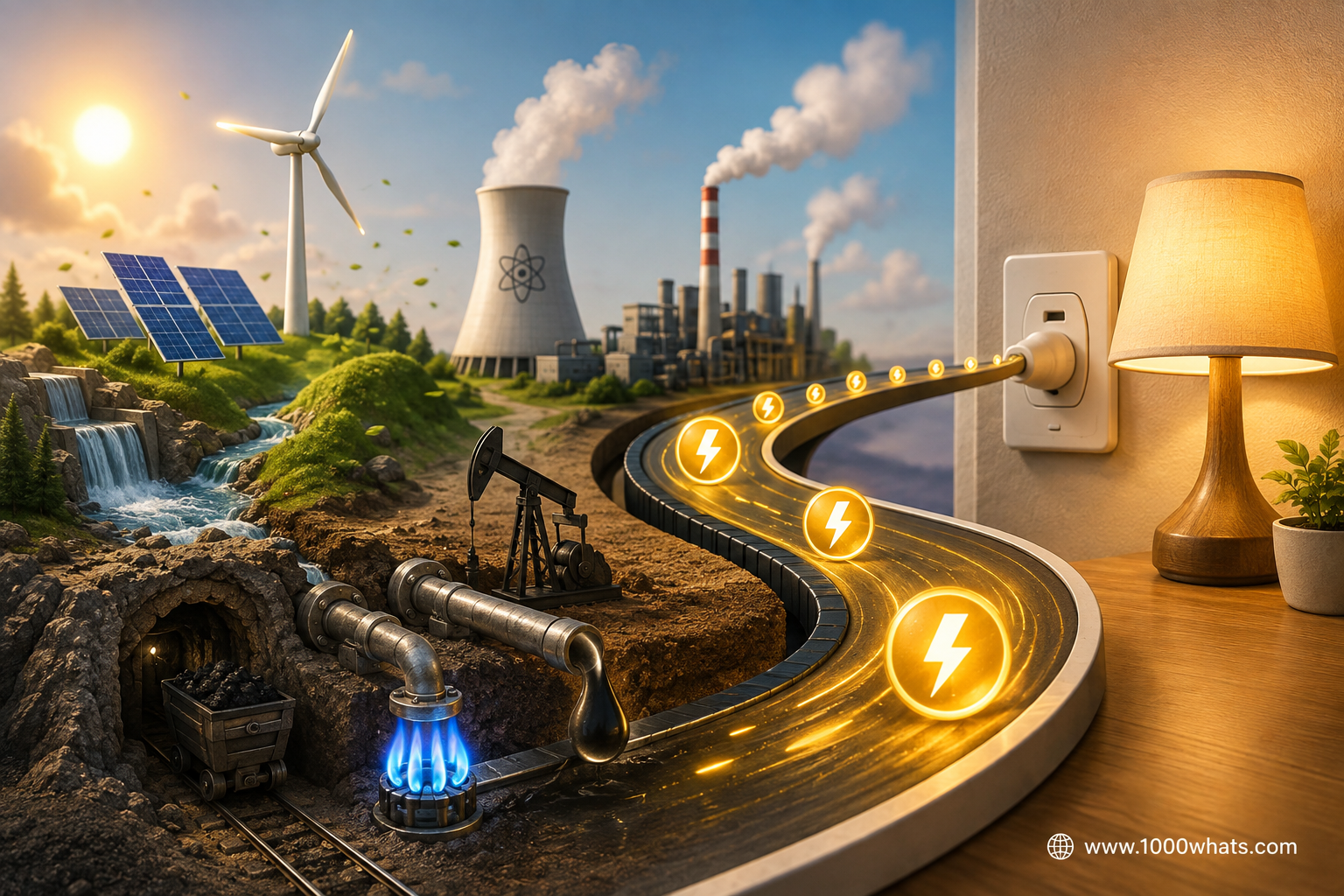
But where did that electricity begin?
Maybe as natural gas extracted from underground.
Maybe as uranium inside a nuclear reactor.
Maybe as sunlight hitting a solar panel.
Maybe as moving air passing through a wind turbine.
By the time energy reaches your socket, it may already have changed form several times.
So if we want to answer a seemingly basic question—
How much energy does a country actually use?
—where exactly should we start counting?
At your electricity meter?
At the power plant?
At the gas field?
At the coal mine?
At the sunlight hitting the panel?
That is the problem primary energy is trying to solve.
⚡ “Primary energy is not another type of energy. It is where we decide the energy journey begins.”
Welcome to 1000whats — where today we’re going upstream, past your electricity bill, past the power plant, and back to the point where energy first enters the human energy system.
That starting point is primary energy.
So, what is primary energy?
The usual definition sounds simple:
Primary energy is energy available from a natural source before it has been transformed into another energy carrier.
Think:
- coal before it is burned;
- crude oil before it is refined;
- natural gas before it is converted or burned;
- biomass;
- uranium used for nuclear energy;
- flowing water;
- wind;
- sunlight.
Eurostat describes a primary energy product as one extracted or captured directly from natural resources.
But there is a more useful way to understand it:
Primary energy is the upstream starting point of energy accounting.
It is not a new physical form of energy.
Energy can be chemical, thermal, kinetic, electrical, nuclear, gravitational, and so on.
“Primary” tells us something different.
It tells us where that energy sits in the supply chain.
That distinction is crucial.
A lump of coal contains chemical energy.
Calling it primary energy does not describe its physics.
It describes its position:
we have not yet transformed it into something else.
Think of energy as a journey
Energy rarely goes straight from nature to the thing you actually want.
It travels.
Consider oil.
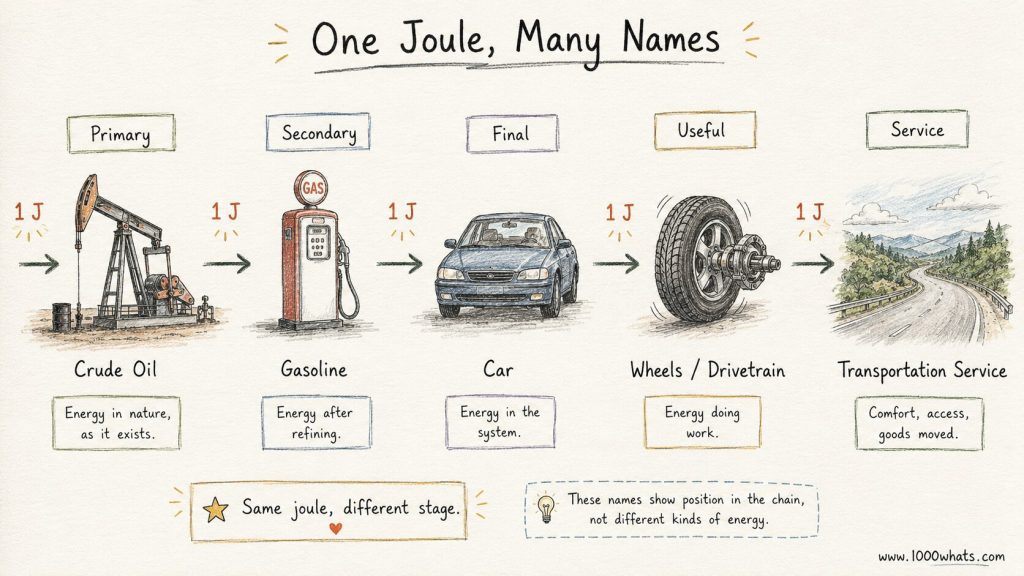
crude oil → refinery → gasoline → car engine → wheels → transportation
Or natural gas used to generate electricity:
natural gas → power plant → electricity → grid → electric motor → mechanical work
Or uranium:
uranium → nuclear heat → steam → turbine → electricity → end user
At different points along those chains, energy gets different names.
A simplified version looks like this:
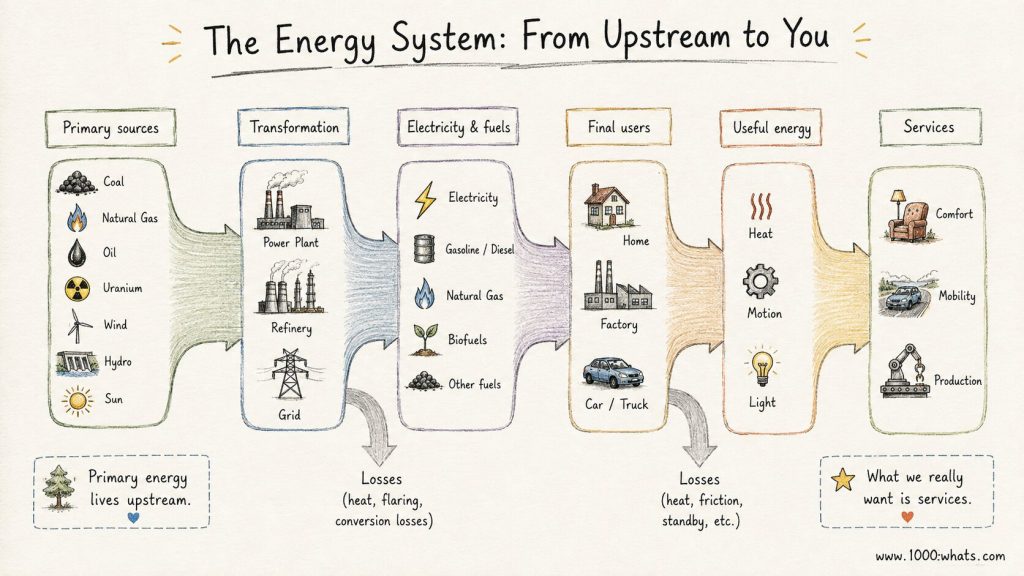
Primary energy → Secondary energy → Final energy → Useful energy → Energy service
That sounds like an unnecessarily bureaucratic collection of adjectives.
But each one answers a different question.
Primary energy: Where did the energy enter the system?
This is the first step.
Examples:
Crude oil extracted from the ground.
Coal leaving a mine.
Natural gas entering the energy system.
Biomass harvested for energy.
For these fuels, primary energy is relatively intuitive because we can measure their energy content.
Burn a certain amount of natural gas and it releases a measurable amount of heat.
That energy content becomes the starting number.
Then we begin transforming it.
Secondary energy: What did we turn it into?
Now take crude oil.
Very few people pour crude oil into their cars.
We refine it.
The refinery produces gasoline, diesel, jet fuel, LPG, and other products.
Those are secondary energy products because they were created by transforming primary energy.
The same applies to electricity generated from natural gas or coal.
The fuel is the primary energy source.
The electricity is a transformed energy carrier.
So:
natural gas → electricity
or:
crude oil → gasoline
The product on the right is secondary.
Why bother making this distinction?
Because otherwise we could easily count the same energy twice.
If 100 units of crude oil enter a refinery and produce 90 units of petroleum products, we cannot simply say:
Great. We have 190 units of energy.
We don’t.
We have followed approximately the same energy through two stages.
Energy balances exist partly to stop us from performing this kind of statistical alchemy.
Eurostat describes the energy balance as a framework that tracks energy products through production, trade, transformation, and consumption while avoiding double counting.
That is one of the main reasons primary energy exists as a concept.
We need to know where to start counting.
Final energy: What actually reaches the customer?
Now move downstream.
You pull into a gas station and put 50 liters of gasoline into your car.
That gasoline is final energy.
Or electricity arrives at your home.
That electricity is final energy.
Or natural gas arrives through a pipe and your boiler burns it.
That gas is also final energy.
Eurostat describes final energy consumption as the energy actually used by homes, cars, businesses, industry, and other end users, excluding what the energy sector itself uses or loses during transformation and delivery.
So:
Primary energy looks upstream.
Final energy looks at what reaches the end user.
Easy?
Almost.
Because here comes a distinction that causes a surprising amount of confusion.
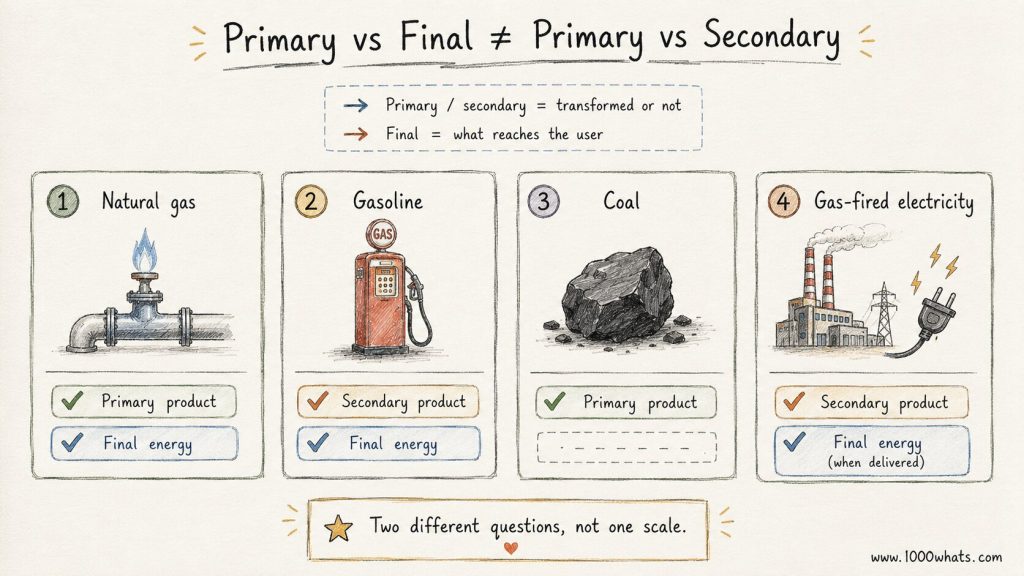
Primary vs. secondary is NOT the same as primary vs. final
This is worth stopping for.
The words sound like they belong to one neat ladder.
They don’t quite.
Primary vs. secondary describes the energy product.
Primary vs. final describes where we are in the energy flow.
Consider natural gas.
Natural gas extracted from the ground is a primary energy product.
If that same natural gas is delivered directly to your home and burned in your boiler, it also becomes part of final energy consumption.
So it can be:
primary product + final energy
at the same time.
Now gasoline.
Gasoline was produced by refining crude oil.
So gasoline is a secondary energy product.
But when you put it into your car, it is also final energy.
So:
secondary product + final energy
Electricity generated from natural gas is another secondary product.
When it reaches your meter, it becomes final energy.
This is much easier to see in a table:
| Energy | Primary or secondary product? | Can it be final energy? |
|---|---|---|
| Natural gas | Primary | Yes |
| Coal | Primary | Yes |
| Crude oil | Primary | Usually transformed first |
| Gasoline | Secondary | Yes |
| Diesel | Secondary | Yes |
| Electricity from gas | Secondary | Yes |
That distinction sounds fussy until you try to read an energy balance.
Then it becomes essential.
And what comes after final energy?
Suppose one liter of gasoline reaches your car.
That is final energy.
But you did not actually want gasoline.
You wanted movement.
The engine converts the chemical energy in gasoline into mechanical work.
Some becomes useful motion at the wheels.
A large amount becomes heat.
The mechanical energy that actually performs the desired job is often called useful energy.
And even that is not really what you wanted.
You wanted:
transportation.
The same logic works at home.
Natural gas reaches your boiler.
Final energy.
The boiler converts it into heat.
Useful energy.
Your house becomes comfortable.
Energy service.
So the full chain might be:
Primary energy: natural gas
↓
Final energy: gas delivered to your home
↓
Useful energy: heat delivered by the boiler
↓
Energy service: warm house
Or:
Primary energy: crude oil
↓
Secondary energy: gasoline
↓
Final energy: gasoline in your tank
↓
Useful energy: mechanical work at the wheels
↓
Energy service: getting to work
Notice what happens as we travel right.
We get increasingly close to the thing humans actually care about.
⚡ “Nobody wakes up wanting 40 kWh. We want a warm house, a moving car, cold food, light, steel, and Wi-Fi.”
Energy is the machinery that gets us there.
Why do we need primary energy at all?
Now we can answer the real question.
Why not simply measure final energy?
Because final energy hides everything that happened upstream.
Imagine two energy systems that both deliver:
100 units of electricity to consumers.
System A produces that electricity mainly by burning fuel in thermal power stations.
System B produces much of it from wind and hydro.
Consumers see the same 100 units.
But the energy systems behind them are very different.
System A may need substantially more upstream fuel energy because thermal generation converts only part of the fuel’s energy into electricity.
System B has a different conversion chain.
If you measure only the electricity delivered to customers, you cannot see that difference.
Primary-energy accounting gives us a way to look at the whole upstream energy requirement, not merely the energy crossing the consumer’s meter.
That helps governments and analysts understand things such as:
- overall energy demand;
- dependence on particular fuels;
- transformation losses;
- import dependence;
- energy efficiency;
- structural changes in the energy system.
It is why virtually every national energy balance begins upstream rather than at your socket.
A simple fossil-fuel example
Imagine a gas power plant.
Let’s deliberately use very round numbers.
The plant receives:
100 units of natural-gas energy
Suppose it converts 50 units into electricity.
The other 50 mostly leave as heat.
The grid then delivers perhaps 47 units to consumers after network and station losses.
You could describe the chain roughly like this:
100 primary → 50 electricity → 47 final electricity
The consumer sees 47.
The upstream energy system had to handle 100.
This is the intuitive version of primary energy.
And it explains why primary energy consumption is normally larger than final energy consumption in a fossil-heavy energy system.
But then renewables arrive and ruin our beautifully simple explanation.
Here is the weird part: What is the primary energy of wind?
Imagine a wind turbine.
What exactly should we count as its primary energy?
All the kinetic energy in the moving air?
Only the air crossing the rotor?
Only the fraction the turbine could theoretically extract?
Only the electricity it actually generates?
There is no barrel of wind arriving at the power station with a label saying:
Contents: 14.7 MWh.
Solar creates the same problem.
Should we count all solar radiation hitting the panel?
Only the part absorbed?
Only the electricity produced?
Hydropower?
Do we calculate all the gravitational potential energy of the water?
And nuclear brings another question.
Do we count the theoretical energy inside uranium?
The heat produced in the reactor?
The electricity coming from the generator?
Suddenly, “energy before transformation” is not quite enough.
We need an accounting boundary.
Primary energy is partly physics—and partly convention
This is perhaps the most important nuance in the whole article.
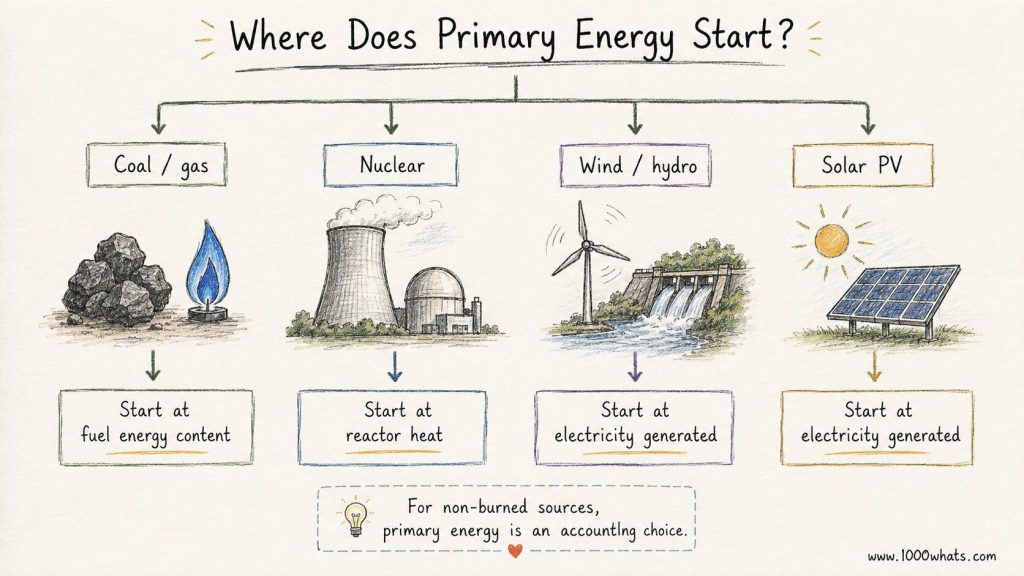
For combustible fuels, primary energy accounting is relatively straightforward.
Under Eurostat’s methodology, coal, crude oil, natural gas, biomass, and similar combustible products are generally counted using their actual energy content.
But for non-combustible energy sources, Eurostat has to choose a practical starting point.
Its energy-balance methodology uses what is called the physical energy content method.
Broadly:
- for coal, oil, gas, biomass, and other combustible fuels, primary energy is their fuel energy content;
- for nuclear, the primary form is the heat produced in the reactor;
- for geothermal and solar thermal, heat is used;
- for wind, solar PV, hydro, wave, and tidal power, the generated electricity is taken as the primary energy form.
Read that again.
For coal-fired electricity, primary energy is measured before the power plant’s conversion losses.
For wind electricity, under this methodology, the electricity generated is itself the primary form being counted.
That means primary energy is not simply a giant physics meter measuring every joule nature contains.
It is an energy-accounting framework with defined boundaries.
And those boundaries matter.
This is why two primary-energy charts can disagree
Different organizations have historically used different methods to compare combustible and non-combustible energy sources.
One approach counts the direct energy form.
Another can calculate a substituted primary-energy equivalent—essentially asking:
How much fossil-fuel input would have been required to generate this amount of renewable electricity?
Those methods produce different numbers for exactly the same solar farm or wind fleet.
Neither changes how much electricity the turbine generated.
The difference is accounting.
Eurostat itself notes that energy-balance methodologies are not completely harmonized internationally.
That gives us a useful rule.
If somebody shows you a chart of:
“Primary energy consumption by source”
before arguing that one technology is enormous and another insignificant, ask:
Which primary-energy methodology?
That is not pedantry.
The answer can materially change the picture.
So what does “primary energy consumption” actually mean?
We now need to distinguish the concept of a primary energy source or product from an aggregate indicator called primary energy consumption.
In EU statistics, primary energy consumption is essentially a measure of total domestic energy demand before energy reaches final consumers.
It includes the energy needed by the energy system itself and the energy involved before transformation and distribution losses have been stripped out.
Final energy consumption is further downstream:
the energy actually delivered to end users.
The 2026 Eurostat energy overview reports that in 2024 the EU had around:
1,209 Mtoe of primary energy consumption
versus:
901 Mtoe of final energy consumption.
Mtoe means million tonnes of oil equivalent, because apparently measuring energy in joules was not confusing enough. We deal with that particular zoo in What is the unit of energy?.
The important point is not memorizing 1,209 or 901.
It is understanding what the two numbers are looking at.
1,209 Mtoe looks at the energy system further upstream.
901 Mtoe looks much closer to the end user.
The difference reflects transformation and distribution losses, energy-sector own use, and the way the energy balance is constructed.
They are not two competing estimates of the same thing.
They measure different stages of the journey.
Think of an energy balance as a Sankey diagram
This may be the easiest way to visualize the concept.
Imagine a giant river entering a country.
That is upstream energy supply.
Then the river splits.
Some oil goes into refineries.
Some gas goes directly to industry.
Some gas enters power plants.
Some electricity comes from wind and hydro.
Some energy is exported.
Some is used by the energy industry itself.
Some is lost during conversion.
Eventually the remaining streams reach:
- homes;
- transport;
- factories;
- offices;
- agriculture.
Eurostat literally presents energy systems using Sankey-style energy balance diagrams.
Primary energy sits near the upstream side of that map.
Final energy sits near the consumer side.
Useful energy would take us one step further inside the car, boiler, motor, furnace, or appliance.
That is probably the cleanest mental model:
Primary energy is not “better” or “more real” energy. It is an upstream accounting perspective.
Now we can finally talk about efficiency
Only now does conversion efficiency become useful to the story.
Because once you understand the chain, you can see why primary and final energy differ.
Every conversion step may require more upstream energy than eventually reaches the consumer.
Coal becomes heat.
Heat becomes steam.
Steam becomes motion.
Motion becomes electricity.
Electricity travels through networks.
At each stage, some energy ends up in forms we do not find useful for the intended service.
Energy is still conserved—our article on heat goes deeper into why “lost energy” is slightly misleading.
But the usefulness of that energy changes.
That is why energy efficiency matters.
It changes how much upstream energy we need to obtain the same downstream result.
But efficiency is a consequence of understanding the chain.
It is not the definition of primary energy.
And now the electric-car paradox finally makes sense
This brings us back to the strange claim from the beginning.
An economy can electrify transport and heating while total primary energy demand falls.
Why?
Partly because electric technologies can have shorter or more efficient energy chains.
A combustion car takes fuel and converts only part of its chemical energy into motion.
An EV converts a much larger share of the electrical energy reaching the vehicle into mechanical work.
So the same transportation service can require less final energy.
A heat pump creates another striking example because it uses electricity to move ambient heat rather than producing all useful heat through combustion.
And a power system with more wind and solar may avoid some thermal-conversion losses that existed when electricity was produced by burning fuel.
So:
more electricity
does not necessarily mean:
more total energy required upstream.
That is not magic.
It is what happens when the route between primary energy and useful service changes.
But there is now one extra caveat you know to ask about:
How is primary energy being accounted for?
Excellent.
You are becoming annoying at energy conferences.
This is progress.
Does falling primary energy always mean higher efficiency?
No.
And this is another place where careless charts can mislead.
Primary energy consumption might fall because:
- technologies became more efficient;
- fossil thermal generation was replaced;
- transport or heating electrified;
- industrial production fell;
- weather reduced heating demand;
- consumers genuinely used fewer energy services;
- economic structure changed;
- or the statistical treatment of different energy sources affected the measured total.
Usually several things happen at once.
So a falling primary-energy number is useful information.
It is not a diagnosis.
You still need to know why it fell.
Why policymakers care about primary energy
Despite all these caveats, the concept is extremely useful.
The EU does not only set targets for final energy consumption.
It also tracks primary energy consumption.
Under the Energy Efficiency Directive, the EU’s 2030 targets correspond to no more than:
992.5 Mtoe of primary energy consumption
and:
763 Mtoe of final energy consumption.
Why have both?
Because they look at different parts of the system.
Final energy tells us a lot about what homes, transport, industry, and businesses are consuming.
Primary energy tells us more about how much energy the broader system needs upstream to make that possible.
One looks closer to the customer.
The other steps back and looks at the machinery behind the customer.
Primary, secondary, final, useful: the cheat sheet
If the terminology has begun forming a small hostile crowd in your head, here is the simplest version.
| Stage | The question | Example |
|---|---|---|
| Primary energy | Where does the energy journey begin? | Crude oil, natural gas, coal, nuclear heat, wind electricity under Eurostat accounting |
| Secondary energy | What energy carrier did we produce through transformation? | Gasoline, diesel, electricity from gas or coal, hydrogen |
| Final energy | What energy reaches the end user? | Electricity at the meter, gas at the boiler, gasoline in the tank |
| Useful energy | What did the device actually turn into useful output? | Heat in the room, mechanical work at the wheels |
| Energy service | What did we really want? | Warmth, transport, light, cooling, industrial production |
And remember:
Primary/secondary and primary/final are not the same classification.
A primary energy product such as natural gas can also be final energy when consumed directly by a household.
A secondary product such as gasoline can also be final energy.
That one detail will save you a remarkable amount of confusion.
So, what is primary energy in one sentence?
Here is the version worth remembering:
Primary energy is the energy counted at the upstream starting point of the energy system, before subsequent transformations create the energy carriers delivered to consumers.
For fuels, that often means their original energy content.
For wind, solar, hydro, nuclear, and other non-combustible sources, statistical conventions define where that starting point sits.
That second sentence matters almost as much as the first.
Because primary energy sounds like a perfectly objective physical quantity.
At the level of an individual fuel, it often feels that way.
At the level of an entire modern energy system, it is also an accounting concept.
Final thoughts
Primary energy sounds like it should be the simplest energy number of all.
Surely you just go back to the source and count.
Coal.
Gas.
Oil.
Wind.
Sun.
Uranium.
Done.
Except the moment you ask exactly where to count wind, solar, nuclear heat, transformed fuels, imported electricity, refinery output, or direct gas consumption, the simplicity disappears.
And that is actually the interesting part.
Primary energy exists because an energy system is a chain.
We need a starting point if we want to follow energy through that chain without counting the same joule again every time it changes clothes.
So crude oil enters.
Gasoline leaves the refinery.
Fuel reaches the car.
The engine produces motion.
And eventually you arrive somewhere you actually wanted to go.
Primary energy is simply where we start telling that story.
Once you understand that, something else becomes clearer too.
The energy transition is not a competition to replace every upstream fossil-fuel joule with another upstream joule.
We care about what happens at the end of the chain:
warm homes,
moving vehicles,
working factories,
light,
cooling,
communication,
modern life.
If we can reach those same services through shorter, cleaner, and more efficient energy chains, total primary energy can fall without civilization somehow doing less.
No missing energy.
No magic.
Just a better map of where the journey starts—and where we actually want it to end.
What part of the energy chain should we pull apart next?
Until next time, stay curious! 😎
Discover more from 1000whats
Subscribe to get the latest posts sent to your email.