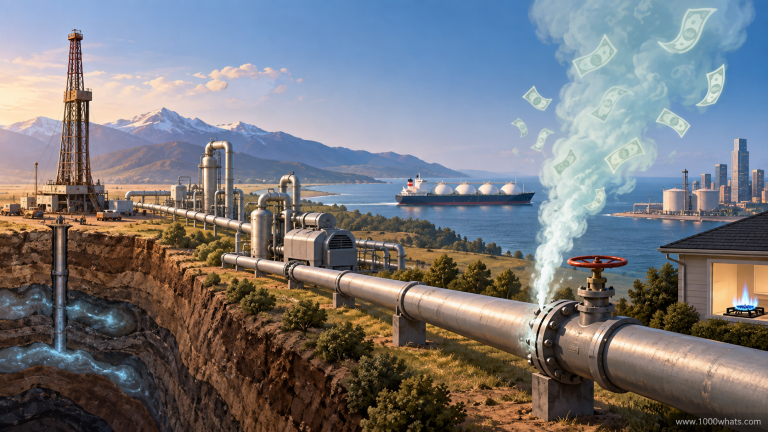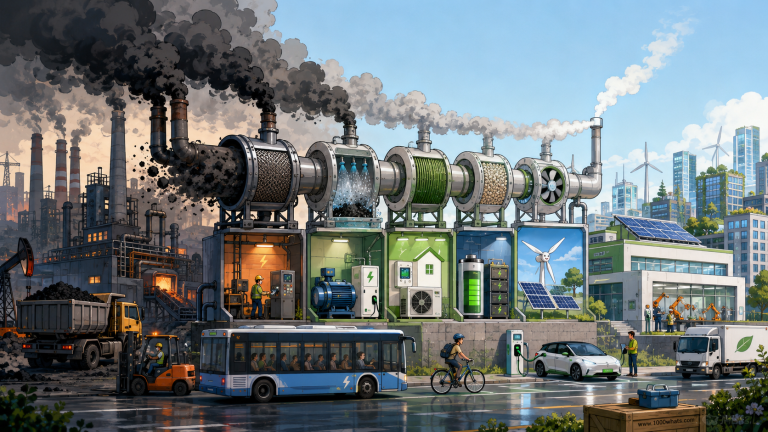
Imagine a factory.
Natural gas enters.
Money leaves.
The gas burns.
A furnace gets hot.
Steel, glass, food, chemicals, or some other useful product comes out.
And then, through a chimney, cooling tower, warm-water loop, ventilation system, or hot piece of machinery:
a large chunk of the energy leaves too.
Nobody ordered that part.
Nobody invoices the atmosphere.
The energy simply escapes.
Welcome to 1000whats — where today we investigate one of industry’s stranger habits: buying energy, using part of it, and then paying equipment to get rid of the rest.
That escaping energy is often called:
waste heat.
And the name is slightly misleading.
Because much of it is not useless.
It is simply:
heat whose original owner has finished with it.
⚡ “Waste heat is not necessarily useless heat. It is heat looking for a second job.”
First, where does waste heat come from?
Almost any process involving energy eventually produces heat.
An electric motor warms up.
A combustion engine gets hot.
A refrigerator removes heat from food and rejects it somewhere else.
A gas turbine produces extremely hot exhaust.
A steel furnace sends hot flue gases up a stack.
A data center consumes electricity and then spends considerable effort keeping thousands of servers from cooking themselves.
Even your laptop eventually turns nearly all the electricity it consumes into heat.
This is not an engineering mistake.
It is thermodynamics.
Energy conversions are never perfectly clean, and many industrial processes specifically require high temperatures.
Once the useful job is done, some thermal energy remains.
The U.S. Department of Energy estimates that roughly 20% to 50% of industrial energy input can ultimately leave as waste heat, including hot exhaust gases, cooling water, hot products, and heat escaping from equipment surfaces. The Department of Energy’s Energy.gov
That is an enormous range because industry is enormous.
A bakery oven and a steel furnace are both industrial heat systems.
One makes bread.
The other makes something you can build the bakery from.
Their thermal problems are understandably different.
But isn’t all rejected heat “waste”?
Not quite.
This distinction matters.
Suppose a furnace needs:
1,000°C
to perform an industrial process.
Hot exhaust leaves at:
500°C.
To the furnace, that exhaust heat may be:
waste.
But imagine another process nearby only needs:
200°C.
Suddenly our 500°C exhaust looks rather attractive.
Use it there.
Afterward, perhaps the stream is still at:
100°C.
Could it heat water?
Possibly.
After that, perhaps it falls to:
50°C.
Could a heat pump raise that temperature and feed a heating network?
Potentially.
Same energy.
Several jobs.
This idea is called:
heat cascading.
Use high-quality heat where high temperature is necessary.
Then keep finding lower-temperature jobs as the heat works its way down.
The DOE’s industrial process-heating guidance lists heat cascading, combustion-air preheating, fluid heating, steam generation, absorption cooling, and electricity generation among common waste-heat recovery options. The Department of Energy’s Energy.gov
The key lesson is:
temperature matters.
A lot.
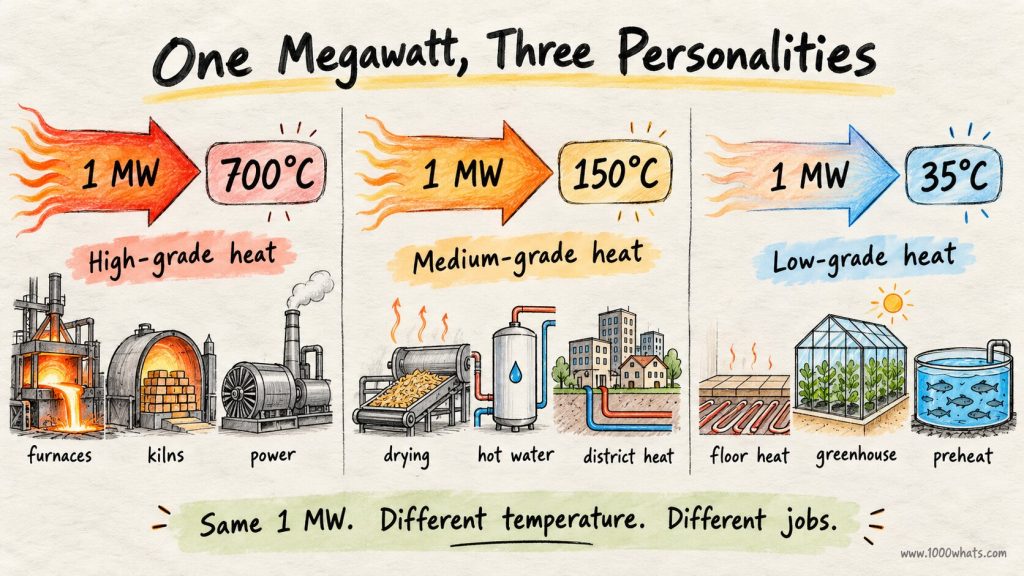
A megawatt of heat is not always equally useful
This is where waste heat becomes more interesting than simply counting energy.
Imagine two sources.
Source A provides:
1 MW of heat at 700°C.
Source B provides:
1 MW of heat at 35°C.
Same thermal power.
Very different usefulness.
The 700°C source may be able to:
preheat furnace air,
generate steam,
drive another thermal process,
or potentially help produce electricity.
The 35°C source cannot directly do most of those things.
But it may still be useful for:
low-temperature heating,
preheating,
or as the source side of a heat pump.
This is why engineers talk about the quality or grade of heat.
High-temperature heat has more options.
Low-temperature heat has fewer.
My article on heat explained that heat moves because of temperature differences.
Waste-heat recovery inherits the same inconvenient rule.
If your waste stream is at:
40°C
and the process you want to heat needs:
150°C,
heat will not spontaneously volunteer to climb uphill in temperature.
Thermodynamics has already reviewed the request.
Denied.
You need another technology.
Often:
a heat pump.
The easiest recovery is often inside the same process
Before we build pipes across cities, let us start with the obvious.
Suppose a furnace burns natural gas.
Cold combustion air enters.
Hot exhaust leaves.
Instead of sending all that exhaust heat up the chimney, install a heat exchanger.
The outgoing hot gases preheat the incoming combustion air.
Now the burners need less fuel to reach the same furnace temperature.
Nothing revolutionary happened.
No new energy source appeared.
The process simply stopped throwing away quite as much of the energy it had already purchased.
The same principle can preheat:
feedwater,
raw materials,
process fluids,
drying air,
or incoming products.
This is why waste-heat recovery is fundamentally an efficiency strategy.
The cleanest MWh of thermal energy may be the one you do not need to buy again.
CCGT is basically waste-heat recovery wearing a hard hat
One of the best examples already has its own 1000whats article.
A simple-cycle gas turbine burns gas.
The hot combustion gases expand through a turbine.
Electricity is generated.
And the exhaust remains:
very hot.
A simple-cycle plant can let that heat leave.
A combined-cycle gas turbine instead sends the exhaust through a heat recovery steam generator.
That recovered heat makes steam.
The steam drives another turbine.
More electricity appears.
Same original fuel.
More useful output.
A CCGT is therefore an elegant reminder that the boundary between:
waste
and:
resource
can be one heat exchanger away.
CHP takes the idea in another direction
Now imagine a thermal power plant producing electricity.
Electricity generation only uses part of the fuel’s energy.
A lot of thermal energy must eventually be rejected.
But what if somebody nearby needs:
steam,
hot water,
industrial heat,
or building heating?
Instead of trying to convert all the remaining heat into more electricity, use some of it directly.
That is the logic behind combined heat and power, or CHP.
One fuel input.
Two useful outputs:
electricity + heat
The same basic energy stream that might otherwise warm a river, cooling tower, or atmosphere now heats buildings or serves industry.
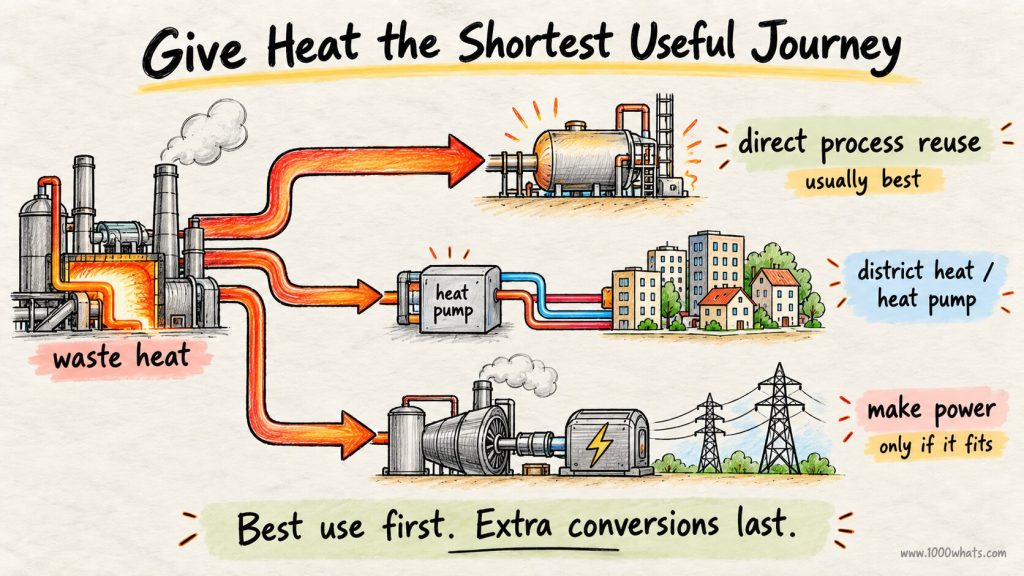
This matters because turning heat into electricity is not always the cleverest thing to do.
Sometimes:
you already need heat.
Converting thermal energy into electricity and later converting electricity back into heat can be a wonderfully elaborate way to arrive where you started.
Thermodynamics appreciates the effort.
Sometimes waste heat should become electricity
But not always.
Suppose the waste heat is:
hot enough,
continuous enough,
large enough,
and there is no better nearby thermal use.
Then generating electricity can make sense.
Steam systems can use high-temperature waste heat.
Other technologies, such as Organic Rankine Cycle systems, can work with lower-temperature sources than conventional steam cycles by using a working fluid with different boiling characteristics.
The U.S. Department of Energy describes waste-heat-to-power systems as producing electricity from thermal energy that would otherwise be discarded, without requiring additional fuel for the recovered portion. Better Buildings Solution Center
DOE has also investigated supercritical CO₂ power cycles for waste-heat applications from furnaces, kilns, engines, turbines, and other industrial equipment. The Department of Energy’s Energy.gov
But there is an important hierarchy here.
If somebody nearby needs heat at approximately the temperature you already have, using the heat directly is often more sensible than converting it into electricity first.
Every conversion adds:
equipment,
losses,
cost,
and another engineer who wants instrumentation.
Then we reach the most annoying variable: distance
Suppose a steel mill produces enormous amounts of recoverable heat.
Wonderful.
Suppose a neighborhood needs heating.
Also wonderful.
Suppose they are:
80 kilometers apart.
Less wonderful.
Heat is not electricity.
You cannot casually inject it into a continental transmission grid and retrieve it three countries later.
Moving heat usually requires:
hot water,
steam,
another thermal fluid,
and:
pipes.
Pipes cost money.
Pumps consume energy.
Heat leaks along the way.
Civil works happen.
Roads get excavated.
Municipal permits discover your project.
Suddenly a source of “free heat” has acquired a rather impressive infrastructure budget.
This is why location matters enormously.
Waste heat becomes valuable when useful demand exists:
nearby,
at the right temperature,
at the right time.
This is where district heating becomes interesting.
A heat network gives waste heat somewhere to go.
Without the network, an industrial plant may have useful thermal energy and absolutely nobody to sell it to.
The heat is not useless.
The geography is.
⚡ “Waste heat is a local resource. A perfect heat source in the wrong place can still be economically worthless.”
Data centers have made waste heat fashionable again
A data center has a wonderfully direct energy problem.
Electricity enters.
Computers calculate things.
Nearly all that electrical energy eventually becomes:
heat.
Then cooling systems work very hard to remove it.
Historically, the objective was simply:
get the heat out.
But modern district-heating systems can ask a better question:
Out to where?
The IEA notes that nearly all electricity consumed in data centers ultimately becomes usable heat, with around 70–80% potentially recoverable using heat pumps. IEA
And because many data centers sit near cities, the potential heat customers may already be nearby.
The IEA reports that more than 20 data centers in Stockholm already provide around 1.5% of the city’s district-heating needs, while new data centers in Espoo, Finland, are expected to provide enough recovered heat for around 100,000 homes. IEA
This produces one of the energy transition’s more entertaining loops:
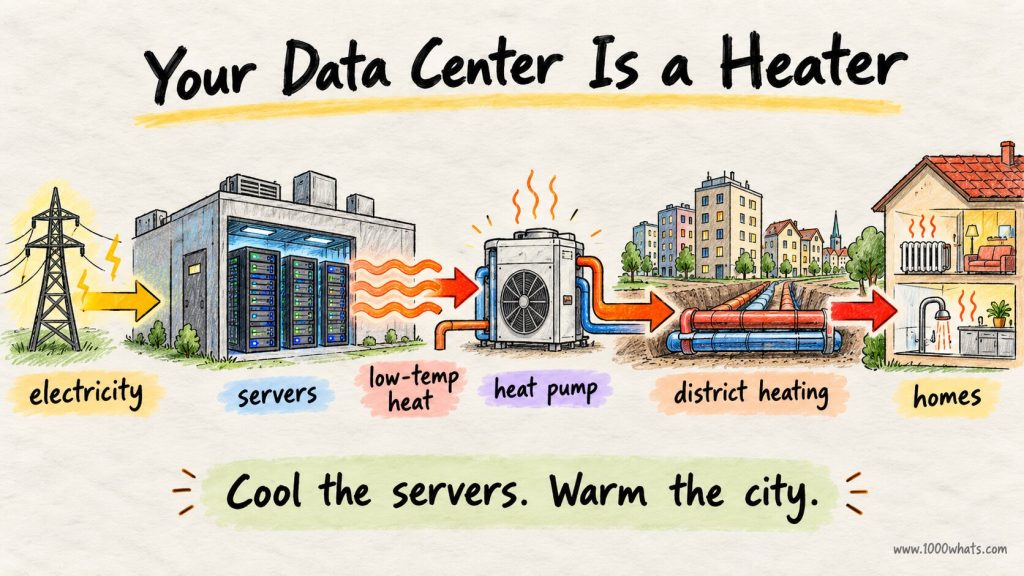
electricity powers servers;
servers generate heat;
heat pumps raise the temperature;
district-heating pipes carry it into homes.
Your cloud storage is now helping warm somebody’s radiator.
Your cat videos have finally found a productive use.
Why does a data center need a heat pump?
Because its waste heat is often too cool.
A server cooling system may reject substantial thermal energy.
But district-heating networks may need water at a higher temperature.
So we have:
lots of heat
but:
not hot enough.
Enter the heat pump.
The machine takes low-temperature thermal energy and uses electricity to raise it to a more useful temperature.
That makes the distinction between:
quantity
and:
quality
very practical.
The heat already exists.
The heat pump upgrades it.
This is why the IEA increasingly links recovered heat, large heat pumps, and district heating in the same system architecture. Its 2026 district-energy assessment explicitly identifies waste heat, large-scale heat pumps, renewables, and thermal storage as complementary resources for decarbonizing heat networks. IEA
Waste heat did not suddenly become warmer.
We simply became better at giving mediocre heat a promotion.
Industry has the same opportunity
Data centers are fashionable.
Industrial waste heat is older and often much hotter.
Steel.
Cement.
Glass.
Chemicals.
Food processing.
Paper.
Refineries.
Foundries.
Kilns.
Dryers.
Compressors.
Engines.
All can produce thermal streams that leave a process with useful energy remaining.
DOE estimates that 20–50% of industrial energy input can be lost as waste heat. The Department of Energy’s Energy.gov
That does not mean half of industrial energy can magically be recovered.
Some losses are technically unavoidable.
Some heat is too cool.
Some is intermittent.
Some is contaminated.
Some occurs far from useful demand.
Some recovery equipment costs more than the recovered energy is worth.
But the scale explains why industrial efficiency engineers keep looking.
Even recovering a modest fraction of a large continuous heat stream can become serious money.
A real factory example: heat that replaced gas
At General Motors’ Fort Wayne Assembly plant, landfill-gas generators were already producing electricity—and waste heat.
The plant previously used a natural-gas-fired steam system for building heating and freeze protection.
GM installed heat recovery equipment and began using heat from the existing generators instead.
According to the U.S. Department of Energy case study, the recovered heat now supplies more than 80% of the site’s building-heating needs, helping reduce onsite natural-gas use and associated carbon emissions by 30%. Better Buildings Solution Center
Notice what did not happen.
GM did not discover a new fuel.
It found another customer for energy already being produced.
That is waste-heat recovery in its purest form.
Waste heat can also be stored
Now suppose the factory produces waste heat:
24 hours a day.
But the nearby heating network needs most of its heat:
morning and evening.
Again:
right energy,
wrong time.
Our article on thermal energy storage gives us the missing piece.
Store some of the recovered heat.
Use it later.
That could mean:
hot-water tanks,
underground thermal storage,
phase-change materials,
or another suitable storage medium.
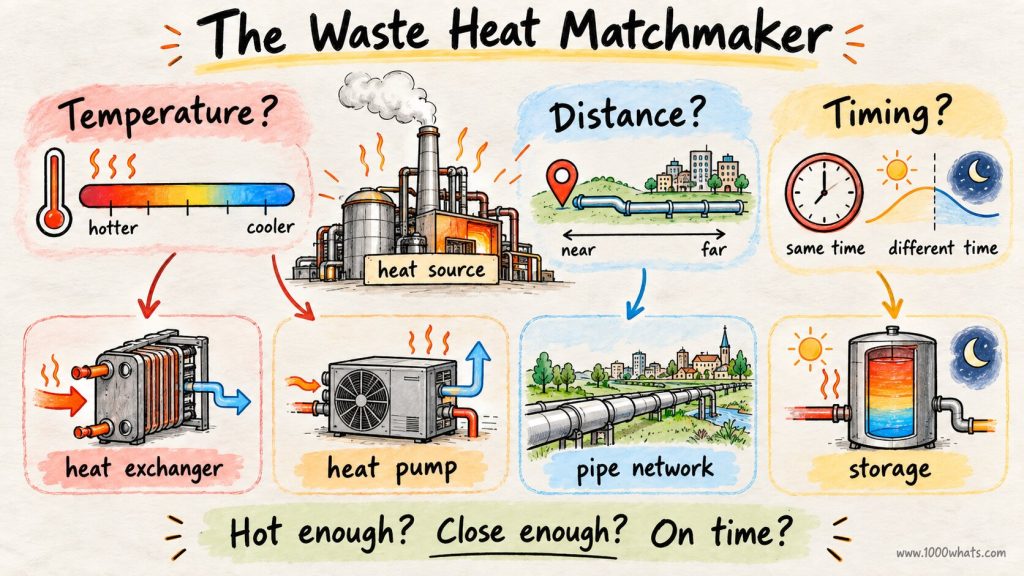
Now waste-heat recovery has three different matching problems:
temperature
distance
time
Heat exchangers help with temperature interfaces.
Pipes help with distance.
Storage helps with time.
Heat pumps can upgrade temperature.
Put those technologies together and heat that once went straight into the environment starts becoming an actual energy system.
So why isn’t all waste heat recovered?
Because “free energy” has an annoying habit of requiring expensive equipment.
Waste heat itself may have zero fuel cost.
Capturing it does not.
You may need:
heat exchangers,
ductwork,
piping,
pumps,
heat pumps,
storage,
control systems,
water treatment,
new process integration,
backup systems,
and maintenance.
Then there is operational risk.
Industrial processes exist primarily to make:
steel,
cement,
food,
chemicals,
cars,
or whatever the factory actually sells.
If your clever heat-recovery system interferes with production, management will develop a sudden and intense interest in removing your clever heat-recovery system.
In practice, industrial projects therefore care about:
temperature,
heat quantity,
operating hours,
reliability,
distance,
contamination,
corrosion,
pressure drop,
maintenance,
capital cost,
energy prices,
and payback.
Waste heat may be free.
Recovering it is an investment.
Intermittency matters too
Imagine a factory runs:
Monday to Friday.
The district-heating network needs heat:
seven days a week.
Or a batch furnace operates unpredictably.
Or a data center has a relatively stable thermal output but building heating demand collapses in summer.
A useful heat source and a useful heat demand can exist in the same location and still fail to match.
This is one reason storage, backup heat sources, and multiple heat suppliers matter.
A district-heating network might combine:
industrial waste heat,
data-center heat,
geothermal,
large heat pumps,
thermal storage,
and boilers for peaks or backup.
The network does not need one perfect heat source.
It needs a portfolio capable of meeting demand reliably.
The same lesson appears everywhere in energy.
One technology rarely gets to be the hero for the entire movie.
Is waste heat renewable energy?
Usually:
no.
This distinction matters.
Suppose a gas-fired industrial furnace produces waste heat.
Recovering that heat is excellent for efficiency.
It may reduce additional fuel consumption and emissions.
But the original energy still came from:
natural gas.
Calling the recovered heat “renewable” would be misleading.
European rules therefore distinguish waste heat and cold from renewable energy, while recognizing it as a potentially valuable recovered energy stream. EU guidance explicitly includes sources such as data centers and cooling systems where heat would otherwise be dissipated into the environment. European Commission guidance on waste heat and cold Eur-Lex
So waste heat can be:
low-carbon,
high-carbon,
renewable-origin,
or fossil-origin,
depending on where it came from.
Its environmental advantage comes from:
using energy that would otherwise be discarded instead of producing additional useful energy somewhere else.
That is an efficiency argument.
Not a magical reclassification of the original fuel.
And waste heat is not the same as CHP
These concepts overlap.
They are not identical.
Waste-heat recovery means capturing thermal energy that would otherwise be discarded.
CHP deliberately produces electricity and useful heat together from the same energy input.
A CHP plant therefore makes useful heat part of the design from the beginning.
Waste-heat recovery can happen:
inside a CHP plant,
behind an industrial furnace,
at a data center,
from an engine,
from refrigeration,
or almost anywhere else unwanted thermal energy exists.
So:
CHP can recover heat.
But waste-heat recovery is the bigger family.
The most important question is not “How much heat?”
It is:
How useful is the heat?
Imagine someone tells you:
This factory wastes 100 MW of heat.
That sounds enormous.
Before celebrating, ask:
At what temperature?
For how many hours?
In what medium?
How far from potential users?
How predictable is it?
What temperature do those users need?
Can the processes be connected safely?
What happens when the factory shuts down?
How much does the recovery equipment cost?
That is the real project.
Energy statistics tell you how much heat exists.
Engineering and economics decide how much of it is a resource.
⚡ “The difference between waste heat and useful heat is often not physics alone. It is infrastructure.”
Waste heat is becoming more important, not less
At first glance, waste heat sounds like an old industrial-efficiency topic.
And it is.
But several modern energy trends are making it more interesting.
We are building:
more data centers,
more district-heating modernization,
more large heat pumps,
more thermal storage,
more electrified industrial processes,
and more integrated energy systems.
The IEA’s 2026 Renewables in District Energy report specifically highlights recovered heat alongside geothermal, bioenergy, solar thermal, large heat pumps, and thermal storage as an increasingly useful source for district-energy systems. IEA
Meanwhile, the IEA estimates that if recoverable data-center heat were fully integrated into nearby European district-heating networks, it could theoretically provide up to 300 TWh of space heating by 2030 for buildings within 5 km—enough for roughly 10% of European homes. IEA
That is potential, not a forecast.
Actually building the pipes, contracts, tariffs, heat pumps, and business models is the difficult part.
Energy has once again discovered that the resource can be easier than the project.
So, what is waste heat in one sentence?
Waste heat is thermal energy produced by a process that is no longer useful to that process and would otherwise be released into the environment.
But the better mental model is:
paid-for energy looking for another customer.
Sometimes that customer is:
the same furnace.
Sometimes:
another industrial process.
Sometimes:
a steam turbine.
Sometimes:
a district-heating network.
Sometimes:
a building several blocks away.
And sometimes there simply is no economically sensible customer.
Then the heat remains:
waste.
Final thoughts
Energy discussions often begin with:
Where do we get more energy?
More solar.
More wind.
More gas.
More nuclear.
More geothermal.
More transmission.
All reasonable questions.
But efficiency starts with a slightly more embarrassing one:
What happened to the energy we already had?
Sometimes it became useful electricity.
Sometimes it moved a car.
Sometimes it melted steel.
Sometimes it heated a building.
And sometimes we paid for it, moved it through expensive equipment, and then released the remaining energy through a cooling tower because nobody nearby had another job for it.
Waste-heat recovery does not violate thermodynamics.
It cannot recycle energy forever.
Temperature falls.
Losses remain.
Eventually the energy becomes too dispersed to use economically.
But between:
useful process
and:
uselessly warm atmosphere
there may be another useful step.
Or two.
A heat exchanger.
A second process.
A steam system.
A heat pump.
A hot-water tank.
A district-heating pipe.
That is the real lesson.
The energy transition is partly about finding cleaner ways to produce energy.
It is also about becoming slightly less casual about throwing away the energy we already produced.
After all, we paid for it.
We might as well ask whether it has one more job left.
Until next time, stay curious! 😎
Discover more from 1000whats
Subscribe to get the latest posts sent to your email.