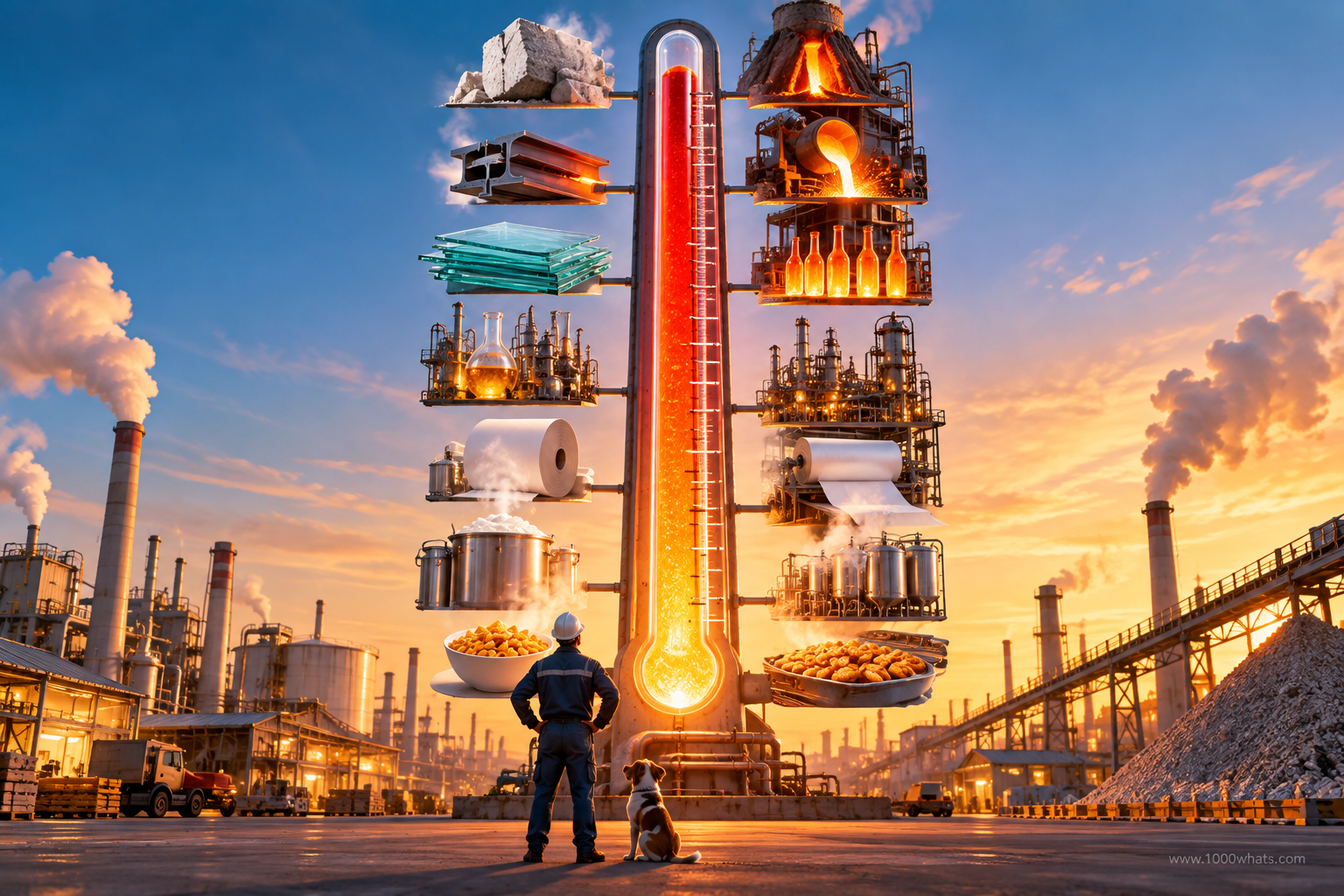
Imagine a factory that makes breakfast cereal.
It needs electricity.
Motors turn.
Conveyors move.
Pumps run.
Lights stay on.
All very electrical.
But then the factory needs to:
cook,
dry,
sterilize,
and perhaps make steam.
Suddenly the really hungry part of the factory is not the motor.
It is the thermometer.
Now replace cereal with:
paper,
glass,
chemicals,
steel,
cement,
aluminum,
or plastics.
The temperatures climb.
The equipment gets stranger.
And an enormous part of the world’s energy system quietly disappears behind factory walls.
Welcome to 1000whats — where today we discover that manufacturing civilization involves getting an extraordinary amount of stuff very hot.
That is:
industrial heat.
And if we want to decarbonize industry, we need to understand why 100°C and 1,400°C are not remotely the same energy problem.
⚡ “Industrial heat sounds like one energy problem. In reality, it is hundreds of temperature problems wearing the same name.”
First, what does industry actually need heat for?
Almost everything.
Heat can:
dry paper,
pasteurize milk,
evaporate water,
create steam,
cure paint,
separate chemicals,
melt glass,
heat metals,
refine oil,
fire ceramics,
and transform limestone into cement.
The U.S. Department of Energy’s process-heat overview defines industrial process heat as thermal energy used to produce, treat, or alter manufactured goods.
That definition sounds almost suspiciously ordinary.
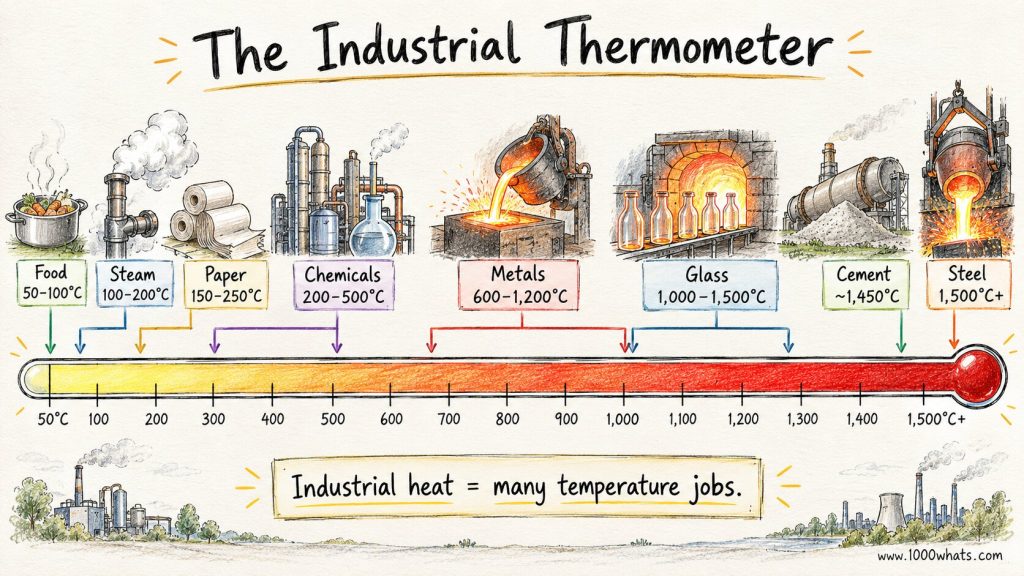
Then look at the temperatures.
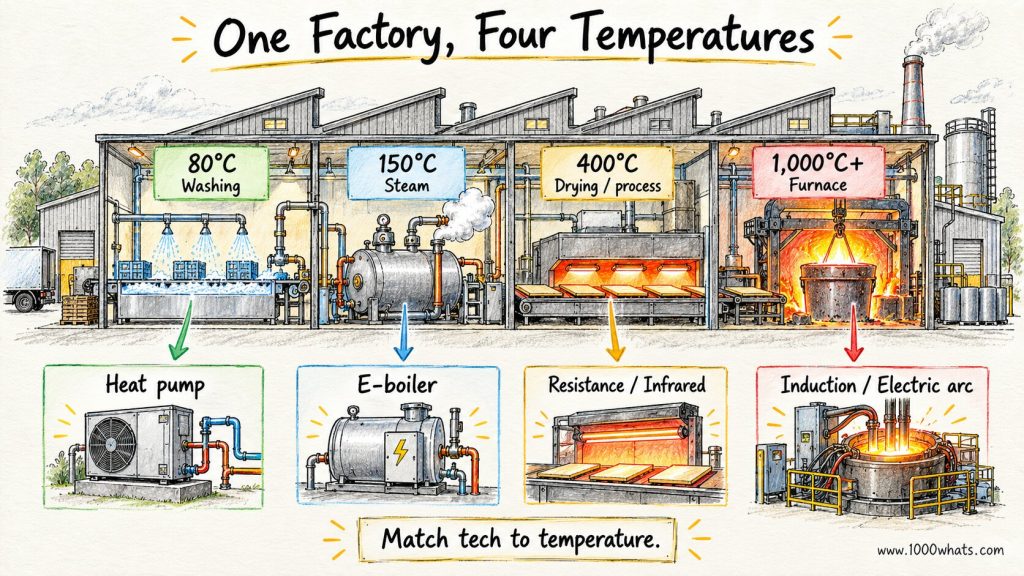
Pasteurizing milk may happen around:
80°C.
Many steam processes live somewhere in the low hundreds.
Metal processing can require several hundred degrees.
Glass, steel and cement can push well beyond:
1,000°C.
Same word:
heat.
Very different engineering.
Why not just burn something?
Historically, that has been an excellent answer.
Need heat?
Burn:
coal,
natural gas,
oil,
biomass,
or another combustible fuel.
Combustion is convenient because flames can create high temperatures directly.
Fuel can be stored.
It can often be delivered through existing infrastructure.
And industry has spent more than a century designing:
boilers,
kilns,
furnaces,
ovens,
dryers,
and process equipment
around combustion.
This matters.
An industrial plant is not a giant kitchen where somebody can remove the gas stove on Friday and install an induction hob before Monday.
The heating equipment may be physically integrated into:
the production line,
material flows,
steam networks,
quality control,
safety systems,
and the chemistry of the process itself.
That is why industrial decarbonization becomes much harder than:
replace fossil fuel with electricity.
Sometimes that works beautifully.
Sometimes the entire process needs redesigning.
Temperature is the first question
Suppose I tell you:
A factory needs 10 MW of heat.
Useful information.
But not enough.
The next question should be:
At what temperature?
Ten megawatts at:
80°C
is one engineering problem.
Ten megawatts at:
1,400°C
is another.
The U.S. Department of Energy commonly divides industrial heat into broad temperature ranges:
low-temperature: below about 200°C
medium-temperature: roughly 200–400°C
high-temperature: above 400°C.
Those boundaries are not laws of nature.
But they are useful because different technologies become practical at different temperatures.
This gives us a much better way to think about industrial heat.
Not:
What replaces natural gas?
But:
What is the cleanest practical way to deliver this particular temperature to this particular process?
That is a far more useful question.
Low-temperature heat is the easier part
Imagine:
food processing,
washing,
drying,
hot water,
low-pressure steam,
or certain chemical and paper processes.
These applications may need substantial heat.
But they do not necessarily need a flame.
That opens the door to:
heat pumps.
A heat pump does not have to create all its useful heat from electricity.
It uses electricity to move thermal energy from a lower temperature to a higher one.
That can make it remarkably efficient.
The IEA’s 2026 Heat Pump Monitor estimates that commercially available industrial heat pumps could already technically supply around 20% of global industrial heat demand, mainly in low- and medium-temperature applications.
That is not a futuristic laboratory technology.
It is an existing machine looking at a surprisingly large addressable market.
And the opportunity gets more interesting when the factory already has:
waste heat.
Factories often have heat on both sides of the building
This is where industrial energy systems become slightly absurd.
One process needs:
120°C.
Another process rejects heat at:
60°C.
The factory may simultaneously be:
burning gas to create heat
and:
running cooling equipment to remove heat.
Congratulations.
We have successfully created two problems.
My Waste Heat explainer looked at exactly this opportunity. DOE estimates that roughly 20–50% of industrial energy input can ultimately leave as waste heat, although only part of that is technically and economically recoverable.
A heat exchanger may transfer useful heat directly.
A heat pump can raise lower-temperature heat to a more useful level.
Thermal storage can shift heat through time.
The cheapest clean industrial heat may therefore occasionally be:
the heat the factory already paid for yesterday.
Then we reach steam
Steam is everywhere in industry.
Paper.
Food.
Chemicals.
Refining.
Pharmaceuticals.
Textiles.
Manufacturing plants love steam because it is:
controllable,
transportable through pipes,
good at transferring heat,
and already deeply embedded in industrial infrastructure.
DOE estimates that steam accounts for roughly 30% of industrial process heat in the United States.
Traditionally, steam often begins with:
fuel → boiler → steam.
But there is no thermodynamic requirement that says:
steam must first meet a flame.
An electric boiler can turn electricity into heat directly.
An electrode boiler can pass current through water.
Industrial heat pumps can produce useful steam in suitable temperature ranges.
Mechanical vapor recompression can recover vapor and upgrade it instead of repeatedly throwing away its latent heat.
Suddenly the humble steam system becomes one of industrial electrification’s biggest opportunities.
Electric boilers are almost suspiciously simple
Take electricity.
Turn it into heat.
Heat water.
Make steam.
No combustion.
No flue gas.
No burner.
No fuel delivery.
No Nobel Prize required.
Resistance and electrode boilers can convert electricity to useful thermal energy with very high point-of-use efficiency.
But there is an obvious problem.
Electricity may cost considerably more per unit of energy than natural gas.
So:
technically easy
does not automatically mean:
economically attractive.
This is one of the recurring themes in industrial decarbonization.
Engineers may already know how to electrify a process.
The finance department would simply prefer not to double the energy bill.
Heat pumps change the economics
Suppose you need:
1 MWh of useful heat.
An electric resistance boiler needs roughly:
1 MWh of electricity,
ignoring small losses.
A heat pump with a coefficient of performance of 3 might need roughly:
0.33 MWh of electricity
to deliver the same 1 MWh of heat, with the rest coming from the lower-temperature heat source.
That difference can transform the economics.
But heat pumps become more challenged as the required temperature lift increases.
Moving heat from:
40°C → 80°C
is much easier than:
20°C → 250°C.
Thermodynamics appreciates ambition.
It still sends an invoice.
This is why industrial heat pumps are especially attractive where the process temperature is moderate and a useful waste-heat source already exists nearby.
⚡ “The industrial heat transition is partly a fuel problem, but just as importantly it is a temperature-matching problem.”
What happens when temperatures get higher?
Now things become more interesting.
Suppose you need:
500°C.
Or:
900°C.
Or:
1,500°C.
The heat-pump conversation begins to leave the room.
But electricity does not.
There are several ways electricity can create extremely high temperatures.
Resistance heating
Pass current through a resistive material.
It gets hot.
Your toaster understands the basic principle.
Industry simply builds a much angrier toaster.
Electric arc furnaces
Create an electric arc capable of generating enormous temperatures.
Electric arc furnaces are already widely used to melt scrap steel.
Instead of burning fuel to heat the entire furnace environment, electrical energy creates the intense heat required for melting.
Induction heating
Use alternating electromagnetic fields to induce currents directly inside conductive material.
The material itself heats.
This can be fast, controllable and efficient.
Infrared, microwave and radio-frequency heating
Energy can sometimes be delivered more directly into the material or product rather than first heating an enormous furnace full of gas.
DOE lists resistance heating, electrode boilers, electric arc furnaces, induction, infrared, microwave, radio-frequency heating and heat pumps among the main technologies available for electrifying industrial process heat.
This produces an important insight:
electrifying heat does not simply mean replacing a gas burner with an electric burner.
Electricity can change how the material is heated.
Sometimes dramatically.
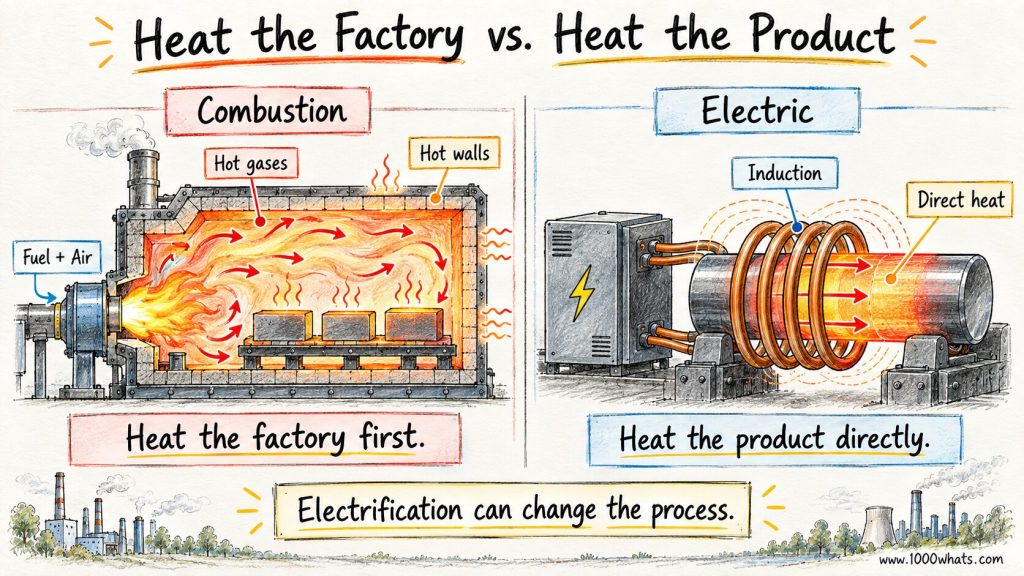
Heating the product instead of the furnace
Imagine you want to heat a metal component.
With combustion, you may:
burn fuel,
heat gases,
heat the furnace,
heat refractory materials,
and finally:
heat the metal.
A lot of other things become hot along the way.
Induction can deliver energy much more directly into the metal itself.
That can reduce:
warm-up time,
thermal losses,
equipment footprint,
and potentially process time.
DOE specifically highlights electromagnetic heating as a way to reduce losses by putting energy directly into the target material.
This is why electrification can sometimes offer more than:
the same process minus CO₂.
It can produce:
a better process.
Faster control.
Different temperature profiles.
Less exhaust.
Higher precision.
Potentially smaller equipment.
This is where industrial electrification stops being merely climate policy and starts becoming manufacturing technology.
So can we electrify all industrial heat?
Technically?
A surprisingly large amount.
Economically and practically?
More complicated.
The IEA’s Renewables for Industry report finds that commercially available technologies including heat pumps, electric boilers and resistance heaters can meet most heat demand in less energy-intensive industries such as food and beverages, textiles, chemicals and paper.
And electrification is growing.
The IEA projects electricity’s share of global industrial process heat rising from around 4% in 2024 to 12% in 2030, driven particularly by lower-temperature applications and industries already suited to electrical heating.
That is a tripling in six years.
But it still leaves most industrial heat elsewhere.
Why?
Because industry is inconveniently diverse.
High-temperature heat is not the only hard part
People often hear:
industrial heat is difficult
and imagine the problem is simply:
very high temperature.
That is only part of it.
A factory may need:
continuous 24/7 operation;
extremely precise temperatures;
specific furnace atmospheres;
fast heating;
slow heating;
direct flame contact;
steam at a particular pressure;
very high reliability;
enormous thermal power;
integration with chemical reactions;
equipment that lasts decades.
Then there is the existing plant.
A furnace may still have:
20 years of useful life.
The gas connection exists.
The electrical connection may not be large enough.
A new electric process may require:
a substation,
transformer,
grid reinforcement,
different controls,
new production equipment,
and a factory shutdown to install everything.
This is where the PowerPoint slide saying:
ELECTRIFY INDUSTRY
meets:
the factory manager.
The factory manager has questions.
Electricity supply itself becomes an industrial problem
Imagine a factory currently burning natural gas for:
100 MW of process heat.
Now electrify it.
Even if the electric process is more efficient, the plant’s electrical demand may rise dramatically.
That means:
more grid connection capacity,
more transformers,
more cables,
more generation,
and possibly:
more transmission.
Industrial electrification therefore moves part of the energy problem upstream.
The gas pipe becomes less important.
The power grid becomes much more important.
That is not a reason not to electrify.
It is a reason to understand that industrial electrification and grid planning are:
the same transition viewed from opposite sides of the meter.
But flexible industrial heat could also help the grid
Now we get to the interesting market part.
Not every industrial heating process must consume exactly the same electricity every minute.
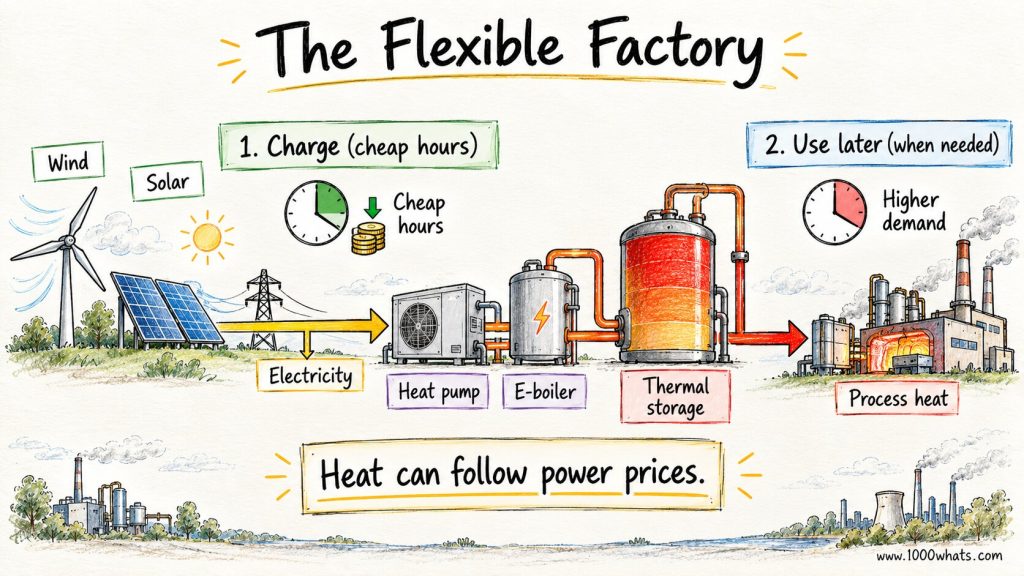
Suppose a factory has:
an electric boiler,
thermal storage,
and a steam network.
At noon:
solar generation is abundant.
Electricity:
€20/MWh.
The electric boiler runs hard.
The thermal store charges.
At 7 p.m.:
electricity:
€150/MWh.
The boiler reduces consumption.
Stored heat supplies the process.
Production continues.
The factory has shifted electricity demand without necessarily shifting production.
That distinction is enormously useful.
The IEA specifically identifies the combination of industrial electrification and thermal storage as a way to create demand flexibility while absorbing more variable renewable electricity.
Suddenly industrial heat is not merely:
another huge load on the grid.
It can become:
a flexible huge load on the grid.
Those are very different things.
What about hydrogen?
Hydrogen enters the industrial-heat conversation because it can be burned.
And if produced with low-emissions electricity, it can potentially replace fossil fuels in some difficult applications.
But:
hydrogen should not automatically be the answer every time someone draws a furnace.
Making hydrogen through an electrolyzer requires electricity.
Then:
electricity → hydrogen → heat.
If electricity can heat the process directly, adding hydrogen introduces another conversion step and additional equipment.
That can make direct electrification more efficient.
Hydrogen becomes more interesting where:
direct electrification is difficult,
the molecule is needed chemically,
very high-temperature operation favors it,
or other process requirements make a gaseous fuel valuable.
My existing green hydrogen explainer makes the same broader point: hydrogen is not a magic green fuel. Its value depends on where molecules solve a problem electrons struggle with.
Industrial heat is one place where that distinction matters.
Cement makes everything more annoying
Imagine a cement kiln.
It needs very high temperatures.
So perhaps we replace fossil fuel heat with:
electricity,
hydrogen,
biomass,
or another low-carbon heat source.
Excellent.
Problem solved?
No.
Because cement has another source of CO₂.
To make clinker, limestone is heated and chemically transformed.
That reaction itself releases carbon dioxide.
So even if the kiln’s heat were perfectly carbon-free, process emissions would remain.
This is the difference between:
energy emissions
and:
process emissions.
DOE’s industrial-decarbonization analysis explicitly separates emissions from heat generation from emissions caused by chemical transformations such as cement calcination.
That is why technologies such as carbon capture remain part of the industrial-decarbonization conversation.
You can decarbonize the heat.
Chemistry may still have paperwork.
Steel has its own plot twist
Traditional blast-furnace steelmaking uses coal-derived coke for more than heat.
Carbon also participates chemically in reducing iron ore.
So again:
replace furnace heat
does not necessarily equal:
decarbonize steel.
Electric arc furnaces are already excellent at melting scrap steel using electricity.
But primary steel from iron ore involves a different challenge.
Alternative routes can use:
hydrogen-based direct reduced iron,
electric furnaces,
different feedstocks,
or combinations of technologies.
The important point here is not the metallurgy.
It is the recurring industrial lesson:
sometimes fossil fuel provides heat. Sometimes it also does chemistry.
If you replace only the heat, the carbon may still have another job.
This is why “electrify everything” is directionally useful and technically incomplete.
What about solar thermal, geothermal and nuclear heat?
Electricity is not the only low-carbon way to deliver industrial heat.
Concentrated solar thermal can produce substantial temperatures by concentrating sunlight.
DOE notes that concentrating solar technologies can operate from below 400°C to above 1,000°C, depending on the system.
Geothermal resources can provide direct heat where suitable temperatures and geology exist.
Nuclear reactors can potentially supply steam and process heat in addition to electricity.
Bioenergy can replace fossil fuels in some applications.
Waste heat can be recovered.
Hydrogen and other low-emissions fuels may serve difficult niches.
This is why industrial heat probably will not have:
one winner.
It will have a toolbox.
And the tool will depend on:
temperature,
process,
location,
fuel prices,
electricity prices,
grid capacity,
existing equipment,
operating profile,
and carbon constraints.
Energy transitions become considerably less tidy once factories are invited.
A useful way to think about the toolbox
| Heat need | Likely options |
|---|---|
| Low-temperature heat | Heat pumps, waste-heat recovery, geothermal, solar thermal |
| Steam | Heat pumps, electric boilers, electrode boilers, recovered heat |
| Medium-temperature processes | Resistance, electric boilers, induction, infrared, heat pumps where feasible |
| High-temperature processes | Electric arc, resistance, induction, plasma, hydrogen/low-carbon fuels, concentrated solar |
| Processes with unavoidable CO₂ chemistry | Clean heat plus process redesign and/or carbon capture |
This is deliberately not a technology ranking.
A paper mill is not a cement plant.
A brewery is not a steelworks.
A chemical cracker is not a dairy.
The phrase:
industrial heat
is useful precisely until it starts making those facilities look identical.
They are not.
The economics can flip surprisingly quickly
Suppose natural gas is cheap.
Electricity is expensive.
A perfectly functional gas boiler may remain difficult to beat.
Now change:
gas price,
electricity price,
carbon price,
operating hours,
heat-pump efficiency,
or availability of cheap renewable electricity.
The answer can change.
The IEA’s 2026 work on European electrification shows that the cost-competitiveness of industrial heat electrification varies strongly with the ratio between electricity and fossil-fuel prices.
This sounds obvious.
It is also commercially decisive.
Industry does not buy:
electricity.
or:
gas.
It buys:
useful heat at the temperature and reliability its process requires.
That is the comparison that matters.
⚡ “The cheapest MWh of fuel is not necessarily the cheapest MWh of useful industrial heat.”
Efficiency can completely change the arithmetic.
So can carbon.
So can flexibility.
So can avoiding an entirely new fuel system.
Why industrial heat matters now
The electricity transition is becoming visible.
Wind turbines.
Solar farms.
Batteries.
EVs.
Transmission lines.
Industrial heat is mostly invisible because it happens:
inside factories.
But the scale is enormous.
The IEA estimates industry consumes around 30% of global energy, with fossil fuels still supplying most of it.
And global industrial heat demand is not standing still.
The IEA projects it growing about 14% between 2025 and 2030.
So the challenge is not merely:
clean up today’s heat.
It is:
clean up today’s heat while industry asks for more of it.
That makes efficiency especially valuable.
Waste-heat recovery valuable.
Electrification valuable.
Flexible demand valuable.
And matching technology to temperature absolutely essential.
So, what is industrial heat in one sentence?
Industrial heat is thermal energy used to transform, treat, dry, melt, separate, cook, cure or otherwise process materials during manufacturing.
But the better mental model is:
the temperature ladder behind almost everything we manufacture.
At the bottom:
hot water.
Steam.
Food.
Paper.
At the top:
glass.
Cement.
Steel.
And as you climb that ladder, the decarbonization options change.
That is the part worth remembering.
Final thoughts
We talk about the energy transition as if the world mostly needs:
clean electricity.
It certainly needs a lot of it.
But electricity is often only the beginning of the question.
A factory does not wake up wanting electrons.
It wants:
dry paper.
Pasteurized milk.
Steam.
Molten glass.
Hot steel.
Cement clinker.
Chemicals at exactly the right temperature.
Energy is the means.
The industrial process is the job.
That is why industrial heat is such a useful way to look at decarbonization.
At 80°C, a heat pump may look brilliant.
At 1,500°C, another technology may win.
Sometimes direct electrification makes sense.
Sometimes recovered heat.
Sometimes thermal storage.
Sometimes hydrogen.
Sometimes carbon capture.
Sometimes the best answer is redesigning the process itself.
The transition will not be won by finding one replacement for fire.
It will be won by getting much better at asking:
How hot does this actually need to be—and what is the smartest way to get it there?
Until next time, stay curious! 😎
Discover more from 1000whats
Subscribe to get the latest posts sent to your email.