Imagine two solar projects.
Same country.
Same technology.
Same 100 MW.
Same sunshine.
Project A has slightly higher expected returns.
Project B makes slightly less money.
Which one gets the bank loan?
You might reasonably choose Project A.
The bank may choose B.
Why?
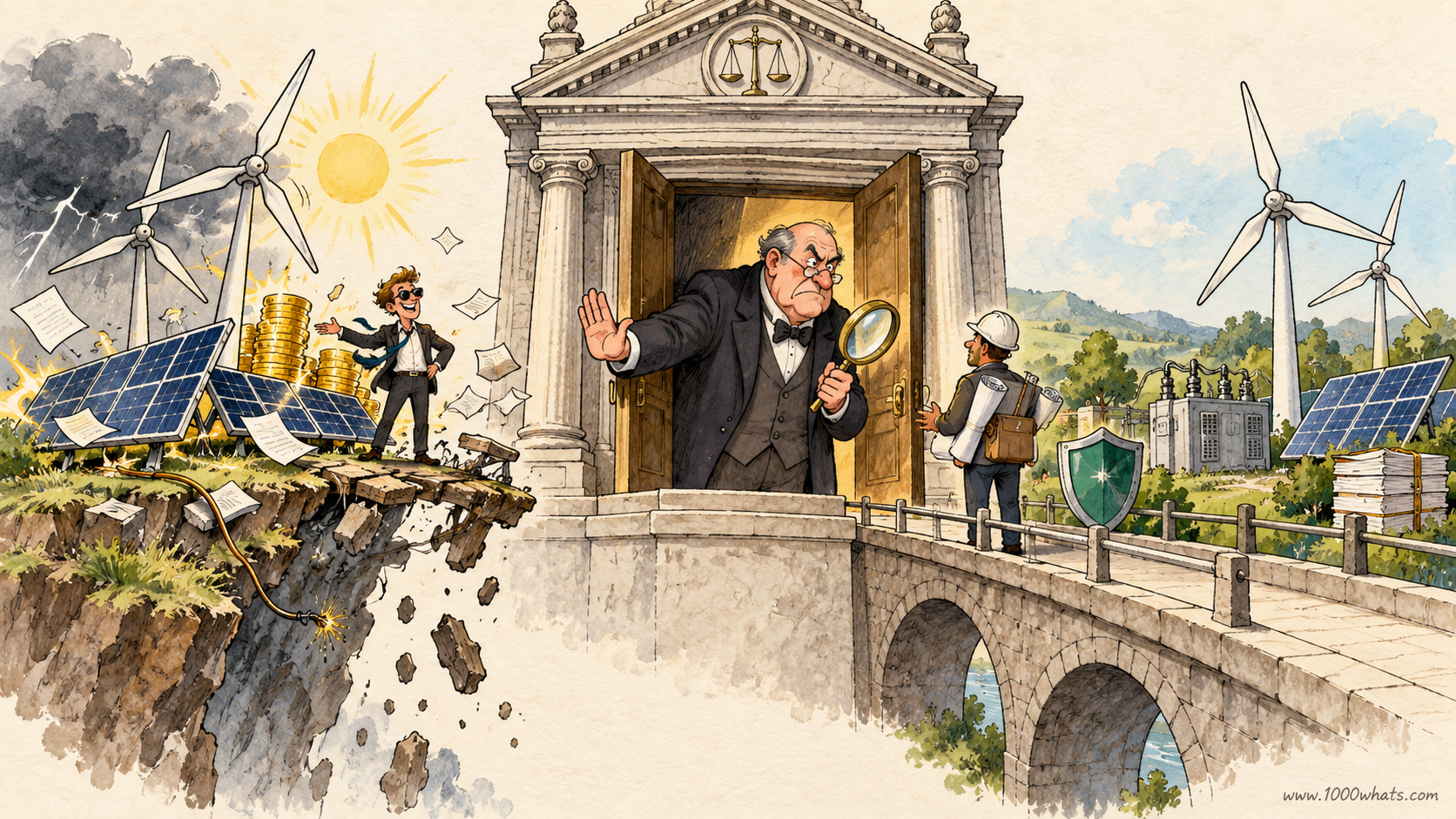
Because lenders are not paid extra when your project becomes spectacularly successful.
They receive:
their debt back + interest.
But if your project fails badly enough, they can lose millions.
That creates a peculiar personality.
Equity investors can look at upside and say:
This could be fantastic.
Banks tend to look at downside and ask:
Fine. What happens if it isn’t?
Welcome to 1000whats — where today we discover why a perfectly good wind farm can still make a banker uncomfortable.
That uncomfortable little word is:
bankability.
⚡ “A project becomes bankable when the lender stops asking whether it looks good and starts believing it can survive looking bad.”
First, forget the idea that bankable means profitable
This is the distinction that makes the whole concept click.
A profitable project can be unbankable.
And a highly bankable project does not necessarily offer spectacular equity returns.
Why?
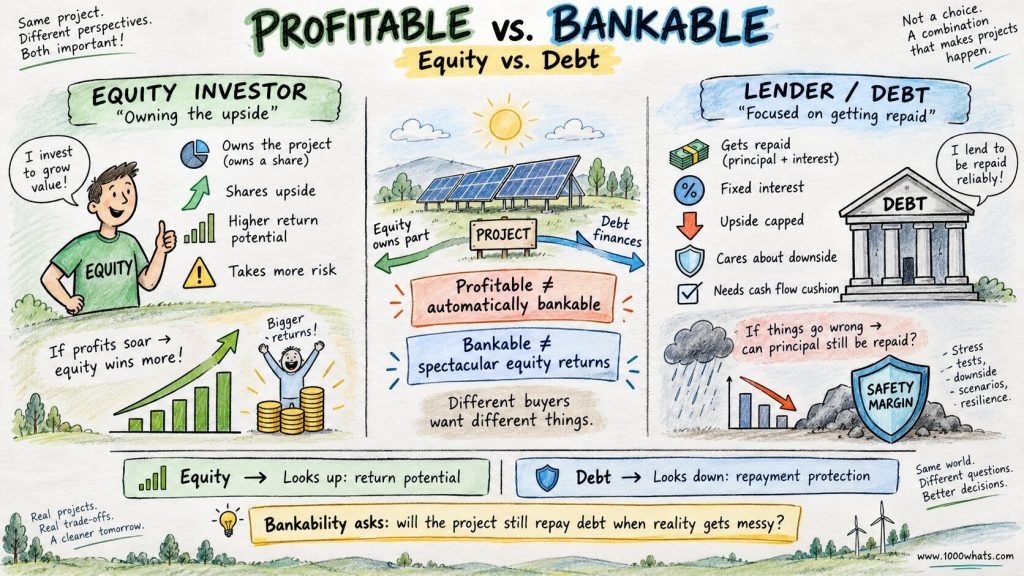
Because investors and lenders are buying different things.
An equity investor owns part of the project.
If everything goes brilliantly, the investor participates in the upside.
A lender does not.
Suppose the project earns twice as much as expected.
The bank does not suddenly receive twice the interest.
Its upside is capped.
But suppose the project collapses.
Now the bank can lose principal.
So lenders naturally care enormously about:
downside protection.
The World Bank’s PPP guidance puts the idea very plainly: bankability is the ability of a project to attract the required financing, particularly debt, and lenders need confidence that project cash flows will remain sufficient to service that debt with an acceptable margin.
That is a very different question from:
Will this project probably make money?
The bank wants to know:
Will this project still repay us when reality becomes annoying?
Why energy projects care so much about banks
A utility-scale energy project is wonderfully capital hungry.
Wind turbines.
Solar modules.
Substations.
Transformers.
Cables.
Construction crews.
Land.
Engineering.
Grid connection.
Development costs.
Insurance.
All of these want money before the project starts earning much of anything.
A 200 MW wind farm cannot normally be built by putting equipment on a credit card and promising to settle up after the first windy weekend.
Developers therefore combine:
equity
with:
debt.
The exact structure varies, but debt can fund a large share of the capital required for mature renewable technologies.
Why use debt?
Because it is usually cheaper than equity.
Equity investors accept more risk and therefore expect higher returns.
Banks take less risk and charge less.
That makes leverage powerful.
But leverage also means the project acquires one extremely inflexible obligation:
the loan must be repaid.
Preferably on schedule.
Banks are old-fashioned that way.
Project finance makes the question even sharper
Many large energy assets are financed through project finance.
Instead of lending primarily against the entire balance sheet of a giant company, lenders finance a special project company—often called an SPV—and rely heavily on the project’s own future cash flows for repayment.
This is closely connected to the IPP structure I have already explored.
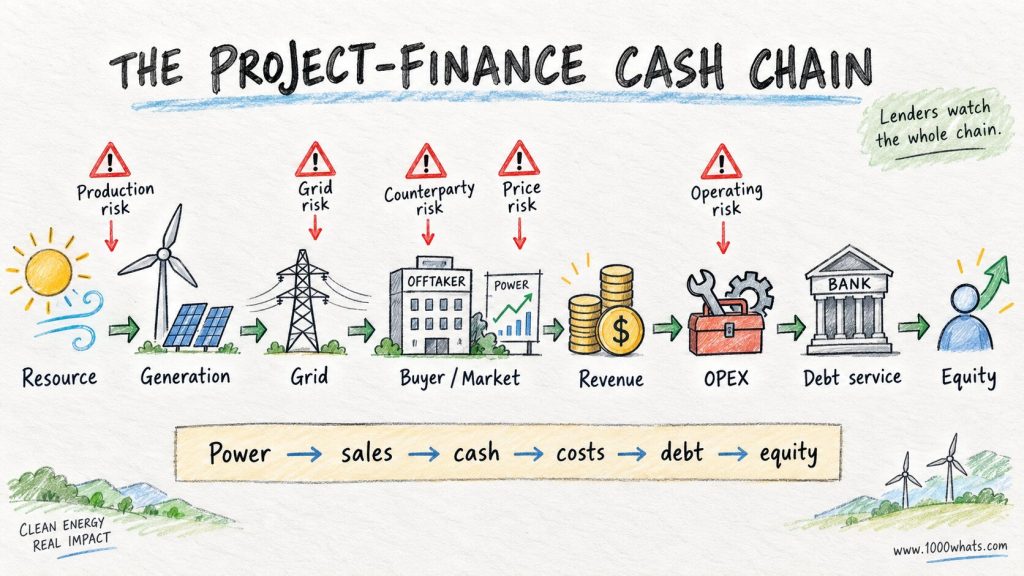
Imagine:
Sunshine → electricity → revenue → operating costs → debt repayment
That chain needs to work for years.
The lender therefore becomes obsessed with every point where it could break.
What if construction finishes late?
What if the turbine underperforms?
What if solar production is lower than expected?
What if the grid curtails output?
What if the buyer stops paying?
What if electricity prices collapse?
What if operating costs rise?
What if a permit gets challenged?
What if the law changes?
What if the project company simply runs out of cash?
Bankability is basically the process of making those questions boring enough that somebody wires the money.
So what exactly makes an energy project bankable?
There is no universal certificate.
You do not receive a laminated card saying:
Congratulations. This wind farm is officially bankable.
Bankability is a judgment.
Different banks.
Different markets.
Different technologies.
Different countries.
Different risk appetites.
But lenders repeatedly return to the same broad question:
Can this project’s risks be understood, controlled, allocated, and absorbed while leaving enough reliable cash flow to repay the debt?
IRENA groups renewable-project bankability around several recurring pillars including project readiness, financing and offtake, sponsor quality, risk mitigation, and wider environmental and social considerations.
Let’s open the machine.
1. Is the project actually real?
Developers live with projects for years.
That can create a dangerous psychological effect.
After the fifteenth land meeting, eighteenth grid call, and seventh version of the layout, the project feels extremely real.
The lender has just opened the data room.
Its first question is essentially:
Do you actually have the right to build this thing?
That means checking:
land rights,
permits,
licenses,
environmental approvals,
grid access,
corporate documents,
technical studies,
planning conditions,
and whatever else the jurisdiction requires.
A beautiful financial model cannot compensate for land rights that expire halfway through the loan tenor.
Nor can an impressive PPA rescue a project that legally cannot connect to the grid.
This is why project readiness comes first.
IRENA reports that 45% of projects submitted for financing consideration through its ETAF experience were rejected because readiness was too low.
That is an extraordinary number.
Not because the projects necessarily had bad technology.
Because financing begins much later than the idea.
2. Does the technology work?
This sounds embarrassingly obvious.
Banks prefer power plants that can produce power.
But the question is not simply:
Does solar PV work?
Of course it does.
The lender wants to know:
Which modules?
Which inverter?
Which turbine?
Who manufactured them?
What warranties exist?
How experienced is the supplier?
What is the expected degradation?
Who operates the plant?
Are spare parts available?
What happens if a major component fails?
A technology can be technically exciting and financially awkward.
Banks like innovation.
They like proven innovation considerably more.
This creates a genuine tension in the energy transition.
New technologies often need financing to reach scale.
Lenders often want operating history before providing cheap financing.
Someone has to take the first risk.
That somebody is rarely the most conservative commercial lender in the room.
3. How much electricity will it actually produce?
Now we reach renewable-energy forecasting.
Imagine a 100 MW solar farm.
Its nameplate capacity tells you the maximum power.
It does not tell you annual revenue.
Revenue depends on actual electricity production.
For solar:
irradiation,
temperature,
module degradation,
availability,
soiling,
electrical losses,
grid losses,
curtailment,
and equipment performance all matter.
For wind:
wind speed,
wake losses,
turbine availability,
electrical losses,
curtailment,
and long-term resource uncertainty enter the model.
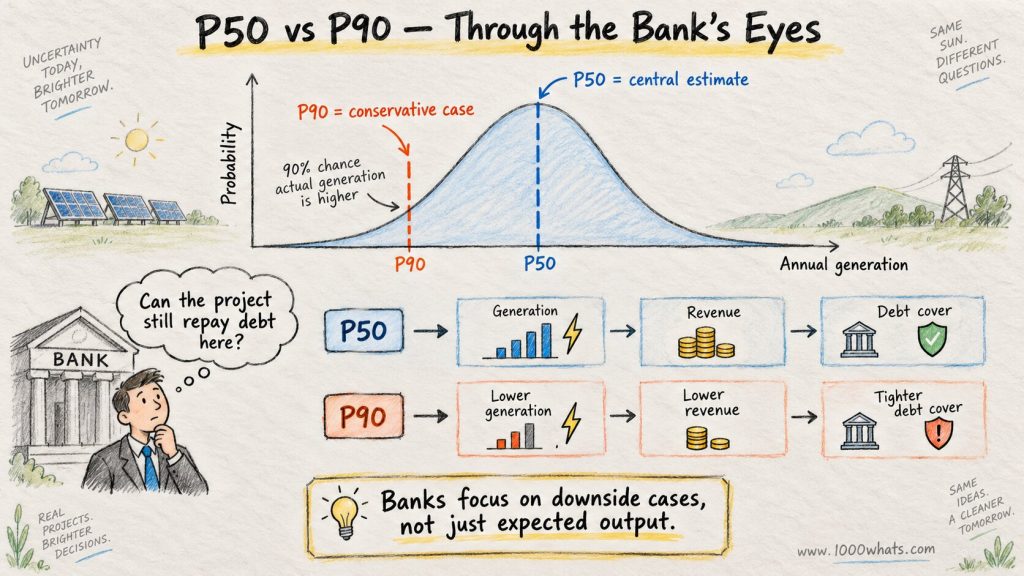
This is why renewable projects use probability forecasts such as:
P50
and:
P90.
The project developer may naturally enjoy looking at the central case.
The bank is professionally attracted to worse ones.
Why?
Because debt does not disappear during a bad wind year.
If annual production falls 10%, loan payments remain remarkably uninterested in the weather.
⚡ “Equity asks how much the project can earn. Debt asks how little it can earn and still survive.”
4. Who buys the electricity?
Now we arrive at the commercial heart.
Your solar farm works.
Excellent.
It produces 200 GWh.
Wonderful.
Who pays?
This is where the Power Purchase Agreement enters.
A long-term PPA can dramatically improve bankability because it gives future project revenue more structure.
But there is an important trap here:
signed does not automatically mean bankable.
Banks do not simply check:
PPA?
✓
Next page.
They read the contract.
Very carefully.
They want to understand:
price,
volume obligations,
term,
indexation,
termination rights,
payment security,
curtailment allocation,
balancing responsibility,
change in law,
force majeure,
credit support,
assignment rights,
and dozens of other details.
Then comes perhaps the most important question:
Who is the buyer?
A 20-year contract with someone who may be unable to pay in year three is not quite the revenue certainty the spreadsheet was hoping for.
This is counterparty credit risk.
The contract matters.
The company behind the signature matters too.
A PPA does not eliminate market risk
This becomes increasingly important in modern renewable projects.
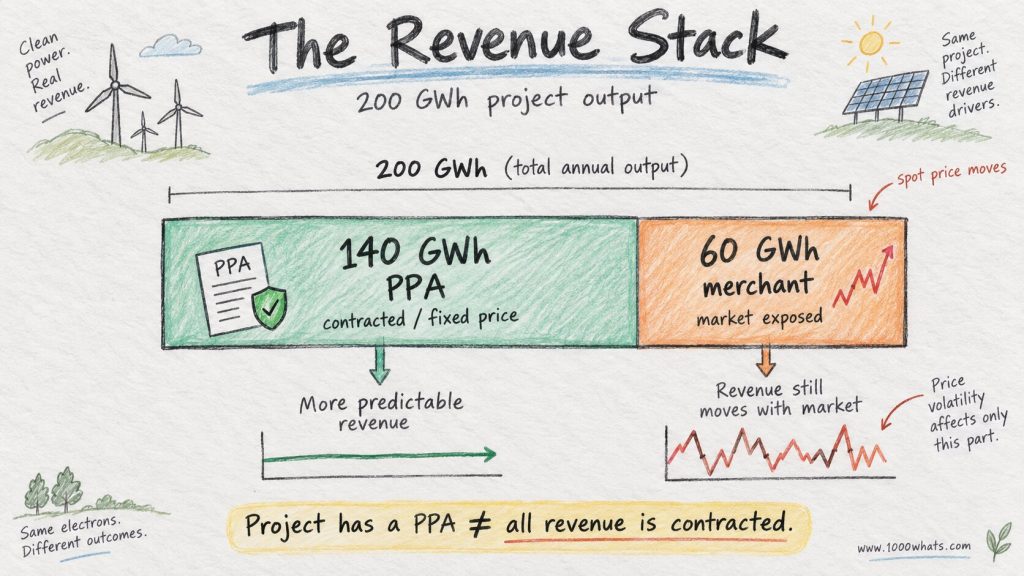
Suppose the PPA covers:
70% of expected production.
The remaining:
30%
is sold into the wholesale market.
Now the project has merchant exposure.
Perhaps electricity prices remain attractive.
Perhaps they do not.
Perhaps the project produces heavily during hours when every neighboring solar plant is also producing heavily.
Prices can fall exactly when production rises.
That creates capture-price risk.
Or perhaps the grid cannot accept all production.
Now curtailment appears.
Or balancing costs rise.
Or negative prices become more common.
None of these automatically destroys the project.
But each makes future cash flow less predictable.
And predictable cash flow is the natural habitat of debt.
An illustrative 200 GWh project
| Revenue exposure | Share | Annual production | What the lender sees |
|---|---|---|---|
| Contracted under PPA | 70% | 140 GWh | More predictable revenue |
| Merchant | 30% | 60 GWh | Exposure to wholesale and capture prices |
| Total | 100% | 200 GWh | A mixture of contracted and market risk |
5. Can the project actually get its electricity to market?
This sounds like the previous point.
It is not.
You can have:
the panels,
the permits,
the PPA,
the sunshine,
the buyer,
and the loan.
Then discover the grid is the problem.
Connection rights matter enormously.
Banks need confidence that the project will actually be able to:
connect,
export,
comply with grid requirements,
and remain connected under the relevant commercial framework.
This is why the grid has moved from engineering appendix to financing headline.
We explored the physical side of this in our article on grid congestion.
From the lender’s perspective, grid risk becomes:
revenue risk wearing electrical equipment.
A project that cannot export cannot invoice the electricity it intended to sell.
6. Who builds it—and who pays when construction goes wrong?
Before a project can repay 15 years of debt, it first has to survive construction.
Construction risk includes:
cost overruns,
delays,
equipment problems,
contractor failure,
supply-chain disruption,
performance shortfalls,
and approximately seven thousand opportunities for someone to say:
That was not included in our scope.
Banks therefore care deeply about the EPC structure.
Who is the contractor?
Is the contract fixed price?
Is completion date defined?
Are there liquidated damages for delay?
Are there performance guarantees?
Who absorbs cost overruns?
What security backs those obligations?
This is really a risk-allocation exercise.
If the turbine arrives six months late, somebody will suffer financially.
The lender’s preferred answer is generally:
not the debt repayment schedule.
COD suddenly looks much less ceremonial
This is where the Commercial Operation Date becomes financially serious.
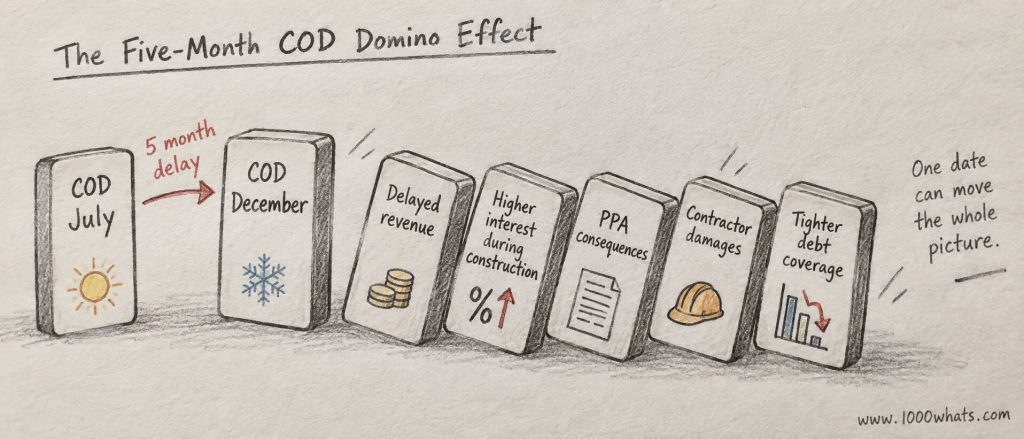
Suppose COD moves from:
July
to:
December.
Five months.
Sounds annoying.
But follow the money.
| COD delay | Financial consequence |
|---|---|
| Revenue starts later | Less operating cash arrives |
| Construction financing stays outstanding | Interest during construction increases |
| PPA milestone moves or is missed | Contractual consequences may apply |
| Incentive deadline is crossed | Expected project economics may change |
| EPC completion is late | Liquidated damages may become relevant |
| Debt schedule no longer matches operations | Financing may need adjustment |
Revenue starts later.
Construction financing remains outstanding longer.
Interest during construction increases.
The PPA may contain delay consequences.
Incentives may expire.
Contractors may owe damages.
The debt repayment schedule may need adjustment.
A delay therefore is not simply an engineering calendar problem.
It flows directly into bankability.
A project’s schedule is ultimately part of its financial model.
7. Who operates the project for the next 20 years?
Developers understandably obsess over getting projects built.
Banks lend money expecting them to remain alive afterward.
That means operations matter.
Who maintains the turbines?
Who monitors the plant?
What availability guarantees exist?
What happens when an inverter fails?
How much has been budgeted for replacement equipment?
How realistic are operating costs?
Are major-maintenance reserves needed?
An energy asset does not repay debt because construction finished.
It repays debt because it keeps operating.
This seems obvious.
It becomes less obvious around year 14 when somebody discovers the financial model assumed equipment would age with the dignity of a Swiss watch.
8. Does the cash flow actually cover the debt?
At some point, every bankability discussion enters Excel.
There is no escape.
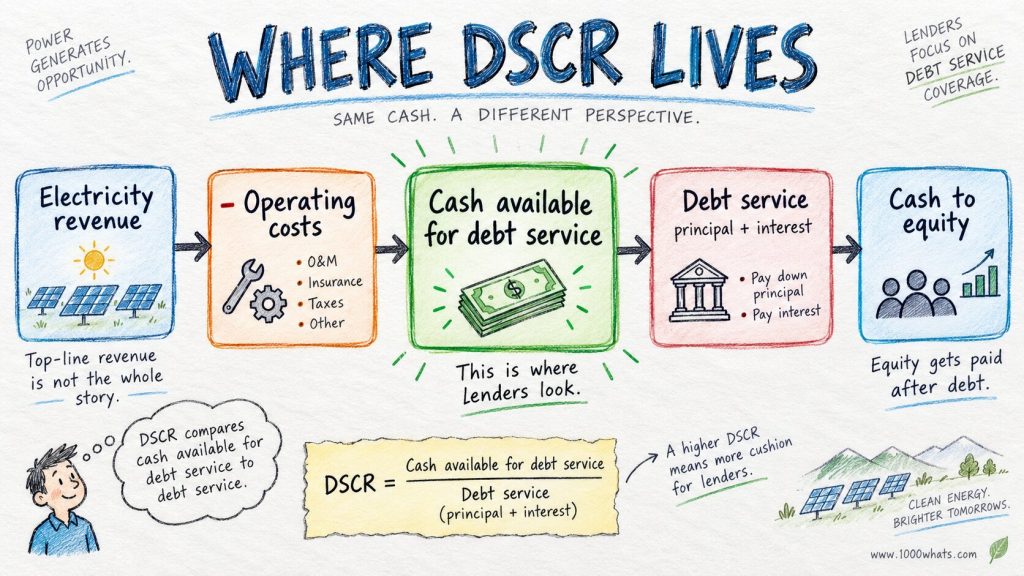
A central project-finance metric is the Debt Service Coverage Ratio, or DSCR.
The idea is simple:
cash available for debt service / debt service
Suppose the project has:
€13 million
available for loan repayment during a year.
Its required principal and interest payments equal:
€10 million.
Then:
DSCR = 1.30
There is a 30% cash-flow cushion above the required debt payment.
Now imagine:
Cash available = €9 million
Debt service = €10 million
DSCR:
0.90
We have reached the technical finance term:
problem.
| Healthy case | Problem case | |
|---|---|---|
| Cash available for debt service | €13 million | €9 million |
| Debt service | €10 million | €10 million |
| DSCR | 1.30x | 0.90x |
| Cash-flow cushion | €3 million | €1 million shortfall |
| Can operating cash cover scheduled debt? | Yes | No |
The World Bank explains bankability in precisely this logic: lenders want operating cash flow comfortably above debt service, with enough margin to survive variation in those cash flows.
An IFC utility-scale solar guide similarly emphasizes DSCR as one of the key measures lenders use to test whether a project can service debt under different scenarios.
The bank does not believe your base case
Well.
It believes it exists.
It simply does not stop there.
Developers naturally build a base case:
Expected production.
Expected price.
Expected operating cost.
Expected schedule.
Expected everything.
Reality has never signed a base-case agreement.
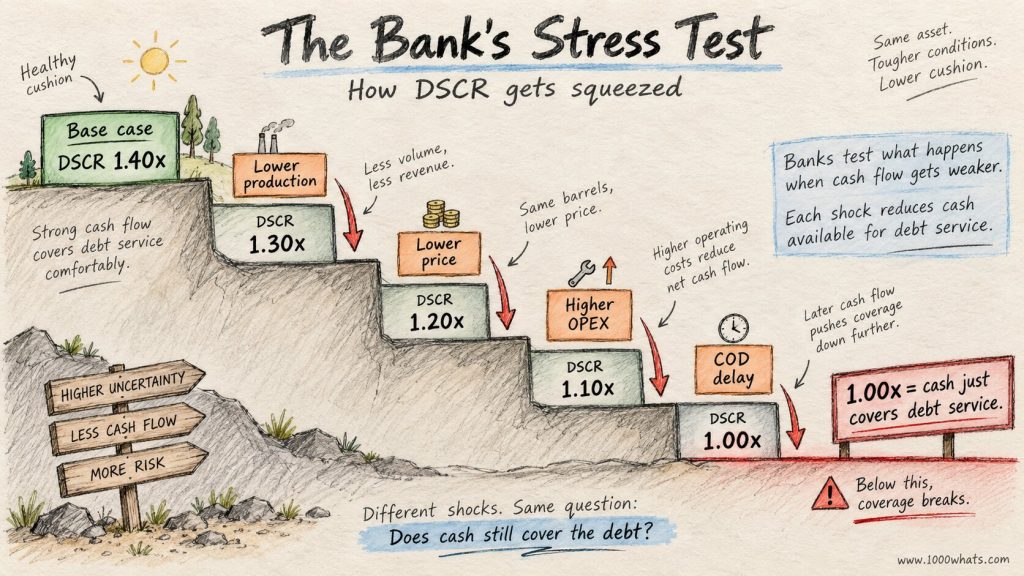
So banks stress the model.
What if:
production falls?
electricity prices fall?
interest rates rise?
construction is delayed?
CAPEX rises?
OPEX rises?
inflation behaves differently?
the currency moves?
curtailment increases?
the offtaker defaults?
Several things happen together?
That final question is important.
Risks are rude enough individually.
Occasionally they socialize.
A weak-price year might coincide with:
poor production,
high balancing costs,
and unexpected maintenance.
Bankability is partly about whether the project remains standing when assumptions stop behaving independently.
Illustrative downside stress test
| Scenario | Production | Power price | Costs | Illustrative DSCR |
|---|---|---|---|---|
| Base case | Expected | Expected | Expected | 1.40x |
| Lower production | ↓ | Expected | Expected | 1.27x |
| Lower production + weaker prices | ↓ | ↓ | Expected | 1.17x |
| Production + price + higher OPEX | ↓ | ↓ | ↑ | 1.08x |
| Severe combined downside | ↓↓ | ↓↓ | ↑ | <1.00x |
Illustrative figures only—the purpose is to show how lenders think about cumulative downside, not to suggest universal bankability thresholds.
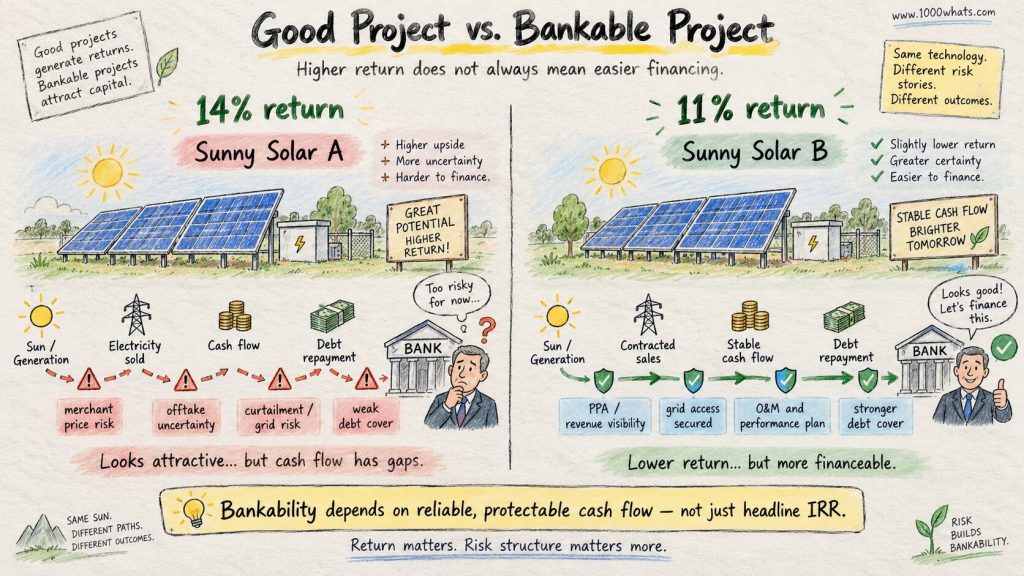
A simple example: Two identical-looking solar projects
Meet:
Sunny Solar A
and:
Sunny Solar B.
Both are:
100 MW.
Both use proven technology.
Both have excellent solar resources.
| Sunny Solar A | Sunny Solar B | |
|---|---|---|
| Expected equity return | 14% | 11% |
| Revenue structure | 40% merchant | Most revenue contracted |
| PPA buyer | Weak credit | Highly creditworthy |
| EPC price | Partly floating | Fixed |
| Grid / curtailment position | Unclear | Clearly allocated |
| Land rights | Renewal required after year 12 | Extend beyond debt tenor |
| Downside DSCR | Tight | Comfortable |
| Expected bankability | Weaker | Stronger |
Project A
Expected equity return:
14%
Sounds attractive.
But:
- 40% of output is merchant;
- the PPA buyer has weak credit;
- grid curtailment compensation is unclear;
- construction price is partly floating;
- project land rights require renewal after year 12;
- downside DSCR becomes tight.
Project B
Expected equity return:
11%
Less exciting.
But:
- most revenue is contracted;
- the buyer is highly creditworthy;
- EPC price is fixed;
- grid rights are clear;
- land rights extend beyond the debt tenor;
- insurance is robust;
- downside cash flow comfortably covers debt.
Which project does the lender prefer?
Probably B.
Not because B necessarily produces more electricity.
Not because it makes more money.
Because the road between:
project risk
and:
loan repayment
has fewer open trapdoors.
That is bankability.
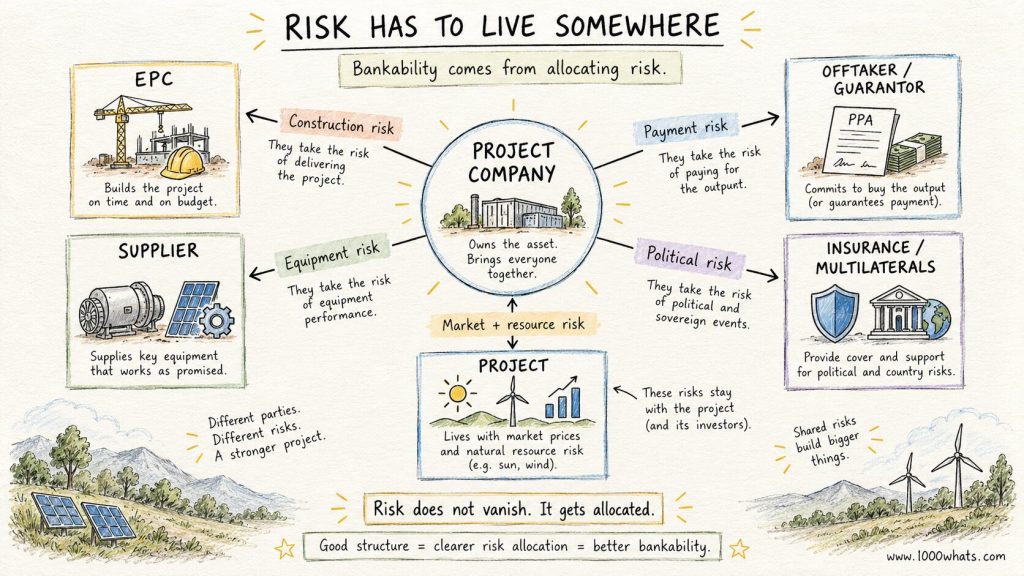
One of the worst ways to structure a project is to pretend risks can be deleted.
They cannot.
They can usually be:
reduced,
insured,
transferred,
shared,
priced,
or retained.
The World Bank’s project-finance guidance repeatedly emphasizes that good infrastructure financing depends on allocating each material risk to the party best able to manage it.
Construction risk?
Perhaps the EPC contractor can manage much of it.
Equipment performance?
Manufacturer warranty.
Offtaker payment risk?
Credit support or guarantee.
Resource risk?
Developer and lenders may retain it through conservative production assumptions.
Political risk?
Specialized guarantees or multilateral institutions may absorb parts of it.
Market-price risk?
PPA, hedge, or merchant exposure retained by investors.
| Risk | Typical tool or risk holder |
|---|---|
| Construction delay / cost | EPC contract / contractor |
| Equipment performance | Manufacturer warranties |
| Offtaker payment | Credit support / guarantee |
| Wind or solar resource | Project, reflected in conservative forecasts |
| Market price | PPA / hedge / project investors |
| Political or regulatory risk | Project / insurance / guarantees / multilateral support |
| Operations | O&M contractor / project company |
| Grid and curtailment | Depends heavily on contractual and regulatory framework |
The trick is not:
Give every risk to someone else.
The trick is:
Put each risk where it can be managed most efficiently.
Dump impossible obligations on a contractor and the project does not become safer.
The contractor simply:
charges more,
refuses to sign,
or signs and later discovers lawyers.
Risk allocation has to be credible.
Guarantees can make an unfinanceable risk financeable
This is where governments and development banks become interesting.
Imagine an otherwise sound renewable project where lenders worry about:
political instability,
state-owned offtaker credit,
currency convertibility,
new technology,
or merchant revenue.
A guarantee can absorb a specific layer of risk.
The World Bank describes guarantees as tools that can enhance project bankability by mitigating risks lenders or investors are unwilling to absorb alone.
EBRD is doing exactly this in current European energy-transition financing.
Its RenewEU framework uses InvestEU first-loss guarantees to support renewable generation, batteries, and grid projects that would otherwise carry risks making conventional financing harder.
This is de-risking.
But there is an important distinction.
A guarantee can make a good project with one difficult risk financeable.
It does not turn a fundamentally terrible project into infrastructure.
At least it should not.
Bankability is not binary
People sometimes speak as though a project is:
bankable
or:
not bankable.
Reality is messier.
A lender may say:
We’ll finance it…
but with less debt.
Or:
at a higher interest margin.
Or:
with a shorter tenor.
Or:
if the sponsor provides additional equity.
Or:
if you create a debt-service reserve account.
Or:
if that PPA clause changes.
Or:
if somebody guarantees the offtaker.
Risk does not always kill financing.
Sometimes it changes the price and structure of financing.
That distinction matters enormously.
The real question is often not:
Can this project raise debt?
It is:
How much debt, at what price, for how long, and under what conditions?
More bankable can mean cheaper electricity
Now we reach an underappreciated connection.
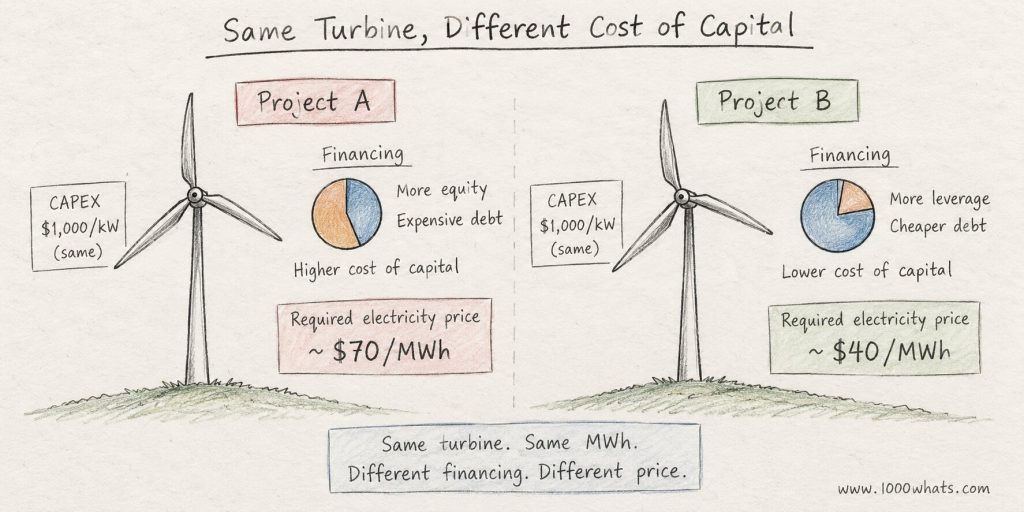
Suppose two projects use identical turbines.
Project A is risky.
Banks demand:
higher interest,
more equity,
shorter debt tenor.
Project B is well structured.
Banks offer:
lower interest,
more leverage,
longer tenor.
The physical cost of the turbines did not change.
But the project’s cost of capital did.
And renewable projects are especially sensitive to this because so much of their lifetime cost is paid upfront.
Wind and solar do not buy large volumes of fuel every year.
They buy:
equipment now,
then recover the investment over decades.
That means financing cost can materially affect the electricity price the project needs.
Bankability therefore does not merely decide whether projects get built.
It can influence how cheaply they can sell power.
This is why strong contracts matter so much
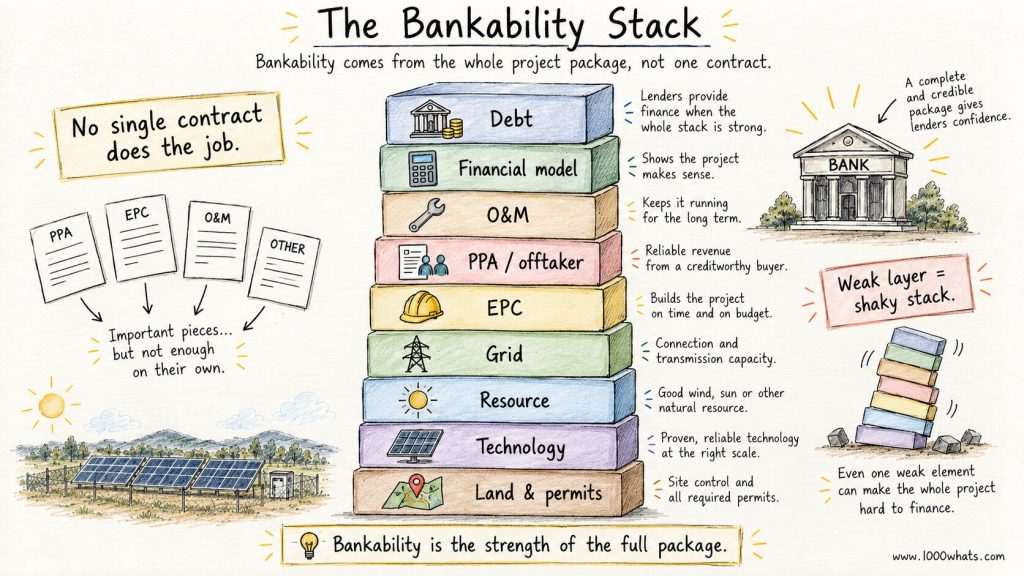
A contract in an energy project is not administrative decoration.
It is a way of reshaping risk.
The PPA allocates revenue risks.
The EPC contract allocates construction risks.
The O&M contract allocates operating obligations.
Land agreements secure site rights.
Grid agreements structure connection rights.
Insurance transfers certain losses.
Loan documents impose lender protections.
Guarantees absorb specific credit or political risks.
Put together, these contracts form an invisible second power plant.
The first plant produces electricity.
The contractual plant produces predictability.
Banks are surprisingly fond of the second one.
⚡ “Steel and silicon build the asset. Contracts decide whether somebody will lend against it.”
But bankability has a downside
A lender’s caution is rational.
It can also produce awkward outcomes.
Proven technologies get favored
Banks naturally prefer equipment with operating history.
That can make genuinely promising new technologies harder to finance.
Strong countries get cheaper money
A technically identical solar farm can face radically different financing costs depending on:
country risk,
currency risk,
regulatory stability,
and capital-market depth.
Sunlight may be free.
Capital absolutely is not.
Strong counterparties matter disproportionately
A project with an excellent resource but weak electricity buyer may struggle.
A project with merely good resource and an excellent offtaker may finance easily.
Innovation can need public support
If every lender waits until a technology is proven at scale, something has to finance the first large projects.
That is why:
development banks,
guarantees,
concessional capital,
public programs,
and blended finance
often appear around emerging technologies and markets.
The World Bank describes blended finance precisely this way: public or concessional resources absorb certain risks to crowd private capital into investments conventional markets consider too risky.
Bankability is therefore useful.
But it is not the same thing as social value.
A project can be socially valuable and difficult to finance.
Another can be extremely bankable and not particularly transformative.
Finance answers:
Can the capital structure survive?
Society may be asking a different question.
Does a signed PPA make a project bankable?
No.
Useful?
Absolutely.
Potentially essential?
Yes.
Sufficient?
No.
A project can have a PPA and still face:
weak counterparty credit,
poor termination protection,
uncompensated curtailment,
unacceptable change-in-law provisions,
uncertain connection,
unresolved land rights,
construction risk,
unproven technology,
or weak downside coverage.
This is one of the most important misconceptions in renewable project development.
People sometimes talk about “getting a PPA” as though the project then marches directly into a bank and emerges carrying debt.
The PPA is one important piece.
Bankability is the whole package.
Does reaching financial close mean the project is bankable?
Essentially, somebody has now demonstrated enough bankability for an actual financing transaction to happen.
This is why financial close matters so much in project development.
Before financial close:
studies,
contracts,
negotiations,
permits,
models,
due diligence,
credit approvals.
After financial close:
the money becomes committed under agreed conditions.
The project’s financial story stops being theoretical.
Someone has agreed to fund it.
Our overview of the six stages of renewable projects places financial close exactly at that transition between development and implementation.
But remember:
Financial close proves lenders accepted the project structure at that moment.
It does not make construction risk disappear afterward.
Projects retain an impressive ability to create new problems.
Why bankability matters more as renewables scale
The energy transition is often presented as a technology deployment problem.
We need:
more solar,
more wind,
more batteries,
more grids,
more clean industry.
Correct.
But each physical asset needs capital.
And the numbers are enormous.
That turns the transition into something else:
a financing problem.
The IEA’s 2026 database notes the EU’s Clean Energy Investment Strategy is explicitly trying to strengthen the connection between private capital and the pipeline of energy projects, with the European Investment Bank planning more than €75 billion of financing over three years.
The World Bank’s ASEAN Power Grid Financing Initiative makes the same logic explicit at regional scale: it aims to move infrastructure projects from concept toward construction through project preparation, financing, guarantees, and de-risking tools.
The engineering pipeline is not enough.
You need a bankable pipeline.
Otherwise we end up with gigawatts of excellent presentations.
Power systems prefer actual power plants.
So, what is a bankable energy project in one sentence?
A bankable energy project is one whose technical, legal, commercial, financial, and operational risks are sufficiently understood and controlled that lenders are willing to provide debt on acceptable terms.
Notice what is missing:
perfect.
No project is perfect.
Bankable means the risks have become:
visible,
manageable,
allocated,
priced,
and survivable.
That is the real trick.
Final thoughts
Energy projects often look physical.
Panels.
Turbines.
Transformers.
Steel.
Concrete.
Cables.
But long before any of that arrives on site, the project exists mostly as:
rights,
assumptions,
contracts,
forecasts,
risks,
and promises about future cash flow.
Bankability is where those promises get interrogated.
The lender does not ask whether the project is exciting.
It asks whether the land rights survive.
Whether the grid connection works.
Whether the equipment performs.
Whether the buyer pays.
Whether the model survives a bad year.
Whether construction finishes.
Whether enough cash remains after all of that to repay the loan.
And perhaps most importantly:
who takes the loss when one of those assumptions fails?
That is why bankability can feel frustratingly conservative.
It is supposed to.
Debt is not venture capital wearing a tie.
But bankability also does something enormously useful.
It forces a project to stop being a collection of optimistic assumptions and become a structure capable of surviving reality.
A good project tells a convincing story.
A bankable project shows what happens when the story goes wrong.
And still repays the bank.
Until next time, stay curious! 😎
Discover more from 1000whats
Subscribe to get the latest posts sent to your email.