
At 8:30 on a Tuesday morning, a chemical plant has a relationship problem.
In one building, a hot process stream is being cooled. The cooling tower is working hard to throw its heat into the atmosphere.
In the building next door, a cold process stream needs heating. The boiler is burning fuel to supply it.
The two streams have never met.
They are, in fact, paying separate utility bills to avoid meeting.
The plant manager calls a meeting. The maintenance supervisor suggests another heat exchanger. The finance director asks whether the heat exchanger comes with a refund for the last ten years. And a process engineer quietly opens a spreadsheet.
“Before we buy anything,” she says, “can we find out which hot streams can actually heat which cold streams?”
Welcome to the world’s least romantic matchmaking service: pinch analysis. There are temperatures to compare, boundaries to respect, and a strict policy against pretending that chemistry can overcome the second law of thermodynamics.
And welcome to 1000whats, where today’s love story comes with a heat balance and, ideally, a smaller gas bill.
Everyone wants heat. Everyone wants to get rid of heat. Nobody talks.
Factories are full of equipment with conflicting ambitions. A reactor needs its feed warmed. A finished product must be cooled before packaging. A dryer wants hot air. A condenser wants something cold enough to remove heat. A wash line wants warm water, preferably without a discussion about its childhood.
Traditionally, each department solves its own problem. Heating gets a boiler or steam connection. Cooling gets a cooling-water loop, air cooler, or refrigeration system. Everyone meets their production target. Everyone sends the finance department a bill.
Individually, those choices may be sensible. Together, they can be spectacularly wasteful.
A plant might purchase energy to heat one stream while paying to reject heat from another. If the temperatures and operating conditions line up, a heat exchanger can move some of that heat directly from the stream that has too much to the one that needs more.
But the important words are if the temperatures line up. Heat does not read organizational charts. It moves spontaneously from higher temperature to lower temperature. The boiler and cooling tower may both be expensive, but they cannot negotiate an exemption from physics.
My industrial heat explainer looks at why factories need so many different temperatures. Pinch analysis asks a more pointed question: how much of that heating and cooling could the factory avoid by making its processes share heat intelligently?
What is pinch analysis, exactly?
Pinch analysis is a systematic method for finding the minimum external heating and cooling required by a process, for a chosen minimum heat-transfer temperature difference, before designing the heat-exchanger network.
That sounds like something an engineer might say at a party to make the guests leave early. So let’s translate.
First, identify every relevant process stream that needs to cool down and every stream that needs to warm up. Then determine how much heat each stream can give or needs to receive at different temperatures. Finally, find the most heat those streams could exchange without violating a realistic temperature gap.
The answer gives you three valuable things: a minimum hot-utility target, a minimum cold-utility target, and the temperature bottleneck called the pinch.
Hot utility means externally supplied heat, such as steam or a fired heater. Cold utility means externally supplied cooling service, such as cooling water or refrigeration. The targets are thermal duties, usually expressed in kW or MW, not automatically fuel input or electricity consumption.
These targets are a thermodynamic benchmark under the stated process data and assumptions. They do not guarantee that the cheapest, safest, or most operable plant will use exactly that amount. A theoretical minimum is a destination on a map, not a purchase order.
The first dating rule: hot and cold are job descriptions
In pinch analysis, a hot stream is a process stream that must be cooled. A cold stream is one that must be heated.
That can sound backward. A stream entering at 80°C might be called cold, while another at 70°C is called hot. The first needs to reach 140°C; the second needs to fall to 30°C. Their labels describe what must happen to them, not whether they would feel pleasant in a bathtub.
Each stream needs a little dating profile: supply temperature, target temperature, and heat-capacity flow rate.
For a stream with approximately constant specific heat and no phase change, the thermal duty is:
Q = CP × |Ttarget − Tsupply|
where CP = mass flow rate × specific heat capacity.
If CP is 2 kW/°C and a stream cools from 180°C to 60°C, it can release 2 × 120 = 240 kW of heat.
Not 240 kWh. That’s energy over time. We are describing a heat-transfer rate. Run that duty for one hour and you have 240 kWh of thermal energy. The units are not being difficult. They are protecting us from very expensive misunderstandings.
Real process models must handle changing heat capacities, condensation, evaporation, and other complications. Our first date will be deliberately simpler.
Four streams walk into a spreadsheet
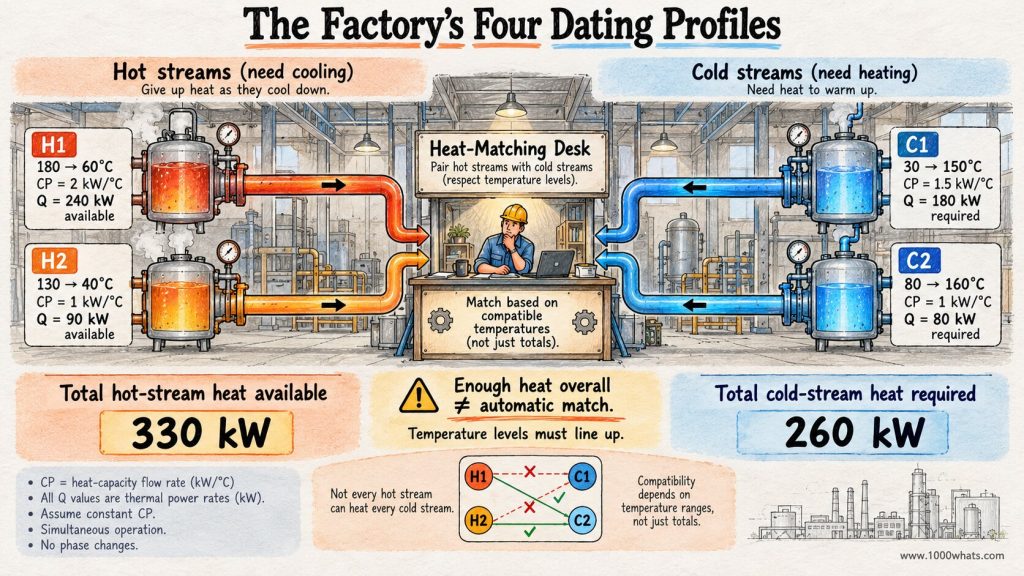
Consider a hypothetical specialty-chemical plant. It has two streams that need cooling and two that need heating. All four operate simultaneously at steady conditions, with constant CP and no phase changes. These are invented teaching numbers, not data from a real facility.
| Stream | Job | Supply → target | CP | Thermal duty |
|---|---|---|---|---|
| H1 | Cool | 180°C → 60°C | 2.0 kW/°C | 240 kW available |
| H2 | Cool | 130°C → 40°C | 1.0 kW/°C | 90 kW available |
| C1 | Heat | 30°C → 150°C | 1.5 kW/°C | 180 kW required |
| C2 | Heat | 80°C → 160°C | 1.0 kW/°C | 80 kW required |
The plant’s hot streams can release 330 kW. Its cold streams need 260 kW.
A hopeful accountant subtracts 260 from 330 and announces that the boiler can retire. The cooling tower will still need to reject 70 kW, but that seems manageable. Somebody starts planning a farewell cake for the burner.
Not so fast.
There may be enough heat in total, but not enough heat at the right temperatures. You cannot use a stream at 60°C to finish heating another stream to 160°C through an ordinary passive heat exchanger. That is not heat recovery. That is asking a lukewarm cup of tea to boil a kettle.
The accountant puts the cake order on hold.
Temperature is the bouncer at this party
To transfer heat through a heat exchanger, the hot side must be warmer than the cold side wherever the transfer takes place. In practical equipment, we normally require a positive minimum approach temperature, written as ΔTmin.
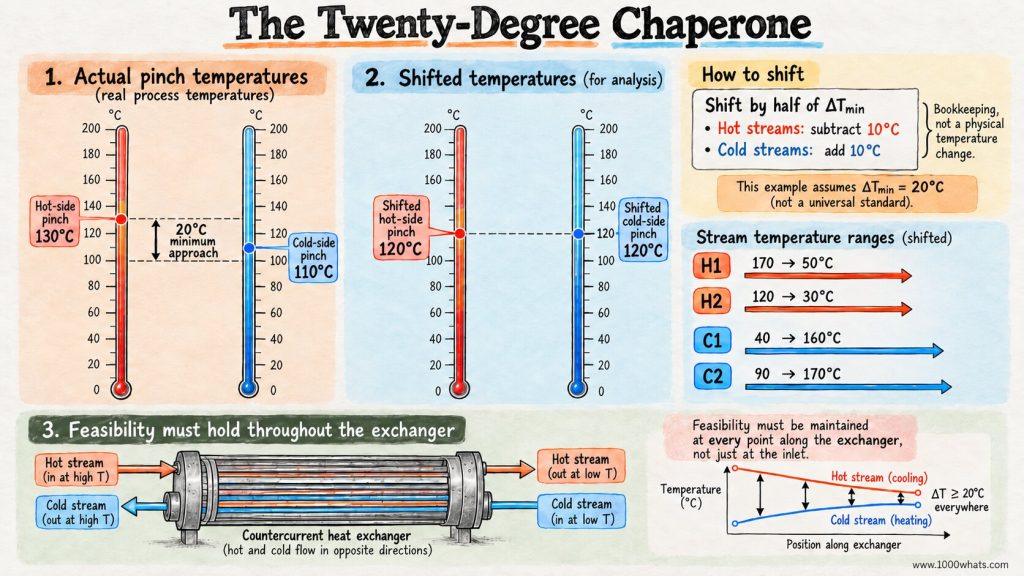
Suppose our design study chooses ΔTmin = 20°C. That is a modeling choice for this example, not a universal industrial standard.
It means that, in the idealized heat-exchanger network we are targeting, process-to-process heat exchange must maintain at least a 20°C temperature difference at its closest approach.
Why not make the difference one degree and recover nearly everything? Because heat transfer gets harder as the driving temperature difference shrinks. Smaller differences generally demand more heat-transfer area, larger equipment, and more capital. A one-degree gap can be the engineering equivalent of trying to empty a swimming pool through a drinking straw.
Go too far the other way and use an enormous temperature gap, and you buy smaller heat exchangers at the cost of more boiler and cooling duty. This is the central economic trade-off in pinch analysis: heat-exchanger capital versus ongoing utility cost.
Singapore’s National Environment Agency’s energy best-practice guide describes exactly this relationship. A pinch target only makes sense together with the chosen ΔTmin.
Why engineers move temperatures by ten degrees
Here comes a neat trick. Instead of carrying a 20°C separation through every line of a calculation, we can shift the temperatures onto a common scale.
For ΔTmin = 20°C, subtract 10°C from every hot-stream temperature and add 10°C to every cold-stream temperature.
H1’s range becomes 170°C to 50°C. H2’s becomes 120°C to 30°C. C1’s becomes 40°C to 160°C. C2’s becomes 90°C to 170°C.
Why? Because a real hot stream at 130°C and a real cold stream at 110°C are exactly 20°C apart. After shifting, both sit at 120°C. The required gap is now built into the coordinate system.
We have not cooled any real liquid or heated any real pipe. No energy has moved. This is bookkeeping, not a new thermodynamic technology. The thermometer readings in the plant remain gloriously indifferent to the spreadsheet.
These shifted temperatures let us divide the entire process into temperature intervals and calculate where heat is abundant and where it is scarce.
The heat cascade: a very honest running tab
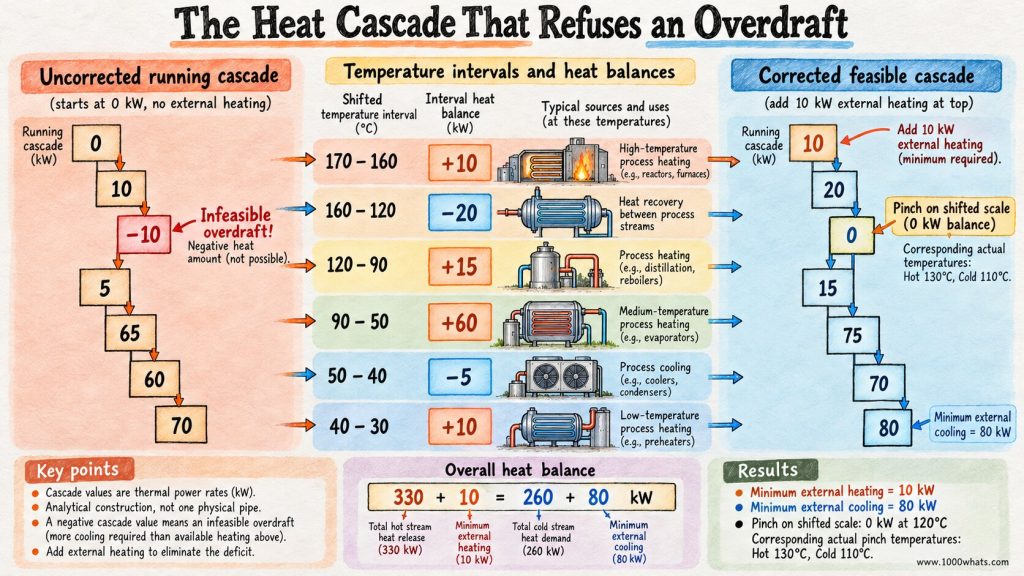
Imagine moving from the hottest shifted temperature down to the coldest. At each interval, add the heat released by active hot streams and subtract the heat demanded by active cold streams.
Positive balance? Heat is available to pass down to a lower temperature interval. Negative balance? That interval wants more heat than it receives. The cascade is the plant’s running thermal tab, and it does not accept IOUs from colder temperatures.
For our four streams, the intervals work out as follows. Every number in the balance columns is a thermal duty in kW.
| Shifted interval | Hot CP | Cold CP | Interval balance | Running cascade, starting at zero |
|---|---|---|---|---|
| 170–160°C | 2.0 | 1.0 | +10 kW | +10 kW |
| 160–120°C | 2.0 | 2.5 | −20 kW | −10 kW |
| 120–90°C | 3.0 | 2.5 | +15 kW | +5 kW |
| 90–50°C | 3.0 | 1.5 | +60 kW | +65 kW |
| 50–40°C | 1.0 | 1.5 | −5 kW | +60 kW |
| 40–30°C | 1.0 | 0 | +10 kW | +70 kW |
Take the 160–120°C interval. Its width is 40°C. The active hot streams together have CP = 2.0 kW/°C; the cold streams total 2.5 kW/°C. Net CP is −0.5 kW/°C. Multiply by 40°C and the interval has a 20 kW heat deficit.
The running cascade first reaches +10 kW, then falls to −10 kW. That’s our problem. A heat cascade cannot legitimately run negative if it represents heat flowing downward from hotter to colder intervals. Heat from 90°C cannot travel back up to pay a bill at 150°C.
So we add exactly 10 kW of external hot utility at the top. The entire cascade shifts upward by 10 kW, its lowest point becomes zero, and every interval can now be supplied without borrowing heat from below.
At the bottom, the corrected cascade ends at 80 kW. That is the minimum external cooling duty.
For this example, at ΔTmin = 20°C: minimum hot utility = 10 kW; minimum cold utility = 80 kW; maximum process-to-process heat recovery = 250 kW.
Our accountant was right that the plant had more heat than it needed overall. But the missing 10 kW was at the wrong end of the thermometer. The boiler gets to keep its job, albeit with a drastically reduced workload. The farewell cake becomes a modest cupcake.
The pinch is where the thermal wallet hits zero
Where did that corrected heat cascade touch zero? At a shifted temperature of 120°C.
Undo the shifts and the pinch appears at two actual temperatures: 130°C on the hot side and 110°C on the cold side. They are 20°C apart, precisely our selected ΔTmin.
That is the pinch: the most constrained temperature location in the heat-recovery problem. It separates the process into two regions with different jobs.
Above the pinch, the process has a net heat deficit and needs hot utility. Below the pinch, it has a net heat surplus and needs cold utility.
The pinch is not necessarily one physical valve, one pipe, or one heat exchanger waiting to be photographed. It emerges from the combined heating and cooling demands of the process. Sometimes the most important location in a factory is a point on a graph.
And no, the pinch is not where engineers gather to discuss the budget. That happens everywhere.
Three rules, and the one everyone wants to break
Once the pinch is known, the classic minimum-utility design rules become wonderfully strict.
Rule one: do not transfer heat across the pinch
Heat recovered above the pinch should serve demands above the pinch. Heat recovered below should serve demands below. Moving heat from the heat-deficient region above to the heat-surplus region below makes both utility requirements worse.
Suppose a network unnecessarily transfers 20 kW across the pinch, from above to below. The upper region now needs 20 kW more external heating. The lower region has 20 kW more heat to reject. Relative to our minimum targets, hot utility rises from 10 to 30 kW and cold utility from 80 to 100 kW.
One badly arranged transfer has given the boiler and cooling tower a matching 20 kW raise. They were already the two most expensive employees at the party.
Rule two: do not use external cooling above the pinch
If a hot process stream above the pinch could help warm a cold process stream, throwing that heat into cooling water instead increases the heat the plant must buy. You’re paying to discard the very thing you’re about to purchase.
Rule three: do not use external heating below the pinch
Below the pinch, the process already has a net heat surplus. Supplying extra boiler heat there, rather than recovering available process heat, ultimately adds to the cooling burden.
These are rules for achieving the minimum-utility targets, not a claim that any real plant violating one should be demolished immediately. A plant may rationally accept extra utility use to reduce capital cost, avoid contamination, simplify control, or keep production reliable. Thermodynamics identifies the penalty. Engineering decides whether avoiding it is worth the price.
Composite curves: the matchmaking profiles become a map
The heat cascade is a calculator’s view. Composite curves are the picture.
On a temperature-versus-heat-duty chart, combine the heat available from all hot streams into a hot composite curve. Combine the heat needed by all cold streams into a cold composite curve. Each curve bends where streams enter or leave a temperature interval, because the combined CP changes.
Slide the curves horizontally until their closest vertical temperature separation reaches the chosen ΔTmin. Their overlapping heat-duty span shows the maximum heat that could be exchanged between process streams under the targeting assumptions. The nonoverlapping portions indicate the minimum external heating and cooling.
At the pinch, the curves come closest. They do not merge into a miraculous zero-temperature-difference exchanger. They remain separated by the required temperature approach. The matchmaker respects personal space.
Composite curves reveal the target before anyone has decided which actual pipe connects to which actual heat exchanger. That distinction is why pinch analysis is more powerful than walking around the plant with a thermometer and a hopeful attitude.
One heat exchanger is a date. A network is a marriage.
Finding that 250 kW can theoretically be recovered is not the same as designing a plant that actually recovers it.
Now we must choose which streams exchange heat, how much duty each exchanger carries, where heaters and coolers go, and how the system behaves during startup, shutdown, and changes in production.
One exchanger may be enough for a simple process. A complicated refinery can have an intricate heat-exchanger network, with streams split into branches and rejoined, multiple utility levels, bypasses, and controls.
Each match must satisfy temperature driving forces throughout the exchanger, not just at the inlet. It must also survive pressure-drop limits, fouling, corrosion, product-quality requirements, cleaning access, and the uncomfortable possibility that one process stops while another keeps running.
A proposed match between hot solvent and food-grade water may be thermodynamically excellent and operationally unacceptable. A heat exchanger wall separates the fluids, but leakage risk, contamination consequences, and materials compatibility still matter. “They have chemistry” is not a safety assessment.
Heat recovery is especially awkward when the two streams do not operate at the same time. A hot batch at 9 a.m. cannot directly warm a cold batch that arrives at 4 p.m. without some form of thermal storage or another scheduling solution. The spreadsheet assumes simultaneous availability unless told otherwise.
In short, pinch analysis tells you what is thermodynamically possible; network design tells you what is physically buildable.
Before and after: the boiler and cooling tower get a pay cut
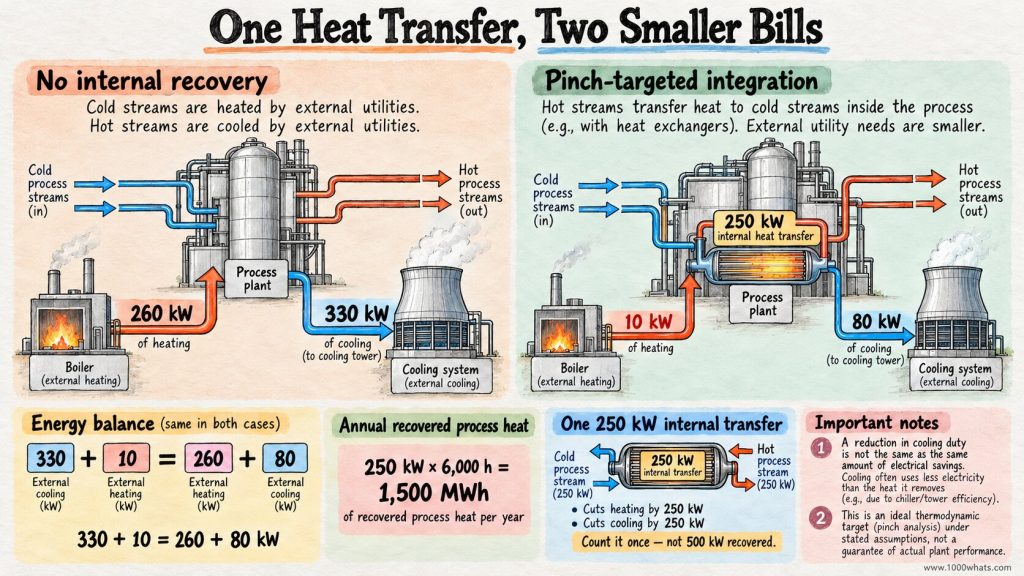
Return to our four-stream plant. Without any process-to-process recovery, the external utilities would have to supply all 260 kW of heating and remove all 330 kW of cooling. With ideal pinch-targeted integration, they supply only 10 kW of heating and remove 80 kW of cooling.
| Thermal duty | No internal recovery | Pinch target | Reduction |
|---|---|---|---|
| External heating | 260 kW | 10 kW | 250 kW |
| External cooling | 330 kW | 80 kW | 250 kW |
| Internal process heat recovery | 0 kW | 250 kW | +250 kW |
Check the heat balance: 330 kW released by hot process streams + 10 kW external heating = 260 kW absorbed by cold process streams + 80 kW external cooling. Both sides equal 340 kW.
Notice what we have not done. We have not invented 250 kW of energy. We have moved 250 kW from streams that needed cooling to streams that needed heating. That single transfer reduces two external duties, but it is still one transfer of heat.
We also have not claimed that avoiding 250 kW of cooling duty saves 250 kW of electricity. A cooling tower’s electrical demand is generally much smaller than the heat it rejects; a refrigeration system’s electricity use depends on its coefficient of performance. Thermal duty and electrical input are different entries on the invoice.
What does 250 kW of recovered heat actually save?
Let’s give the plant a hypothetical 6,000 operating hours per year, during which the modeled streams are simultaneously available at these duties.
Recovering 250 kW for 6,000 hours yields 1,500 MWh of process heat transferred annually.
Suppose externally delivered hot utility costs $60 per MWh of useful heat, and avoiding cooling service is worth another $5 per MWh of heat removed. These are illustrative utility-service costs, not universal energy tariffs.
The annual gross utility benefit is:
1,500 MWh × ($60 + $5)/MWh = $97,500 per year.
That number looks lovely on a slide. The engineering team, being less easily seduced, immediately asks about heat-exchanger installation, piping, pumps, pressure losses, maintenance, cleaning, downtime, control systems, and whether the plant can really operate in the assumed pattern for 6,000 hours.
Good questions. Gross utility benefit is not net savings, and net savings are not project profit. The capital cost and operating consequences still need a proper economic assessment.
Also, if $60/MWh were the fuel price rather than the cost of delivered useful heat, we would need to account for boiler efficiency. The accountant may be impatient, but the denominator is not optional.
Why the best heat recovery project might not recover the most heat
At first glance, the design goal seems obvious: recover every possible kilowatt.
But the final few kilowatts can be very expensive. As temperature differences shrink, exchanger area grows. A dirty process stream may require frequent cleaning. Long pipe runs may turn a promising match into a civil-engineering project with a heat exchanger attached.
Suppose Design A recovers 250 kW but requires an elaborate network costing $900,000. Design B recovers 220 kW using two accessible exchangers for $250,000. Without evaluating operating hours, utility prices, lifetime, financing, and maintenance, you cannot declare A the winner simply because its recovery number is larger.
Design A has the prettier thermodynamic résumé. Design B might be the better business decision. It depends on the numbers.
This is why engineers vary ΔTmin and compare total annualized cost: capital plus expected operating costs. The economic optimum often sits somewhere between “recover almost nothing” and “build a heat exchanger the size of a municipal swimming pool.”
Northwestern University’s process-design explanation of pinch analysis makes the same essential distinction: minimum utility consumption is not automatically minimum total cost.
Pinch analysis, exergy, and the trouble with warm leftovers
Pinch analysis and exergy are related, but they answer different questions.
Exergy asks how much useful work potential an energy stream possesses relative to an environment. Pinch analysis asks how to exchange heat among process streams, respecting temperature constraints, so external heating and cooling are minimized.
A stream at 80°C can be extremely valuable for warming wash water from 25°C to 50°C. It is not a suitable direct heat source for a reactor requiring 180°C. Same heat stream, different potential partners.
That is also why my waste heat explainer distinguishes the existence of thermal energy from the ability to recover it usefully. A heat source needs a suitable sink, a workable temperature difference, compatible timing, and a route that does not cost more than the benefit.
Heat is not single. It is selective.
When the matchmaker needs a heat pump
What if a large amount of waste heat is available, but its temperature is too low for the process that needs it?
A passive heat exchanger cannot send heat uphill in temperature. A heat pump can, by using work to lift heat from a lower-temperature source to a higher-temperature sink.
In pinch-based process integration, that can be particularly attractive when a heat pump absorbs heat from the surplus region below the pinch and supplies heat to the deficit region above it. But the economics depend on the temperature lift, heat-pump performance, electricity price, and real operating profile.
Thermal storage can help when hot and cold processes run at different times. Better scheduling can sometimes make a direct match possible without storage. And reducing the process’s heating or cooling requirement in the first place may beat both options.
Pinch analysis is not a competition to install the greatest possible number of shiny exchangers. It is a way to see the thermal system clearly enough to choose intelligently.
Where pinch analysis earns its keep
The method is especially useful in plants with multiple simultaneous heating and cooling duties: oil refining, petrochemicals, specialty chemicals, food processing, pulp and paper, and some other energy-intensive manufacturing operations.
It also informs utility-system design, heat-pump integration, and industrial decarbonization planning. The U.S. Department of Energy’s industrial assessment toolkit includes a Pinch Heat Integration Tool that produces shifted composite curves and grand composite curves. This is not merely a colorful idea from a process-engineering textbook.
But not every site needs a grand pinch study. A tiny facility with one hot stream and one cold stream may need a straightforward heat-exchanger feasibility check. A plant with dozens of interconnected streams may need rigorous targeting, detailed simulation, and network optimization.
The goal is not to impress the factory with a more complicated spreadsheet than it deserves. The goal is to stop paying twice for avoidable thermal services.
Five questions to ask before believing a heat-recovery proposal
Are the streams actually available at the same time? A beautiful annual heat balance can conceal a terrible hourly match.
Are the temperature profiles compatible? Inlet temperatures alone do not establish feasibility. The entire exchanger must respect the minimum approach.
What are the real hot and cold utility costs? Boiler fuel, delivered steam, cooling-water duty, and refrigeration electricity are not interchangeable price tags.
What does the network do when production changes? Turn-down, bypasses, fouling, cleaning, and startup can determine whether the plant loves its new heat exchanger in February as much as it did in the investment presentation.
Is this the best use of capital? The thermodynamic target is a benchmark. The economic decision needs a life-cycle view.
These questions are less glamorous than announcing a 90% reduction in external heating. They are also how a proposal survives its first meeting with an actual plant manager.
Final thoughts
At the end of our factory’s disastrous singles night, the hot streams and cold streams finally receive proper introductions. Some are excellent matches. Some have incompatible temperatures. A few operate different shifts. And one relationship looks wonderful until somebody calculates the piping cost.
Pinch analysis does not force them all together. It shows the maximum useful heat they could share under a chosen temperature constraint, the minimum heating and cooling that must still come from outside, and the thermal boundary that good network design should respect.
That is its real elegance. Before buying a bigger boiler, a better chiller, or an expensive new source of low-carbon heat, a factory can ask whether the energy it already owns has simply been introduced to the wrong department.
The boiler and cooling tower may object. They have grown accustomed to their separate invoices.
Until next time, stay curious! 😎
Discover more from 1000whats
Subscribe to get the latest posts sent to your email.