Let’s be honest: “calculating a carbon footprint” sounds like the kind of thing invented by someone who enjoys spreadsheets a little too much.
You picture a person in a dimly lit office whispering sweet nothings to an Excel file while multiplying your coffee habit by the emotional damage of modern life.
But here’s the twist: the basic logic is actually simple.
Not easy, exactly. Not always neat. But simple.
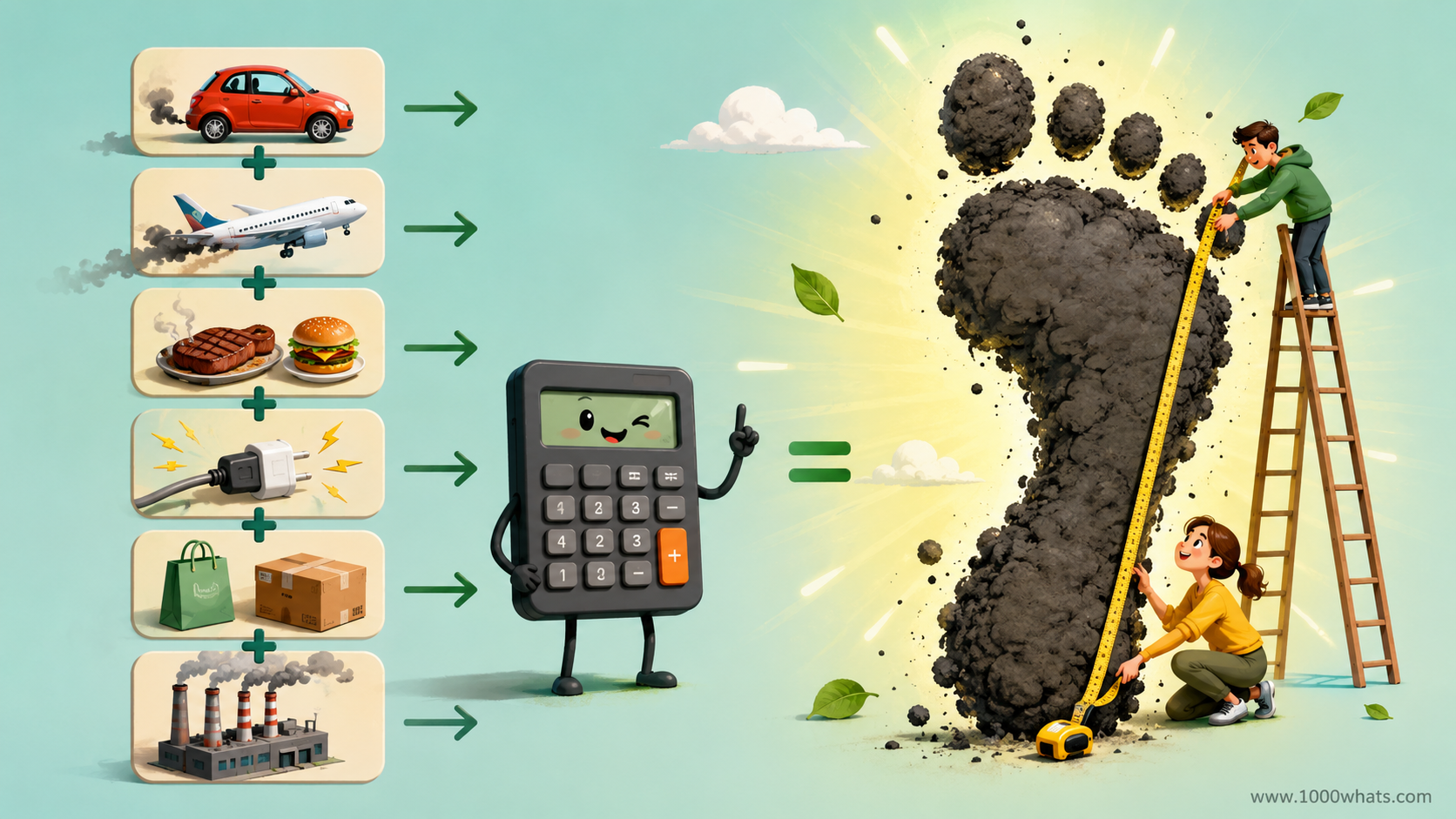
Calculating a carbon footprint is basically environmental detective work. You follow the trail of greenhouse gases left behind by everyday activities—driving, heating, flying, buying, producing—and turn all of that into one number you can actually use. Your original draft says it best: it’s about tracing the invisible trails of greenhouse gases left by every action of a person or organization.
⚡ “Carbon accounting sounds scary until you realize it’s mostly multiplication wearing a serious face.”
So let’s break it down. Welcome to 1000whats — where kilowatts, carbon, and climate finally make sense.
What is the formula for a carbon footprint?
Here’s the core formula:
Carbon footprint = Activity data × Emission factor
That’s it. That’s the engine under the hood.
Now let’s translate that into normal human language.
Activity data
This is the thing you actually did, used, bought, or produced.
Examples:
- kilowatt-hours of electricity used
- gallons or cubic meters of fuel burned
- kilometers driven
- flights taken
- tons of waste generated
Emission factor
This is the average amount of greenhouse gas linked to one unit of that activity.
Examples:
- kg CO₂e per kWh of electricity
- kg CO₂e per kilometer driven
- kg CO₂e per cubic meter of natural gas
- kg CO₂e per ton of waste
Multiply those two together, and you get emissions for that activity.
Then you repeat that process for each category, add it all up, and boom: carbon footprint.
Why the result is usually expressed in CO₂e
Here’s where carbon accounting gets a little fancy.
Your footprint is usually reported in carbon dioxide equivalent, or CO₂e, because carbon dioxide is not the only greenhouse gas in the game. Methane, nitrous oxide, and others also warm the planet, and they do it with different levels of intensity. So instead of reporting five different gases like a chaotic grocery receipt, we convert them into one common currency: CO₂e.
What most people don’t see is that this is what makes comparison possible.
Without CO₂e, your footprint would look like a chemistry lab exploded on a calculator.
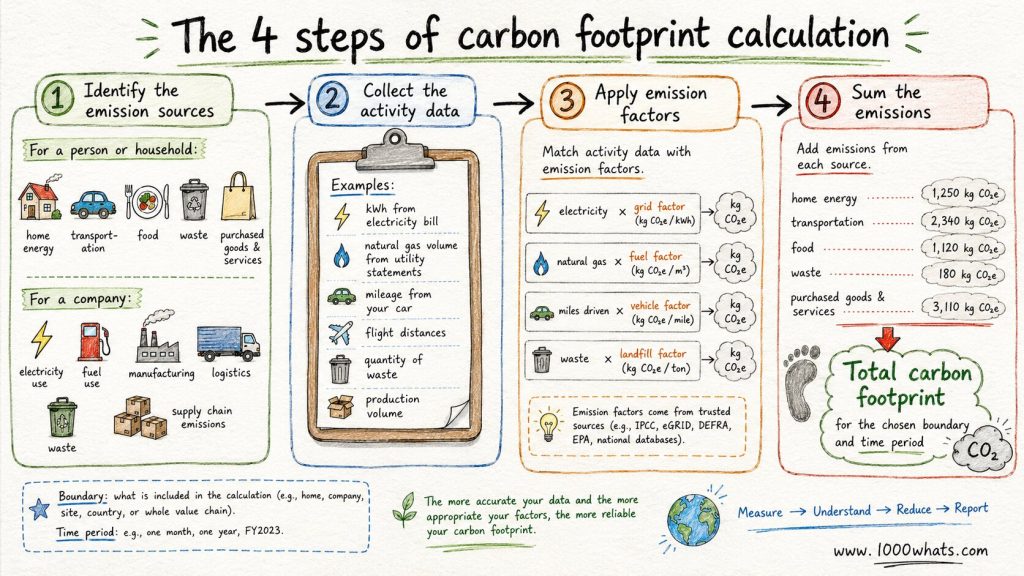
The 4 steps of carbon footprint calculation
Your original carbon footprint draft lays the process out clearly in four steps.
1) Identify the emission sources
First, figure out where emissions are coming from.
For a person or household, that usually means:
- home energy
- transportation
- food
- waste
- purchased goods and services
For a company, it can include:
- electricity use
- fuel use
- manufacturing
- logistics
- waste
- supply chain emissions
2) Collect the activity data
Now gather the numbers.
This is the “how much did you use?” stage:
- kWh from your electricity bill
- natural gas volume from utility statements
- mileage from your car
- flight distances
- quantity of waste
- production volume, if you’re calculating a product footprint
In practice, real bills beat rough guesses. Your source material specifically recommends using actual household consumption data where possible, not just dollar spend, because it gives a more accurate picture.
3) Apply emission factors
This is where the conversion happens.
You match each activity with the right emission factor:
- electricity × grid factor
- natural gas × fuel factor
- kilometers driven × vehicle factor
- waste × landfill factor
This is also where things can go wrong if you use bad data, outdated factors, or mismatched units. Emission factors need to be credible, timely, location-specific when possible, and in the right units.
4) Sum the emissions
Once you calculate emissions for each source, add them together.
That total is your carbon footprint for the chosen boundary and time period.
A simple household example
Let’s use the example from your original draft, because it’s clean and easy to follow.
Home energy
Suppose a household uses:
- 10,000 kWh of electricity per year
- electricity emission factor = 0.5 kg CO₂e/kWh
Then:
10,000 × 0.5 = 5,000 kg CO₂e
Now add natural gas:
- 500 cubic meters of natural gas
- emission factor = 2 kg CO₂e/m³
Then:
500 × 2 = 1,000 kg CO₂e
So total home energy emissions are:
5,000 + 1,000 = 6,000 kg CO₂e
Transportation
Now imagine:
- 15,000 km of car travel
- emission factor = 0.4 kg CO₂e/km
That gives:
15,000 × 0.4 = 6,000 kg CO₂e
Then add flights:
- two 3,000-km round-trip flights
- emission factor = 0.25 kg CO₂e/km
That gives:
6,000 × 0.25 = 1,500 kg CO₂e
Total transportation emissions:
6,000 + 1,500 = 7,500 kg CO₂e
Diet and waste
Your draft also uses:
- 2,000 kg CO₂e for diet
- 100 kg CO₂e for household waste
Grand total
So the total annual footprint becomes:
- Home energy: 6,000 kg CO₂e
- Transport: 7,500 kg CO₂e
- Diet: 2,000 kg CO₂e
- Waste: 100 kg CO₂e
Total = 15,600 kg CO₂e
That’s the whole game.
Not trivial. But not mystical either.
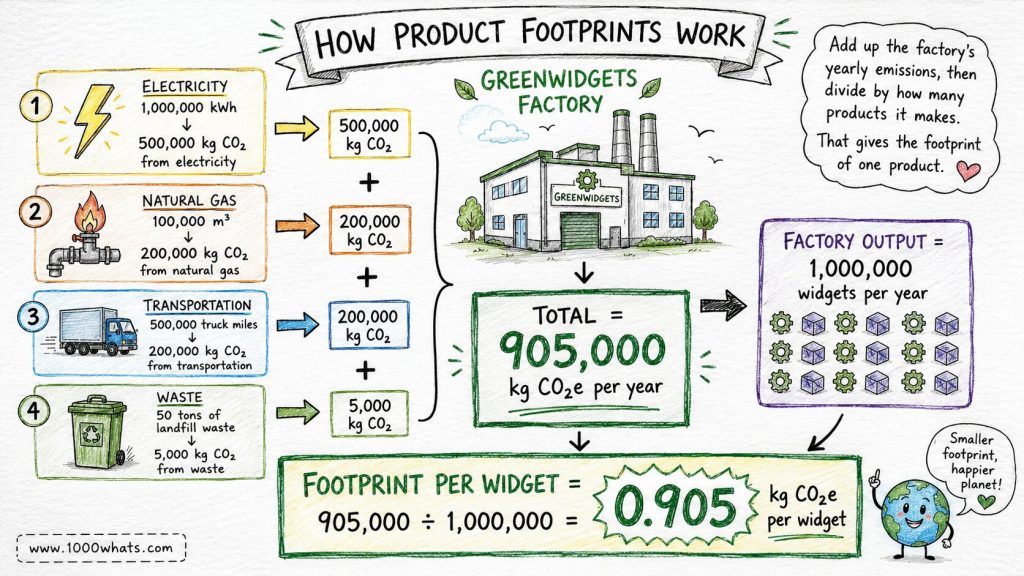
The GreenWidgets example: how product footprints work
Now let’s steal one of the better parts of your original piece: the imaginary factory.
The GreenWidgets Factory uses:
- 1,000,000 kWh of electricity
- 100,000 m³ of natural gas
- 500,000 truck kilometers
- 50 tons of landfill waste
Using the draft’s example factors, the factory ends up with:
- 500,000 kg CO₂ from electricity
- 200,000 kg CO₂ from natural gas
- 200,000 kg CO₂ from transportation
- 5,000 kg CO₂ from waste
That gives a total of:
905,000 kg CO₂e per year
Then, if the factory makes 1,000,000 widgets per year, the footprint per widget is:
905,000 ÷ 1,000,000 = 0.905 kg CO₂e per widget
That’s a great reminder that carbon footprints can be calculated at different levels:
- per year
- per month
- per trip
- per product
- per event
⚡ “A carbon footprint can belong to a person, a factory, a flight, or a single lonely widget.”
What makes the math harder than it looks
The formula is simple. The inputs are not.
Here’s where carbon footprinting gets messy.
1) Emission factors change by location
Electricity is the classic trap.
A kilowatt-hour is not equally dirty everywhere. If your local grid runs on coal, the electricity emission factor will usually be higher. If it runs on more renewables, nuclear, or hydro, it may be lower. That’s why location-specific factors matter so much.
2) Emission factors change over time
They’re not fixed forever.
Grid mixes change. Technologies improve. Policies shift. Old factors can become misleading fast. Your source material explicitly warns against relying on outdated values when more current ones are available.
3) Units can quietly wreck the whole thing
This is the least glamorous problem and one of the most common.
If your electricity is in kWh and your emission factor is in MWh, or your fuel is in gallons while the factor is per liter, you need proper conversion. Otherwise your final result is just mathematically confident nonsense.
4) Some categories are estimates, not perfect measurements
For direct fuel use, you can often get pretty solid numbers.
For food, purchased goods, and supply-chain emissions, things get fuzzier. That’s why organizations sometimes use activity-based, spend-based, or hybrid methods depending on what data they have. Activity-based methods tend to be more precise, while spend-based methods are often easier for harder-to-track indirect emissions.
So what do online calculators actually do?
They do the same thing—just faster and with more hidden assumptions.
Your draft already points this out: carbon calculators can help estimate your footprint and identify the biggest contributors, but they often rely on averages.
That means they’re useful for:
- quick estimates
- spotting big problem areas
- comparing lifestyle choices
But they’re not magic.
In practice, a calculator is only as good as:
- the data you enter
- the emission factors it uses
- how well it matches your actual location and habits
The version nobody tells you: calculation boundaries matter
This part matters a lot.
Before calculating a footprint, you need to decide what you are counting.
Are you calculating:
- your household for a year?
- a single product?
- a company’s operations?
- a company plus its supply chain?
- one event?
Because the answer changes the result.
A product footprint can include raw materials, manufacturing, transport, customer use, and end-of-life treatment. A corporate footprint may include direct emissions, purchased electricity, and value-chain emissions depending on the reporting standard.
So before you touch a calculator, ask:
What exactly am I calculating?
That question saves a shocking amount of chaos.
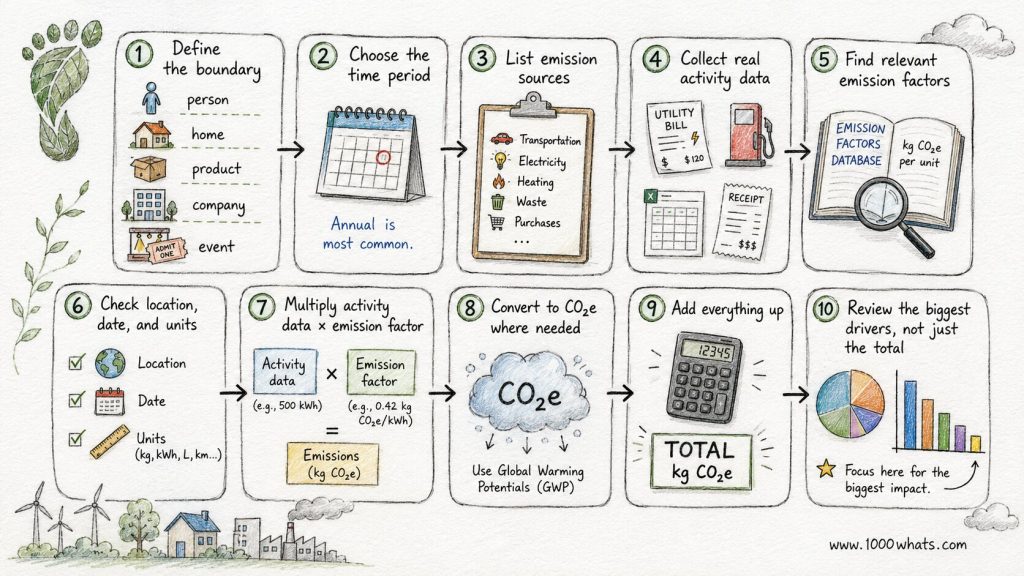
A practical checklist
If you want a no-drama version, here it is:
- Define the boundary: person, home, product, company, event
- Choose the time period: annual is most common
- List emission sources
- Collect real activity data
- Find relevant emission factors
- Check location, date, and units
- Multiply activity data × emission factor
- Convert to CO₂e where needed
- Add everything up
- Review the biggest drivers, not just the total
Final thoughts
The formula for a carbon footprint is surprisingly simple:
what you do × how polluting that thing is
That’s the backbone. The rest is about boundaries, data quality, and not accidentally mixing cubic meters with kilometers like a sleep-deprived goblin.
What most people don’t see is that carbon accounting is not really about chasing one perfect number.
It’s about understanding where emissions come from, which parts of the system matter most, and where change would actually count.
And that’s the good news.
Because once the mystery is gone, the footprint stops being a vague cloud of guilt and starts becoming something you can actually work with.
What do you want next: a follow-up post on what emission factors are, or one on how to calculate your own carbon footprint step by step with a simple template?
Until next time, stay curious! 😎
Discover more from 1000whats
Subscribe to get the latest posts sent to your email.