


Imagine building a solar farm knowing something most businesses would kill to know:
Who will buy your product, how much they’ll pay, and roughly how long they’ll keep paying it.
Sounds suspiciously comfortable, doesn’t it?
Normally, electricity generators live in a market where prices bounce around with fuel costs, weather, demand, transmission constraints, geopolitics, and whatever fresh chaos Tuesday has brought.
A feed-in tariff changes the game.
Instead of telling a renewable generator, “Good luck out there,” the policy effectively says:
Generate eligible electricity, and you’ll receive an agreed payment for every kilowatt-hour.
That simple promise helped turn technologies once considered expensive science projects into investable infrastructure.
And that’s where feed-in tariffs get interesting.
They aren’t really about paying people to be green.
They’re about removing risk.
⚡ “A feed-in tariff doesn’t make the wind blow or the sun shine. It makes the revenue predictable enough for someone to finance the equipment that captures them.”
Welcome to 1000whats, where we turn energy-market alphabet soup into something you could actually explain over coffee.
Let’s feed some electricity into the grid.
What is a feed-in tariff?
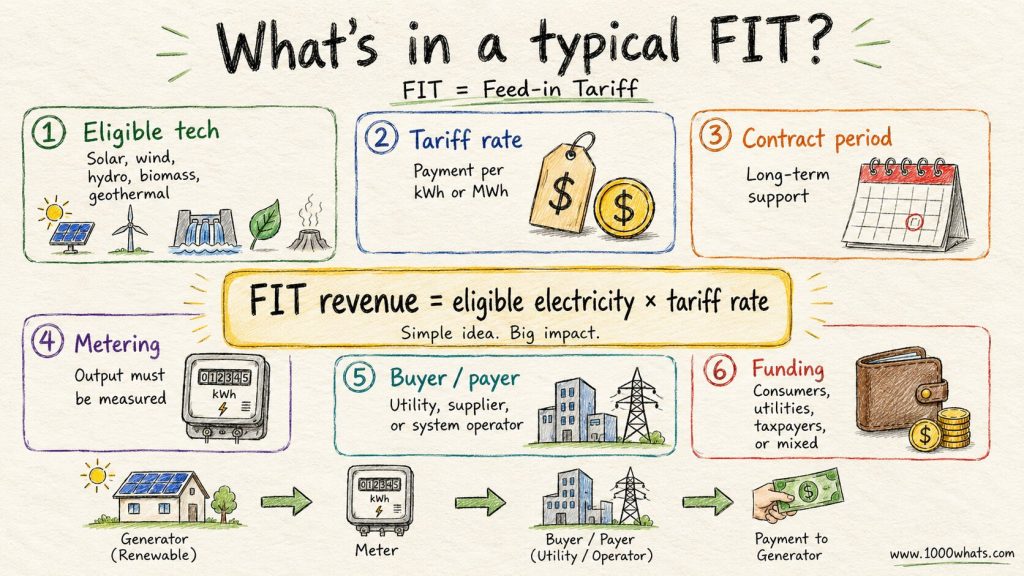
A feed-in tariff, usually shortened to FIT, is a government-backed policy mechanism that guarantees qualifying energy producers a defined level of remuneration for each unit of electricity they produce.
The International Energy Agency describes a feed-in tariff as a policy that guarantees energy producers a level of remuneration for each unit of output, typically with the aim of encouraging investment by reducing price and demand risk.
Translated into 1000whats language:
You generate eligible electricity. The FIT rules determine what you get paid.
The name itself gives the game away.
Feed-in = electricity is fed into the electricity system.
Tariff = a predetermined payment structure.
Put them together and you get a policy designed to make renewable energy projects financially attractive enough to build.
If you want the bigger picture of why governments interfere in energy markets in the first place, jump into my guide to energy regulation.
Because a FIT is exactly that:
energy regulation with a price tag attached.
Why do feed-in tariffs exist?
To understand FITs, forget solar panels for a moment.
Think like a bank.
A developer walks into your office and asks for $50 million to build a wind farm.
You ask:
“How much will the project earn?”
The developer replies:
“Well… electricity prices could be high.”
Could be?
“And they could also be low.”
Hmm.
“And sometimes they might even go negative.”
Security!
That is the financing problem renewable developers have wrestled with for decades.
Power plants require enormous upfront investment. And renewable projects are particularly capital-heavy: much of the money is spent before the first kilowatt-hour is generated.
If you’ve read my breakdown of the six stages of a renewable energy project, you’ll know how much has to happen before a project reaches operation.
Developers need:
- Land
- Permits
- Grid access
- Engineering
- Equipment
- Construction contracts
- Equity
- Debt
- Insurance
- Buyers
- And probably several thousand cups of coffee
All before meaningful electricity revenue starts arriving.
A FIT attacks one particularly ugly risk:
What price will this project receive for its electricity?
By making that revenue more predictable, governments can make projects easier to finance.
And that was especially important when technologies such as solar power and wind power were more expensive and investors were far less comfortable with them than they are today.
How does a feed-in tariff work?
Let’s build the world’s smallest imaginary solar farm.
You install some panels.
The sun does its extraterrestrial nuclear-fusion thing.
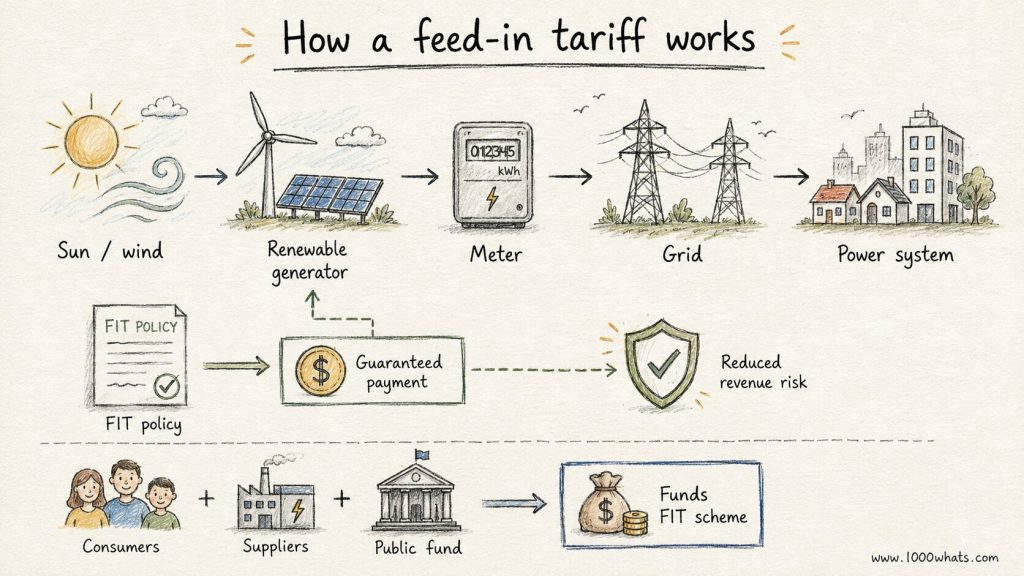
Your panels generate electricity.
A meter records the eligible generation or export according to the rules of the particular FIT scheme.
Then the payment mechanism kicks in.
In simplified form:
Electricity generated × Feed-in tariff = FIT revenue
Suppose your system generates 10,000 kWh per year and the hypothetical tariff is $0.15/kWh.
Your annual FIT revenue would be:
10,000 × $0.15 = $1,500
That’s it.
No PhD in electricity economics required.
Simple FIT examples
These numbers are purely illustrative.
| Project | Eligible annual generation | Example FIT | Annual revenue |
|---|---|---|---|
| Rooftop solar | 8,000 kWh | $0.15/kWh | $1,200 |
| Small wind turbine | 80,000 kWh | $0.11/kWh | $8,800 |
| Biogas plant | 1,500,000 kWh | $0.10/kWh | $150,000 |
| Small hydro plant | 4,000,000 kWh | $0.085/kWh | $340,000 |
Of course, real FIT schemes can be much more complicated.
Payments may depend on:
- Technology
- Project size
- Commissioning date
- Location
- Contract duration
- Whether electricity is generated or exported
- Inflation adjustments
- Annual tariff reductions
- Maximum eligible capacity
- Market prices
Because apparently policymakers looked at the equation electricity × tariff = money and thought:
“Nice. Needs more spreadsheets.”
What actually gets paid under a feed-in tariff?
This is where the term can become slightly misleading.
People sometimes imagine every FIT as:
Renewable plant → electricity exported → fixed price paid
That structure certainly exists.
But not every program works identically.
Some schemes compensate total eligible generation.
Others focus on exported electricity.
Some combine a generation tariff with a separate export payment.
Great Britain’s former FIT scheme, for example, involved payments for electricity generated and exported by accredited installations. Ofgem explains the scheme and its payment structure here.
So the underlying principle is consistent:
Reward eligible output.
The exact plumbing depends on the policy.
The real product being sold is certainty
What most people don’t see is that renewable project economics aren’t determined only by:
“How much does this power plant cost?”
Investors also ask:
“How predictable are the future cash flows?”
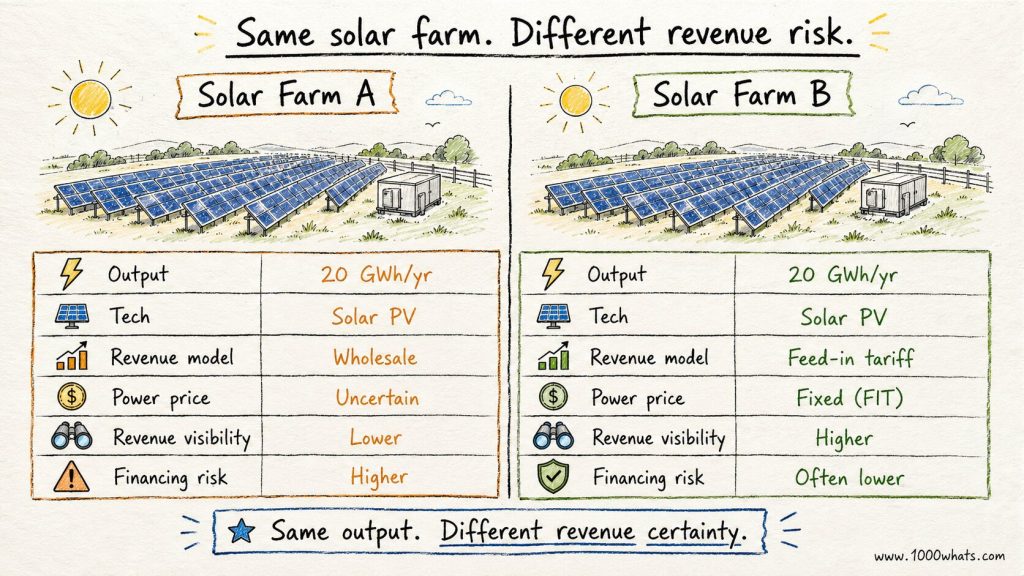
Consider two identical solar farms.
| Solar Farm A | Solar Farm B | |
| Expected annual output | 20 GWh | 20 GWh |
| Generation technology | Solar PV | Solar PV |
| Revenue model | Wholesale market | Feed-in tariff |
| Future electricity price | Uncertain | Predetermined under FIT rules |
| Revenue visibility | Lower | Higher |
| Financing risk | Higher | Potentially lower |
Same panels.
Same sunshine.
Very different investment proposition.
This is why FITs should not be dismissed as some government official randomly deciding solar deserves extra pocket money.
A FIT is a risk-allocation mechanism.
And risk affects financing costs.
That matters because renewable technologies tend to have high upfront capital costs and relatively low operating costs.
If you want to understand how those lifetime costs are compared, take a detour into Levelized Cost of Electricity, or LCOE.
A technology can look cheap on an LCOE basis and still struggle to get financed if investors don’t trust the revenue.
That distinction is enormous.
⚡ “Cheap electricity and bankable electricity are not automatically the same thing.”
How does a feed-in tariff make renewable projects bankable?
Here we arrive at one of my favorite energy-industry words:
bankability.
Bankability basically asks:
“Is this project solid enough that somebody sensible will lend millions of dollars against its future cash flows?”
Revenue certainty helps.
A lot.
Suppose a solar project expects to generate 50,000 MWh annually.
Project A: Merchant market
The project sells electricity directly into the wholesale market.
| Year | Possible electricity price | Revenue |
| 1 | $80/MWh | $4.0 million |
| 2 | $45/MWh | $2.25 million |
| 3 | $95/MWh | $4.75 million |
| 4 | $30/MWh | $1.5 million |
Bank:
😬
Project B: Hypothetical FIT
Assume eligible generation receives $70/MWh.
| Year | FIT | Revenue from 50,000 MWh |
| 1 | $70/MWh | $3.5 million |
| 2 | $70/MWh | $3.5 million |
| 3 | $70/MWh | $3.5 million |
| 4 | $70/MWh | $3.5 million |
Bank:
🙂
Obviously, real projects involve degradation, curtailment, availability, inflation, credit risk, operating costs, taxes, debt-service ratios, and other joyful spreadsheet creatures.
But the principle remains:
Predictable revenue makes future cash flows easier to model.
The same logic explains why Power Purchase Agreements matter so much to renewable projects.
A PPA can also give developers long-term revenue visibility.
And a PPA itself belongs to the broader family of offtake agreements—contracts designed to secure a buyer for future production.
FITs, PPAs, and offtake agreements all attack the same terrifying question from slightly different directions:
“Who is going to pay me for this thing after I spend millions building it?”
Who pays for feed-in tariffs?
Ah.
Now we get to the awkward part.
If a renewable generator receives guaranteed remuneration, where does that money actually come from?
Because contrary to certain election campaigns, money does not grow naturally inside government buildings.
The answer depends on the FIT scheme.
Costs can ultimately fall on:
- Electricity suppliers
- Electricity consumers
- Government budgets
- Dedicated levies or surcharges
- Grid-related payment mechanisms
- Combinations of the above
Great Britain provides a useful example.
Under its FIT arrangements, scheme costs are distributed among licensed electricity suppliers through a process called levelisation, based on their share of the electricity supply market. Ofgem explains the mechanism here.
Germany’s historic 1991 Electricity Feed-in Law worked differently from a tax-funded subsidy. Utilities were required to buy renewable electricity at premium prices, and according to the IEA’s history of Germany’s Feed-in Law, the resulting burden was borne through electricity suppliers and customers rather than the public budget.
So when someone says:
“The government pays renewable generators…”
the better response is:
“Which scheme are we talking about?”
Energy policy loves simple headlines.
The money flows underneath are rarely simple.
Why not just set an enormous feed-in tariff?
Excellent idea.
Let’s pay rooftop solar $5 per kWh.
Within approximately twelve minutes, your entire country would be covered in photovoltaic panels.
Including the highways.
And probably several cows.
The problem is obvious:
Too little support and nobody invests.
Too much support and everybody invests at someone else’s expense.
That balance is the entire art of FIT design.
Imagine a technology needs roughly $0.10/kWh to earn an attractive return.
If policymakers offer:
$0.06/kWh
Developers say:
“No thanks.”
If they offer:
$0.11/kWh
Developers say:
“Interesting.”
If they offer:
$0.35/kWh
Developers say:
“WHERE DO I SIGN?”
And policymakers eventually say:
“Oh.”
What is tariff degression?
Renewable technologies have a habit of becoming cheaper.
Which creates an unusual policy problem.
A tariff that was reasonable when solar modules were expensive can become absurdly generous after equipment costs fall.
Enter tariff degression.
Degression simply means the tariff available to new projects decreases over time.
For example:
| Commissioning year | Example FIT |
| Year 1 | $0.18/kWh |
| Year 2 | $0.16/kWh |
| Year 3 | $0.14/kWh |
| Year 4 | $0.12/kWh |
Existing qualifying projects may continue under previously agreed rules, while new installations receive lower tariffs.
That gives policymakers a way to say:
“Congratulations, solar. You got cheaper.”
“Thanks!”
“So we’re paying you less.”
“Wait…”
But economically, that is exactly what should happen if the technology matures.
Support should follow economics—not nostalgia.
What are the advantages of feed-in tariffs?
FITs became popular for a reason.
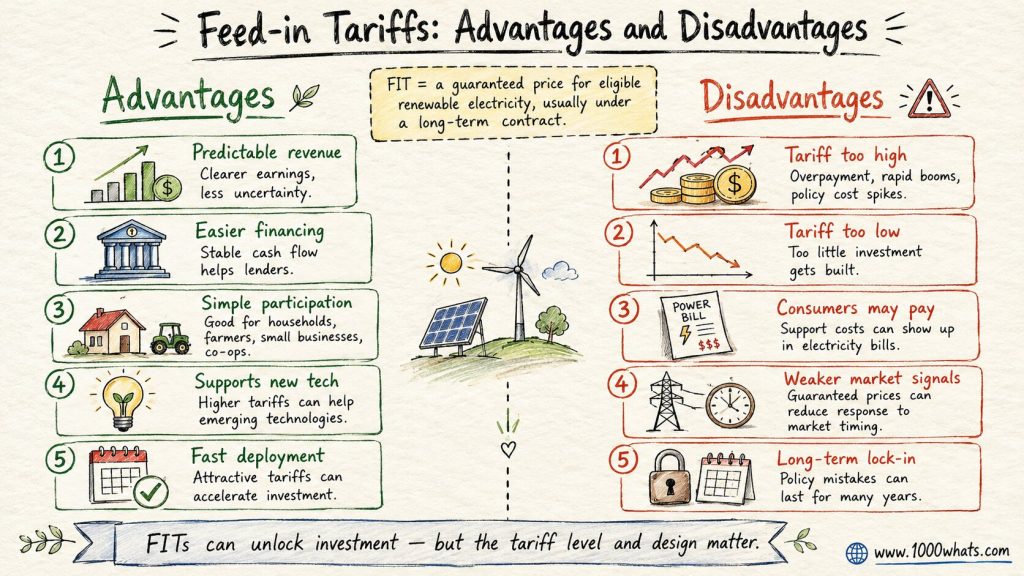
1. Predictable revenue
This is the big one.
Generators know far more about what eligible production will earn.
That can reduce investment uncertainty.
2. Easier project financing
Predictable cash flows can make lenders more comfortable.
And comfortable lenders are generally preferable to lenders who stare at your financial model like it has personally insulted them.
3. Simple participation
Traditional FITs can be relatively straightforward for small generators.
That helped open renewable generation to:
- Households
- Farmers
- Small businesses
- Cooperatives
- Community projects
Renewable generation no longer had to belong exclusively to giant utilities.
4. Technology development
Governments can offer different tariffs to technologies at different stages of maturity.
Emerging technologies can receive stronger support while established technologies receive less.
5. Rapid deployment
If tariffs are attractive enough, investment can move quickly.
Sometimes extremely quickly.
Which leads directly to…
What are the disadvantages of feed-in tariffs?
No energy policy gets to be the hero for an entire article.
1. Governments can set the tariff too high
This is probably the classic FIT problem.
When installation costs fall faster than policymakers adjust tariffs, investors can receive returns far above what was necessary to stimulate deployment.
Congratulations.
You have accidentally created the world’s most environmentally friendly money printer.
2. Governments can set the tariff too low
Then almost nobody builds.
Also awkward.
3. Consumers may carry the cost
Depending on the funding structure, support costs can ultimately be reflected in electricity bills.
4. FITs can weaken market signals
A generator receiving guaranteed remuneration may have less incentive to respond to wholesale electricity prices.
That matters more as renewable penetration grows.
Solar and wind are intermittent renewable energy sources, meaning their production depends on weather rather than electricity demand.
At low penetration, this is manageable.
At very high penetration, when electricity is generated becomes almost as important as how much is generated.
5. Long-term contracts create long-term commitments
Twenty years is a very long time.
Just ask anyone looking at their hairstyle from 2006.
Policy mistakes can live much longer than the government that made them.
Why are feed-in tariffs becoming less dominant?
Here comes the plot twist.
Renewables grew up.
Solar and wind are no longer strange experimental technologies sitting in the corner of the energy system asking whether they’re allowed to play.
In many markets, developers now compete aggressively to build them.
Technology risks have fallen.
Supply chains matured.
Financing became familiar.
Costs declined dramatically.
And governments started asking an obvious question:
“If ten developers want to build this project, why should we decide the tariff ourselves?”
Why not make them compete?
And that is exactly what has happened.
According to the IEA’s Renewables 2025 outlook, competitive auctions are expected to account for almost 60% of global utility-scale renewable capacity additions between 2025 and 2030.
FITs and feed-in premiums account for a much smaller share of expected growth.
That is a major shift.
Instead of:
Government decides price → developers build
we increasingly see:
Government decides quantity/rules → developers compete on price
From a market perspective, that is renewable energy graduating from nursery school.
Does that mean feed-in tariffs failed?
Quite the opposite.
This is one of the strangest things about successful energy policy:
Sometimes success eventually makes the original policy unnecessary.
Feed-in tariffs were designed partly because renewable technologies faced barriers involving cost, financing, investment confidence, and market access.
If those barriers shrink, keeping exactly the same support forever would make little sense.
Imagine training wheels that refuse to leave when the cyclist turns 35.
At some point, Kevin has to ride the bike.
⚡ “The ultimate success of an energy incentive may be reaching the day when the technology no longer needs it.”
FITs helped create markets.
Those markets grew.
Then the support mechanisms began changing.
That is not failure.
That is policy evolution.
Do feed-in tariffs still matter today?
Absolutely.
Just not everywhere and not for everything.
A mature utility-scale solar market with dozens of experienced developers may be perfectly capable of using auctions, corporate PPAs, merchant exposure, or CfDs.
A small distributed renewable market may be a different story.
FITs can still make sense where policymakers want to:
- Encourage rooftop solar
- Support small renewable generators
- Accelerate an immature technology
- Attract investment into a developing market
- Reduce financing risk
- Encourage community-owned generation
- Support technologies that cannot yet compete commercially
The key question is no longer:
“Are FITs good?”
It is:
“For which technology, in which market, at what price, and for how long?”
That is a much better energy-policy question.
So, is a feed-in tariff a subsidy?
Here comes the word that can turn a calm energy discussion into political cage fighting.
Subsidy.
Feed-in tariffs are commonly treated as renewable energy support mechanisms because they provide economic remuneration under policy-defined rules.
The IEA classifies them as performance-based payment policies.
And “performance-based” matters.
FITs generally don’t say:
“You installed a wind turbine. Congratulations. Here’s a sack of money.”
They say:
“Generate eligible electricity, and payment follows the output.”
No output?
No corresponding output-based tariff payment.
That makes FITs fundamentally different from an upfront capital grant.
Both can support renewables.
They simply attack the economics from different directions.
Final thoughts
Feed-in tariffs look almost laughably simple.
Generate renewable electricity. Receive a predetermined level of remuneration.
But hidden inside that mechanism is one of the most powerful ideas in energy economics:
Change the risk, and you change the investment.
FITs helped renewable energy grow because they attacked one of infrastructure investment’s biggest enemies:
uncertain revenue.
They gave developers visibility.
They gave lenders confidence.
They gave households a reason to put generation on their roofs.
And they gave emerging renewable industries somewhere to start.
But markets evolve.
As technologies mature, costs fall, competition increases, and grids become more renewable-heavy, fixed tariffs can give way to feed-in premiums, auctions, PPAs, CfDs, and merchant-market exposure.
That doesn’t make the feed-in tariff obsolete.
It makes it part of a much bigger story.
The smartest renewable incentive isn’t the one that pays the most.
It’s the one that provides just enough support to change investment behavior—without hanging around long after the market has learned to stand on its own.
And that raises the fun question:
Which energy technology needs that push next?
Long-duration storage?
Green hydrogen?
Advanced geothermal?
Floating offshore wind?
Something still hiding in a laboratory?
Drop me a line with the next energy-market rabbit hole you want 1000whats to disappear into.
Until next time, stay curious! 😎
Discover more from 1000whats
Subscribe to get the latest posts sent to your email.