
Picture an aspiring action star choosing a stage name.
He wants something that sounds tough. Something with weight. Something that belongs on a movie poster between an explosion and a suspiciously expensive sports car.
Now imagine he starts borrowing names from the energy world.
Max Coal? A bit strong, but it sounds like someone whose side hustle is making artisanal horseshoes.
Johnny Uranium? Plenty of energy, sure—but it sounds less like an action hero and more like a walking science experiment.
Jack Solar? Clean. Modern. Optimistic. But perhaps a little too wholesome for someone who regularly walks away from explosions without looking back.
And then there’s diesel.
Diesel hits differently.
It sounds smoky, tough, mechanical, and unapologetically raw. Just saying the word conjures the clanging of pistons, the rumble of a truck engine, and the smell of grease in a workshop at six in the morning.
That reputation didn’t come from marketing.
Diesel earned it.
For more than a century, diesel has powered the machines that do the jobs nobody wants interrupted: trucks crossing continents, tractors working fields, excavators moving mountains of dirt, ships carrying global trade, and generators waking up when the grid goes dark.
Diesel became the workhorse of the modern economy because it packs a lot of energy into a small space—and diesel engines are very good at turning that energy into relentless mechanical work.
But there’s a catch.
The same fuel that became synonymous with durability and efficiency also became synonymous with soot, nitrogen oxides, carbon emissions, and our stubborn dependence on oil.
⚡ “Diesel built its reputation by refusing to quit. The energy transition is now asking whether we can afford to let it keep going.”
And that makes diesel much more interesting than a liquid you pour into a truck.
It is a story about chemistry, engineering, economics, infrastructure—and one of the hardest questions in the energy transition:
How do you replace something that works incredibly well when the reason you need to replace it has almost nothing to do with performance?
Welcome to 1000whats.
Let’s open the fuel tank and see what’s really inside.
What is diesel?
Diesel is a liquid fuel designed for use in compression-ignition engines, commonly called diesel engines.
Conventional diesel is produced primarily from crude oil and belongs to the family of petroleum distillates. In other words, it is one of the many useful products refineries pull from that dark geological cocktail we call oil. The U.S. Energy Information Administration classifies it as a distillate fuel used in compression-ignition engines.
That makes diesel both an energy product and a fossil fuel—just like gasoline ultimately traces its energy back to hydrocarbons formed over geological time.
But here’s the distinction that matters:
Diesel is not simply “heavy gasoline.”
Its composition, ignition characteristics, density, volatility, and intended engine cycle are different.
And, critically, diesel engines do not need a spark plug to ignite the fuel.
⚡ “Gasoline waits for a spark. Diesel creates conditions so intense that the fuel ignites itself.”
That single difference explains much of diesel’s personality.
Why does diesel exist?
To understand diesel fuel, you have to start with the engine.
Rudolf Diesel was trying to build a more efficient engine at the end of the 19th century. His concept relied on compressing air so strongly that its temperature rose enough for injected fuel to ignite.
No conventional spark ignition required.
The engine concept therefore came first. The petroleum fuel we now casually call “diesel” evolved around the needs of that engine.
And history contains a lovely twist: Diesel explored the possibility of using vegetable-derived oils as fuel—an idea that feels surprisingly modern today. You can dive into that story in Who Was Rudolf Diesel? A Vision Beyond His Time. The EIA also notes that vegetable seed oil was among the fuels considered in the engine’s early development. EIA
Petroleum eventually won the commercial race.
Why?
Not because nature declared it the perfect fuel.
Because industrial systems did.
Oil production expanded. Refineries scaled. Pipelines, tankers, storage depots, filling stations, engine factories, and global fuel standards grew around petroleum.
From a market perspective, infrastructure can be as powerful as chemistry.
Once billions of dollars of equipment are designed around a fuel, replacing that fuel becomes much harder than inventing an alternative.
What is diesel made of?
Petroleum diesel is not one pure chemical.
It is a mixture of hydrocarbon molecules—mostly compounds made from carbon and hydrogen—selected and processed so they behave properly inside a compression-ignition engine.
That hydrocarbon chemistry is why diesel stores so much energy in such a compact volume.
According to current EIA conversion factors, a gallon of diesel contains about 137,381 Btu, compared with roughly 120,214 Btu for motor gasoline—around 14% more energy per gallon using those figures. EIA
If you want to go deeper into why that matters, see What Is Energy Density? and Energy Units.
This is one reason diesel works so well when the job involves carrying your energy supply onboard.
A battery can be extraordinarily efficient at turning stored electricity into motion. But when a machine must operate for long hours far from charging infrastructure, the ability to pour a large amount of usable energy into a tank within minutes is still a serious competitive advantage.
That is the real diesel moat.
Not nostalgia.
Physics plus infrastructure.
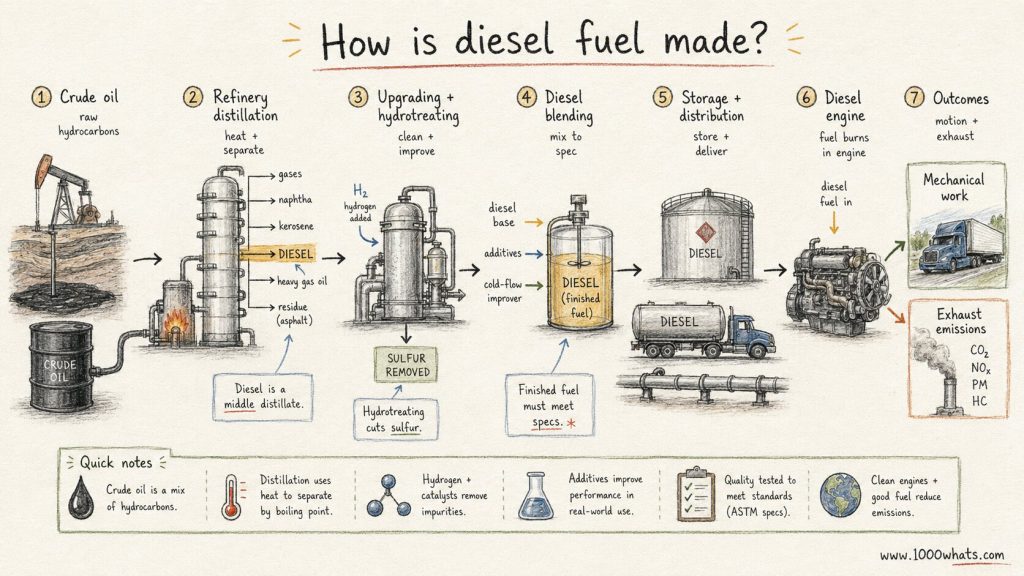
How is diesel fuel made?
A refinery is basically a gigantic molecular sorting machine with commitment issues.
Crude oil arrives containing a chaotic mix of hydrocarbons ranging from light gases to extremely heavy molecules.
The first big step is distillation.
The crude is heated, and different hydrocarbon fractions separate according to their boiling ranges. Diesel sits in the middle-distillate neighborhood, alongside products such as kerosene and jet fuel.
But modern refining does much more than simply “boil and collect.”
Processes such as cracking and hydrocracking break larger molecules into more valuable smaller ones. Hydrogen and catalysts can be used to reshape heavy refinery streams into products including diesel and jet fuel. EIA refining overview and EIA hydrocracking explainer explain the process in more detail.
Then comes cleanup and finishing.
Sulfur must be reduced. Fuel characteristics are adjusted. Additives may improve cold-weather behavior, storage stability, cleanliness, lubricity, or ignition quality.
The result is no longer “crude oil.”
It is an engineered commercial fuel.
That single diagram would explain the entire diesel lifecycle faster than three pages of refinery jargon.
How does a diesel engine work?
Here is where diesel earns its name.
A gasoline engine normally draws in an air-fuel mixture and ignites it with a spark.
A diesel engine takes another route.
It first draws in air. The piston compresses that air dramatically. Compression raises its temperature. Fuel is then sprayed into the hot compressed air, where it ignites and rapidly expands, pushing the piston down.
The U.S. Department of Energy describes precisely this compression-ignition principle in its Internal Combustion Engine Basics.
So when somebody tells you, “Diesel engines don’t have spark plugs,” that is not an engineering omission.
It is the whole point.
⚡ “A diesel engine does not ask a spark to start the fire. It builds enough pressure for chemistry to take over.”
And this leads us to one of diesel fuel’s less famous numbers.
What is cetane number?
Gasoline people talk about octane.
Diesel people talk about cetane.
Cetane number measures the ignition quality of diesel fuel—essentially how readily it begins burning under compression-ignition conditions.
Higher cetane generally means shorter ignition delay and smoother ignition behavior.
The U.S. Department of Energy’s Alternative Fuels Data Center lists typical diesel cetane values and other fuel characteristics in its fuel properties comparison.
What most people don’t see is that commercial diesel is therefore not just “something flammable.”
It has to ignite at the right moment, in the right way, repeatedly, millions of times.
That is why fuel standards and additives matter.
Why are diesel engines so good at heavy work?
People often say, “Diesel makes more torque.”
That is directionally useful—but technically lazy.
Fuel does not contain bottled torque.
Torque comes from the engine system.
Diesel engine architecture, high compression, combustion strategy, turbocharging, gearing, displacement, and operating speed all contribute to the strong low-rpm pulling characteristics associated with diesel machinery.
In practice, the package works extremely well for long-duration, high-load applications.
Think less sports car at a traffic light.
Think tractor dragging an implement through wet soil for ten hours.
Think excavator moving earth all day.
Think truck climbing a mountain with freight behind it.
That distinction matters.
Diesel did not dominate heavy-duty work because it was fashionable. It dominated because the machine-fuel combination fit the duty cycle extremely well.
Where is diesel used?
Follow almost any physical product through the economy and there is a decent chance diesel appears somewhere in its journey.
The wheat may be harvested by diesel machinery. A truck may take it to processing. Another truck moves the finished product to a distribution center. Diesel-powered equipment may work at construction sites, mines, ports, farms, and remote facilities.
That is why the EIA describes diesel as deeply embedded in trucks, trains, boats, agricultural machinery, and construction equipment. EIA
And this is what makes the diesel debate more complicated than “replace old cars with electric cars.”
Passenger vehicles are only one chapter.
The harder question is what replaces diesel when the machine has to work all day, carry its own energy, operate far from infrastructure, and earn money every hour it is running.
Diesel vs. gasoline: What is the real difference?
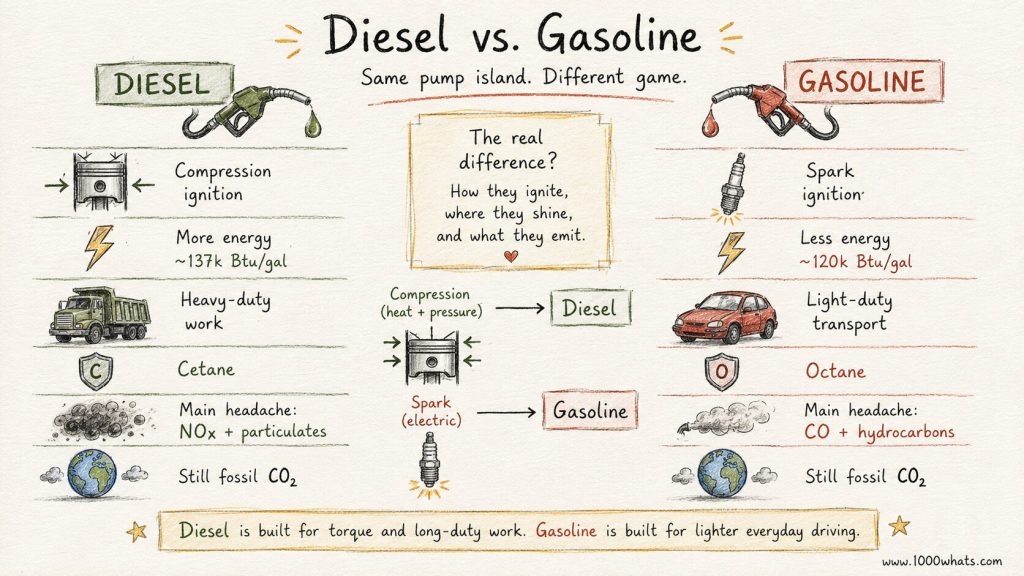
The two fuels often sit beside each other at the pump, but they play very different games.
| Feature | Diesel | Gasoline |
|---|---|---|
| Typical ignition | Compression ignition | Spark ignition |
| EIA energy content | ~137,381 Btu/gal | ~120,214 Btu/gal |
| Traditional sweet spot | Heavy-duty, long-duty-cycle work | Light-duty passenger transport |
| Key fuel-quality concept | Cetane | Octane |
| Historic emissions headache | NOx and particulate matter | CO, hydrocarbons and other combustion pollutants |
| Climate issue | Fossil CO₂ | Fossil CO₂ |
Energy-content values are from the EIA. Actual vehicle efficiency and emissions depend heavily on engine design, duty cycle, fuel specification, and emissions-control technology.
So asking “Which fuel is better?” without specifying the job is almost meaningless.
Better for what?
That is the energy question people forget to ask.
What are the advantages and disadvantages of diesel?
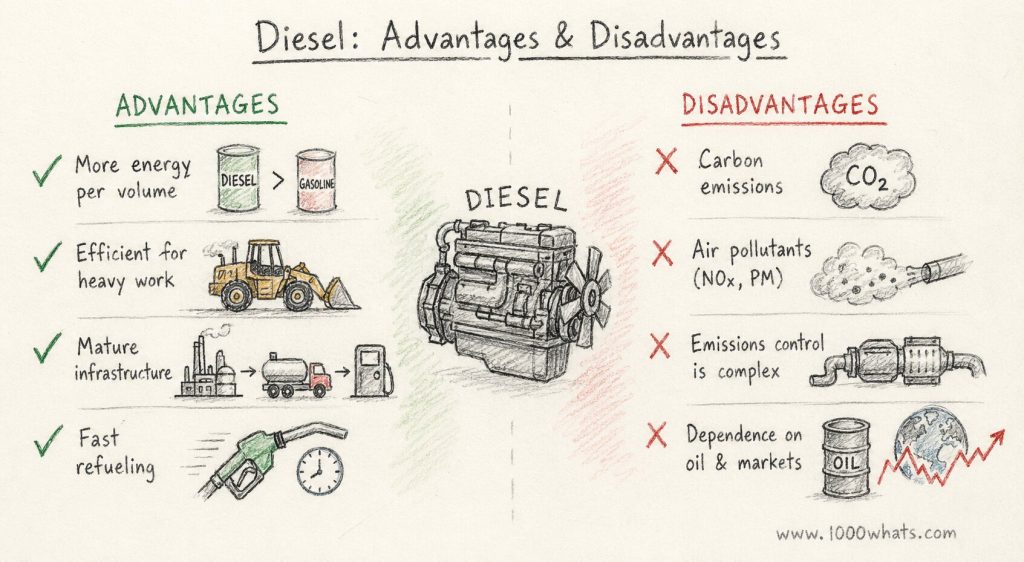
Diesel survived this long because its strengths are real. Its problems are real too.
- Pro — High volumetric energy density: More energy can be carried in a given fuel volume than with gasoline using EIA heat-content values.
- Pro — Heavy-duty efficiency: Compression-ignition engines are well suited to sustained, high-load operation.
- Pro — Mature infrastructure: Fuel production, storage, distribution, repair, and refueling networks already exist almost everywhere industrial activity happens.
- Pro — Fast refueling: Heavy machinery can take on substantial energy quickly and return to work.
- Con — Carbon emissions: Burning petroleum diesel converts fossil carbon into CO₂.
- Con — Air pollutants: Diesel exhaust has historically been a major source of nitrogen oxides and particulate matter, although modern fuel and emissions standards have reduced these pollutants significantly.
- Con — Emissions-control complexity: Cleaner modern diesel systems depend on sophisticated exhaust treatment and careful maintenance.
- Con — Oil dependence: Diesel economics remain tied to petroleum supply chains, refining capacity, geopolitics, and commodity prices.
And that final point is underrated.
Diesel is not only an engineering choice.
It is also an energy-security choice, a trade choice, and sometimes a geopolitical choice.
That connects directly with the broader questions explored in Energy Regulation.
How polluting is diesel?
This is where the romance ends.
Burning fossil diesel releases carbon dioxide because carbon is literally part of the fuel.
The EIA estimates roughly 10.19 kilograms of CO₂ are produced from burning one U.S. gallon of diesel fuel. EIA carbon factors
Then there are local air pollutants.
Diesel exhaust has long been associated with nitrogen oxides (NOx) and particulate matter (PM), pollutants linked to environmental and human-health impacts. The U.S. Environmental Protection Agency provides a detailed overview.
Regulation has made a huge difference.
In the United States, ultra-low-sulfur diesel standards reduced highway diesel sulfur content to a maximum of 15 parts per million, enabling much more effective emissions-control systems. EPA diesel fuel standards
Modern diesel is therefore dramatically cleaner at the exhaust pipe than the soot-belching stereotype from decades ago.
But here is the distinction that matters:
Cleaner exhaust does not make fossil carbon disappear.
A particulate filter can catch particles.
It cannot turn fossil diesel into a zero-carbon fuel.
For the larger climate picture, see What Is a Carbon Footprint? and What Is Decarbonization?.
⚡ “Clean diesel can mean much cleaner exhaust. It does not mean carbon-free diesel.”
What is biodiesel—and is it really diesel?
This is where the naming gets messy.
Biodiesel is a renewable fuel made from materials such as vegetable oils, animal fats, and recycled cooking grease. It can be blended with petroleum diesel and used in compatible diesel engines. The U.S. Department of Energy has a good overview at Biodiesel Basics.
Then there is renewable diesel.
Despite the similar branding, it is not the same product as biodiesel. Renewable diesel is processed so that its hydrocarbon chemistry closely resembles petroleum diesel, allowing it to function as a drop-in replacement in many applications. DOE Alternative Fuels Data Center
That distinction will matter more as transport decarbonizes.
Electricity may dominate some uses.
Biofuels may work better in others.
Renewable diesel may extend the life of existing engines and infrastructure where replacing an entire fleet is economically painful.
And some applications may require technologies we have barely commercialized yet.
That is what an energy transition actually looks like.
Not one magic technology.
A brutal sorting process.
So what was the first production diesel passenger car?
Remember the question from the beginning?
The production milestone belongs to Mercedes-Benz.
The Mercedes-Benz 260 D, presented in 1936, is recognized by Mercedes-Benz’s historical archive as the world’s first series-produced diesel passenger car. Mercedes-Benz Public Archive
That was a turning point.
Diesel had already proven itself in industrial machinery and commercial applications. Putting it into a production passenger car helped push the technology into everyday mobility.
For decades afterward—particularly in Europe—the diesel passenger car would become a major part of the automotive landscape.
Then history turned again.
Does diesel have a future?
Yes.
But probably not the future it had before.
Electrification is already cutting oil demand in transport. The International Energy Agency estimated in its Global EV Outlook 2026 that the global electric-vehicle fleet displaced around 1.7 million barrels per day of oil demand in 2025, with substantially greater displacement expected over the coming decade. IEA Global EV Outlook 2026
That does not mean somebody flips a switch and diesel disappears.
From a market perspective, diesel’s future is likely to fragment.
Applications that electrify easily will increasingly do so.
Applications where batteries, charging time, infrastructure, utilization, range, weight, or remote operation remain difficult will fight much harder to keep liquid fuels.
Meanwhile, those fuels themselves may change.
Petroleum diesel can lose market share while renewable diesel, biodiesel blends, electrification, hydrogen-based systems, and other technologies compete for different pieces of the same market.
That is exactly why net zero, decarbonization, and sustainability cannot be reduced to “ban fossil fuels and buy batteries.”
Energy systems are messier than slogans.
And far more interesting.
Final thoughts
Diesel deserves neither worship nor cartoon-villain treatment.
It became dominant because it was astonishingly good at a particular job: storing a lot of portable energy and turning it into dependable mechanical work.
That helped build modern logistics, agriculture, construction, mining, industry, and global trade.
But the qualities that made petroleum diesel powerful also came with a bill—carbon emissions, air pollution, and deep dependence on fossil-fuel infrastructure.
The next chapter will not be about whether diesel was “good” or “bad.”
It will be about something harder:
Can cleaner technologies beat diesel where diesel is strongest—not just environmentally, but economically and operationally?
Because that is how energy systems really change.
Not when an alternative becomes morally preferable.
When it becomes irresistibly better.
Where do you think diesel will be hardest to replace—long-haul trucking, farms, construction sites, ships, or backup generators? Drop your take in the comments.
Until next time, stay curious! 😎
Discover more from 1000whats
Subscribe to get the latest posts sent to your email.