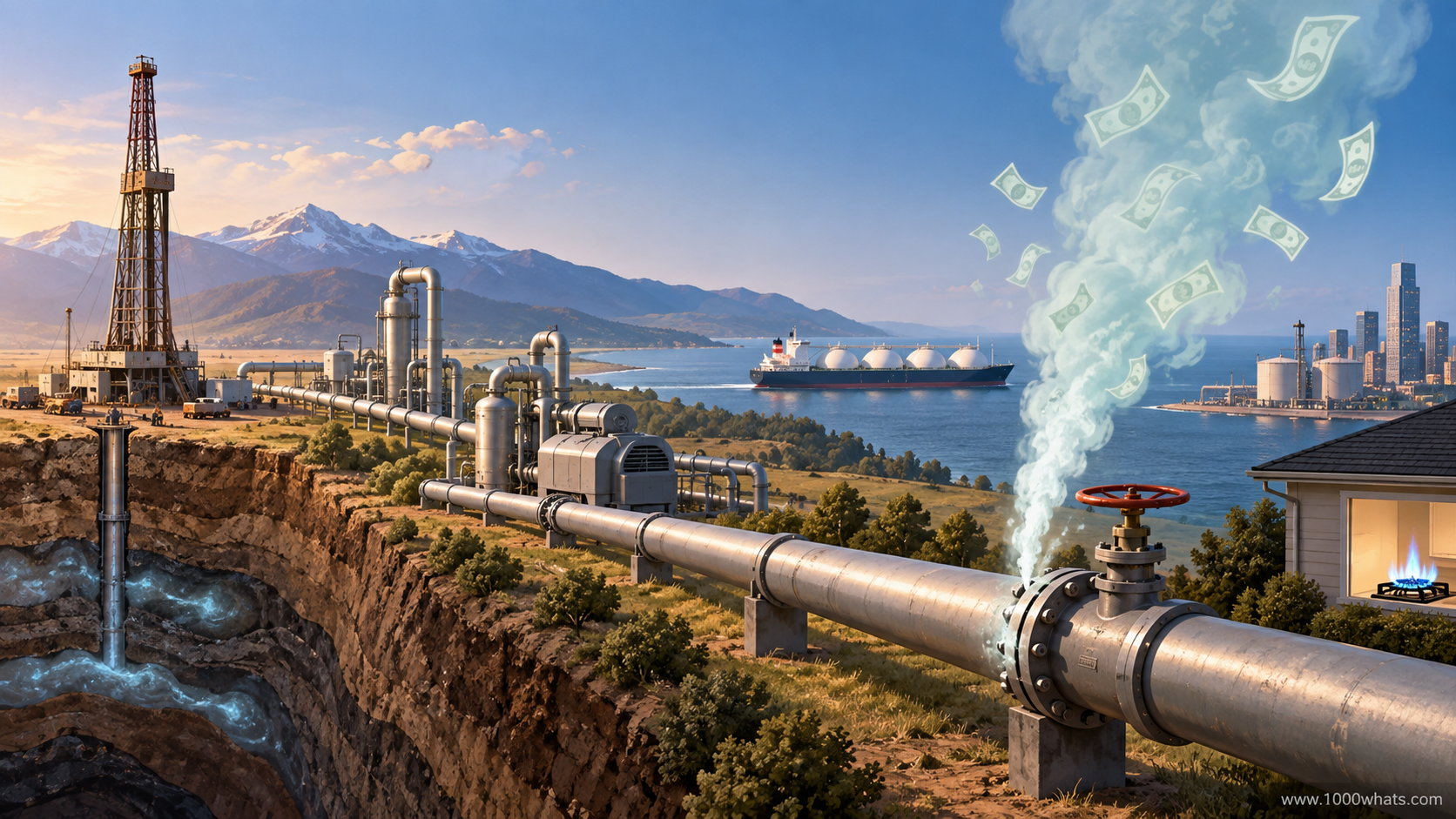
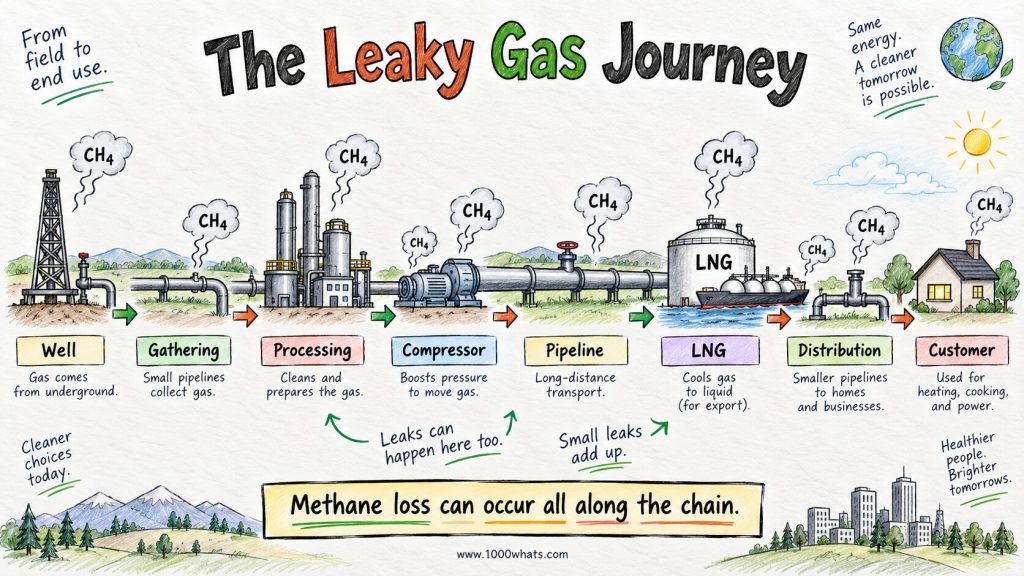
Natural gas companies go to considerable trouble to find gas.
They survey geology.
Drill wells.
Build gathering systems.
Process the gas.
Compress it.
Move it through pipelines.
Sometimes cool it to −162°C, put it on an LNG carrier, sail it across an ocean, warm it back into gas, and send it through another pipeline.
This is an impressive amount of infrastructure devoted to one basic objective:
sell the gas.
Which makes what happens next slightly awkward.
Some of it escapes.
Into the atmosphere.
For free.
Welcome to 1000whats — where today the climate problem and the business problem are, unusually, leaking from the same valve.
That escaped gas is mostly:
methane.
And methane leakage is one of the strangest problems in the fossil-energy system.
Because unlike CO₂ from combustion, methane leakage often represents fuel that created emissions without even producing useful energy first.
⚡ “A methane leak is climate pollution made from a product somebody could have sold.”
First, natural gas is mostly methane
Let’s get the chemistry straight.
Methane is:
CH₄
One carbon atom.
Four hydrogen atoms.
It is the primary component of natural gas.
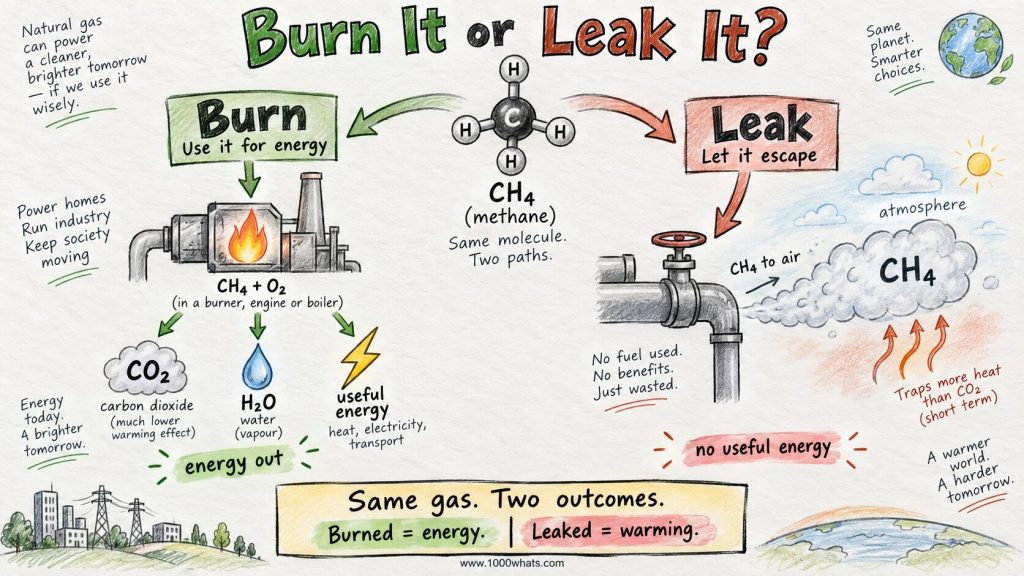
When methane burns properly in oxygen, the simplified reaction is:
CH₄ + 2O₂ → CO₂ + 2H₂O + energy
That final part matters.
Energy.
We burn methane because breaking and rearranging those chemical bonds releases useful energy.
That energy can:
heat a building,
run an industrial furnace,
produce steam,
or drive a gas turbine and generate electricity.
The climate problem after proper combustion is mainly the resulting:
CO₂.
But suppose the methane never reaches the burner.
Suppose it leaks from a valve.
Or escapes during production.
Or gets vented.
Or passes through a flare without fully combusting.
Now the atmosphere receives:
CH₄ directly.
And that creates a different climate problem.
CO₂ and methane are not interchangeable
Carbon dioxide gets most of the attention in climate discussions because humanity emits enormous quantities of it and because it accumulates in the climate system for a very long time.
Methane behaves differently.
It is much shorter-lived.
The IEA’s Global Methane Tracker 2026 describes methane as remaining in the atmosphere for roughly 12 years, compared with the much longer persistence of CO₂.
But while methane is there, it is extremely effective at trapping heat.
UNEP summarizes the comparison this way: over the 20 years after release, methane has roughly 80 times the global-warming potential of CO₂.
That does not mean:
1 tonne methane = 80 tonnes CO₂ forever.
Global-warming potential depends on the time horizon being compared.
But it does mean something very important:
methane is especially powerful in the near term.
Cutting methane can therefore slow warming relatively quickly.
Which makes discovering that we are deliberately extracting methane and then accidentally releasing some of it particularly irritating.
How much warming are we talking about?
A lot.
The IEA estimates atmospheric methane concentrations are now about 2.7 times their pre-industrial level, and methane has been responsible for nearly 30% of the increase in global average temperatures since the Industrial Revolution.
Not all of that comes from energy.
Methane also comes from:
agriculture,
livestock,
rice cultivation,
landfills,
wetlands,
and other natural and human sources.
But the energy sector is enormous.
The IEA’s 2026 assessment estimates fossil-fuel operations emitted about:
124 million tonnes of methane in 2025.
Roughly:
45 Mt from oil
43 Mt from coal
36 Mt from natural gas
And that is before another roughly 20 Mt associated with bioenergy production and consumption.
Methane is not a rounding error hiding behind CO₂.
It is one of the major climate problems.
But where does natural gas actually leak?
Almost everywhere there is equipment.
That sounds flippant.
It is also basically the engineering problem.
An oil and gas system contains:
wells,
valves,
compressors,
seals,
storage tanks,
pneumatic controllers,
gathering lines,
processing facilities,
pipelines,
compressor stations,
LNG facilities,
distribution networks,
and end-use equipment.
Every connection is another opportunity for methane to remain exactly where engineers intended it to be.
Or not.
The IEA estimates around 80% of oil-and-gas methane emissions occur upstream, meaning around production, gathering, and processing.
The remaining share comes farther downstream from transport, storage, LNG operations, distribution, and end use.
So when someone says:
natural gas has methane leakage
do not imagine one mysterious hole in one giant global pipe.
Imagine millions of pieces of equipment.
Most behaving.
Some not.
A leak is not always literally a leak
This terminology gets messy.
Some methane emissions are:
unintentional.
A seal fails.
A valve leaks.
A connector is loose.
A pipeline develops a defect.
These are classic:
fugitive emissions.
But methane can also be released intentionally during normal operations.
That is:
venting.
A tank may vent gas.
Equipment may release gas during maintenance.
A pipeline may need depressurizing.
Certain pneumatic equipment can use pressurized natural gas and release some methane during operation.
Then there is:
flaring.
Flaring means burning unwanted gas rather than releasing it directly.
Ideally:
methane → combustion → CO₂
which is generally much better for climate than releasing methane directly.
But flares are not perfect.
Incomplete combustion can allow some methane to escape.
A flare can malfunction.
Or fail completely.
So the broad phrase methane emissions can include several very different mechanisms.
| Source | What happens? |
|---|---|
| Leak | Methane escapes unintentionally |
| Venting | Methane is intentionally released |
| Flaring | Gas is intentionally burned; incomplete combustion can still release methane |
| Incomplete combustion | Methane passes through combustion equipment unburned |
| Abandoned infrastructure | Old wells or facilities continue leaking after operations stop |
Calling all of this simply:
leakage
is convenient.
Operationally, the distinction matters enormously.
Because you fix a leaking valve differently from a company policy that routinely vents gas.
The wonderfully stupid economics of losing your own product
Imagine you own a bakery.
Every morning you bake 1,000 loaves.
Then you throw 20 out the window.
Not because they are bad.
Not because nobody wants them.
Just because one part of your bakery was designed to throw bread outside.
You would probably investigate.
Natural gas is commercially valuable.
Methane leakage means some of that product never reaches the customer.
The IEA estimates that nearly 100 bcm of natural gas could potentially be made available each year through global efforts to reduce methane emissions from oil and gas operations.
It estimates another roughly 100 bcm could potentially be unlocked by eliminating non-emergency flaring.
To be clear, not every molecule can be economically recovered.
Infrastructure matters.
Location matters.
Gas quality matters.
Markets matter.
But the broad point remains almost comically uncomfortable:
part of methane abatement is simply stopping the energy industry from losing energy.
Climate policy does not always require inventing a fusion reactor.
Sometimes:
tighten the valve
is genuinely on the list.
Some methane fixes can actually save money
This is another reason methane is unusual.
Many decarbonization measures require significant net spending.
Methane abatement can too.
But some measures recover enough saleable gas to offset part—or even all—of the cost.
Examples include:
leak detection and repair,
replacing high-emitting pneumatic devices,
vapor recovery,
compressor maintenance,
capturing gas that would otherwise be vented,
improving flare performance.
The economics depend heavily on gas prices, site conditions, regulations, equipment, and whether the captured gas can reach a market.
But conceptually this is very different from:
spend money purely to destroy an externality.
Sometimes the equation is:
spend money → reduce emissions → recover product → sell product.
That is a much friendlier spreadsheet.
Banks appreciate when morality develops cash flow.
So why haven’t we fixed it already?
Because “just stop the leaks” hides an enormous measurement problem.
You need to know:
where they are.
Oil and gas infrastructure is vast.
Some leaks are tiny.
Some are intermittent.
Some occur in remote locations.
Some appear only during specific operating conditions.
Some inventories rely on engineering estimates and emission factors rather than continuous direct measurement.
And then there are:
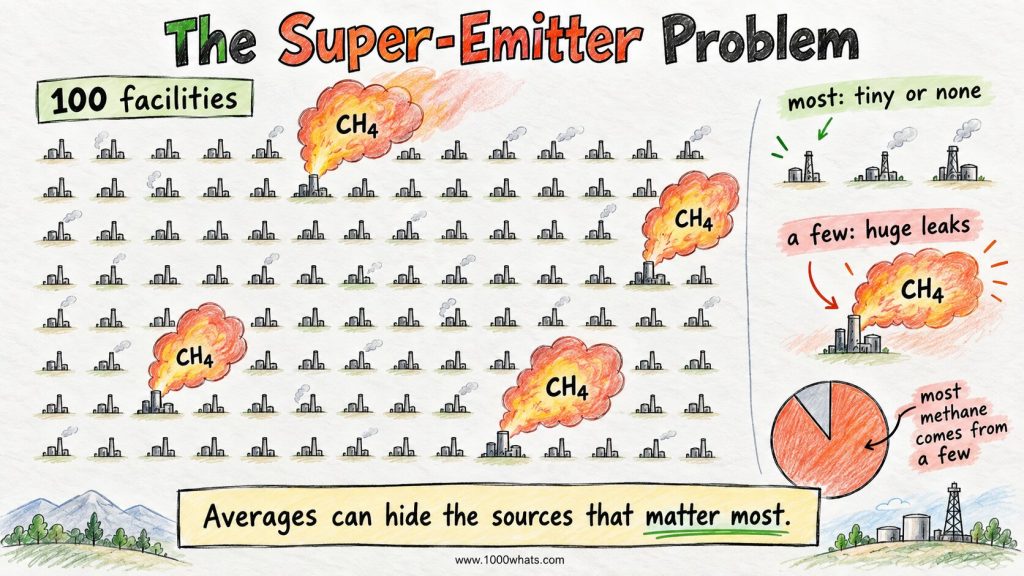
super-emitters.
A relatively small number of sites or events can release enormous amounts of methane.
The IEA cites direct measurement studies in which roughly the top 10% of emitting oil-and-gas sites accounted for around 90% of observed emissions, while no emissions were detected at roughly 55–60% of visited sites.
That distribution is wildly uneven.
Imagine inspecting ten thousand valves.
Most are fine.
Several leak modestly.
Then one facility is basically trying to return the gas field to the atmosphere.
That makes methane measurement unusually important.
⚡ “Methane emissions are not distributed politely. A small number of bad actors can dominate the problem.”
Enter the satellites
This is where methane policy starts looking surprisingly futuristic.
Methane absorbs particular wavelengths of infrared radiation.
That means sufficiently large methane plumes can be detected remotely.
From:
aircraft,
drones,
and increasingly:
satellites.
Yes.
We now have machines orbiting Earth looking for somebody’s leaking gas valve.
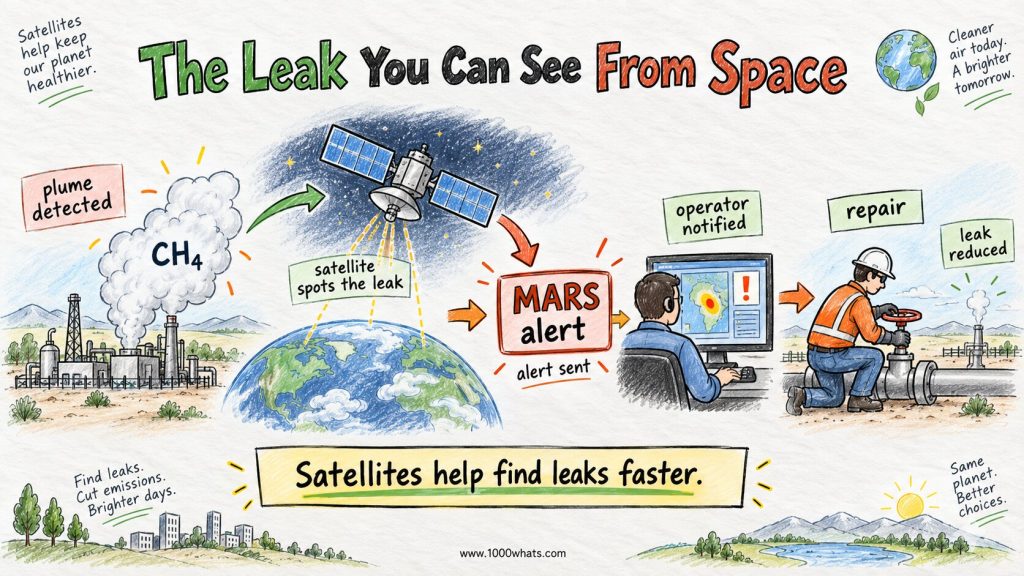
The IEA’s 2026 tracker incorporates satellite observations and discusses large-emission events detected through UNEP’s Methane Alert and Response System, or MARS.
MARS can identify large methane plumes and notify governments and operators.
This changes the old information problem.
A company may estimate emissions from equipment.
A satellite can occasionally reply:
Interesting estimate.
We can see the plume from space.
That is a fairly aggressive audit procedure.
Measurement matters because estimates can be wrong
Traditionally, emissions inventories often worked something like this:
Count equipment.
Assign emission factor.
Multiply.
Add everything together.
That is useful.
But methane does not always cooperate with averages.
Suppose the assumed leak rate for a particular valve type is:
X.
Fine.
Now suppose one valve has failed catastrophically and emits:
100X.
An inventory based purely on average factors may miss the actual event.
Direct measurement can reveal these abnormal sources.
This is why the methane world increasingly talks about:
measurement, reporting, and verification
rather than merely:
estimation.
The distinction sounds bureaucratic.
It is actually physical.
You are moving from:
what should probably be leaking
toward:
what is actually leaking.
Abandoned wells can keep leaking after everybody leaves
Here is another cheerful feature of fossil-energy infrastructure.
Closing the business does not necessarily close the physics.
Old oil and gas wells can continue releasing methane if they are poorly sealed or deteriorate.
The IEA estimates there may be around 8 million abandoned onshore oil and gas wells globally.
It estimates abandoned oil-and-gas wells emitted roughly 3.5 Mt of methane in 2025, although measurement coverage is incomplete and uncertainty remains substantial.
Some properly sealed wells emit little or nothing.
Others can leak for decades.
The IEA even cites a Romanian well drilled in 1909 that was still leaking methane alongside natural seepage more than a century later.
Imagine completing a project in 1909 and discovering that its emissions KPI is still active in 2026.
Infrastructure has an afterlife.
Does methane leakage make natural gas worse than coal?
This is where people usually demand one clean answer.
Unfortunately:
it depends.
For electricity generation, efficient gas plants generally emit much less CO₂ at combustion than coal plants per unit of electricity produced.
But upstream methane leakage worsens the lifecycle climate footprint of natural gas.
How much?
That depends on:
the methane leakage rate,
the plant efficiency,
the coal technology being compared,
the methane global-warming time horizon,
transport distance,
LNG liquefaction and shipping if applicable,
and other lifecycle emissions.
So there is no intellectually serious universal number at which every gas project everywhere suddenly becomes “worse than coal.”
But the underlying relationship is simple:
the more methane leaks, the weaker the climate advantage of switching from coal to gas.
This is particularly important over shorter climate time horizons because methane is such a potent near-term greenhouse gas.
That is why gas-system methane intensity matters.
Not merely:
how much gas did you produce?
But:
how much methane escaped while producing it?
Methane intensity lets us compare producers
Suppose two producers each deliver:
1 billion cubic meters of natural gas.
Producer A releases very little methane.
Producer B has:
leaky equipment,
routine venting,
poor flare performance,
and several large emission events.
The product at the customer may look chemically similar.
The upstream climate footprint does not.
This is where:
methane intensity
becomes useful.
Broadly, it relates methane emissions to the amount of fuel produced or delivered.
The IEA estimates that global average upstream methane intensity from oil and gas has fallen by around 10% since 2019.
Good.
But performance varies enormously.
According to the 2026 Tracker, the best-performing countries can have upstream methane intensities more than 100 times lower than the worst performers.
One hundred times.
Same industry.
Same molecule.
Very different operational performance.
That tells us something important.
High methane emissions are not simply an unavoidable law of natural-gas production.
Operations matter.
This changes the idea of a “cleaner” gas supply
Gas markets traditionally care about:
price,
volume,
delivery point,
heating value,
pressure,
reliability,
contract terms.
Increasingly, another characteristic is entering the conversation:
How much methane was emitted producing this gas?
That starts turning methane performance into a commercial attribute.
Imagine two otherwise comparable gas supplies.
Same energy.
Similar price.
One arrives with a verified low upstream methane intensity.
The other comes from a supply chain with poor measurement and high emissions.
For a buyer with climate obligations, those are no longer necessarily equivalent products.
The methane did not change the calorific value.
It changed the environmental quality of the supply chain.
That is a subtle but potentially important evolution in energy markets.
Europe is already moving in that direction
The EU adopted its first comprehensive regulation aimed at reducing methane emissions from the energy sector in 2024.
Inside the EU, the rules require operators to survey equipment for leaks, repair detected leaks within specified periods, restrict venting and routine flaring, and address emissions from inactive and abandoned infrastructure.
But the really interesting part concerns:
imports.
Europe imports much of its fossil energy.
Reducing methane emissions only at European production sites while importing high-methane gas from elsewhere would be an impressive exercise in moving the spreadsheet problem across the border.
So the regulation phases in requirements for imported fossil fuels as well.
According to the European Commission’s current implementation page, methane-intensity reporting requirements for relevant imported oil, gas, and coal contracts begin in August 2028, followed by methane-intensity requirements from August 2030 for contracts covered by the regulation.
That is potentially significant.
Because methane performance starts moving from:
nice sustainability information
toward:
market-access issue.
LNG makes the methane question longer
Liquefied natural gas adds more steps.
Produce gas.
Process it.
Pipe it to a liquefaction plant.
Liquefy it.
Store it.
Ship it.
Regasify it.
Send it through another pipeline.
Every additional stage introduces:
equipment,
energy consumption,
and potential methane-emission points.
The IEA estimates downstream oil-and-gas operations account for around 20% of sector methane emissions, including transmission, distribution, LNG shipping, storage, and regasification.
This does not mean LNG automatically has catastrophic methane leakage.
It means lifecycle analysis needs to follow the entire chain.
A gas cargo does not acquire its climate footprint only when someone finally burns it.
The story began at the well.
Methane leakage is also an energy-security problem
This is perhaps the most counterintuitive part.
Europe and Asia can spend billions:
building LNG terminals,
signing supply contracts,
chartering ships,
expanding pipelines,
and worrying about whether enough natural gas will be available.
Meanwhile, globally, substantial volumes of gas are simply:
leaking,
vented,
or flared.
The IEA’s 2026 analysis explicitly connects methane reduction with energy security. Against the backdrop of disrupted LNG trade, it estimates that methane-abatement measures could make substantial additional gas volumes available rather than losing them before productive use.
So methane abatement can simultaneously mean:
less warming
and:
more saleable gas.
Energy policy does not always provide such cooperative objectives.
We should probably enjoy this one.
What can actually be done?
Quite a lot.
The technologies are not especially mysterious.
Operators can:
- conduct regular leak detection and repair;
- replace high-emitting equipment;
- improve seals and compressor systems;
- capture vented gas;
- eliminate routine venting where feasible;
- improve flare combustion;
- plug abandoned wells properly;
- use continuous methane sensors;
- deploy drones and aircraft;
- respond to satellite-detected super-emitter events;
- measure emissions directly rather than relying entirely on generic factors.
The challenge is less:
Can humans invent a device capable of stopping methane?
and more:
Can millions of pieces of infrastructure be measured, maintained, regulated, and repaired consistently?
The first problem is engineering.
The second is operations.
Operations usually receives fewer magazine covers.
Why methane reduction can work relatively quickly
CO₂ accumulates.
Even if global CO₂ emissions fell sharply, the CO₂ already emitted would continue affecting the climate for a very long time.
Methane is shorter-lived.
That means reducing methane emissions can reduce the rate of warming on a much shorter timescale.
This does not make methane reduction a substitute for CO₂ reduction.
We need both.
Stopping methane leaks while continuing unlimited fossil-fuel combustion would not solve climate change.
But ignoring methane while focusing exclusively on CO₂ would also leave a powerful near-term lever unused.
Think of the two problems differently:
CO₂ determines much of the long-term climate destination.
Methane strongly affects how quickly we approach it in the near term.
That is why methane has moved so rapidly up the climate-policy agenda.
There is also an air-quality problem
Methane itself is not merely about direct radiative forcing.
Atmospheric methane contributes to the formation of:
ground-level ozone.
That is a harmful air pollutant.
UNEP links methane-driven ozone formation to serious impacts on human health, crops, and ecosystems.
So methane reduction can deliver:
climate benefits,
air-quality benefits,
and—in the fossil-fuel sector—
potentially more usable product.
Again:
unusually cooperative problem.
The most important distinction is upstream vs. combustion
When people debate whether natural gas is “clean,” several completely different questions often get compressed into one word.
Does gas combustion emit less CO₂ than coal combustion?
Often, yes.
Does natural gas combustion produce zero carbon emissions?
No.
Can producing and transporting gas release methane?
Yes.
Can those emissions vary enormously between supply chains?
Also yes.
Can methane leakage materially change lifecycle climate performance?
Absolutely.
So the serious question is not:
Is gas clean?
That is too vague to be useful.
Ask instead:
How efficient is the final combustion?
How much CO₂ does it produce?
How much methane escaped upstream?
Where did the gas come from?
How was it transported?
What fuel or technology is it replacing?
Now we have an energy discussion rather than a bumper sticker.
⚡ “Two cubic meters of natural gas can deliver the same energy to the customer and arrive with very different climate histories.”
That is going to matter increasingly.
So, what is methane leakage in one sentence?
Methane leakage is the unintended—or more broadly uncombusted—release of methane from energy infrastructure before the gas is fully used, including emissions from production equipment, pipelines, compressors, storage, LNG systems, distribution networks, and abandoned wells.
But the better mental model is:
fuel escaping before anyone gets the energy from it.
That captures both sides of the problem.
Climate pollution.
And wasted product.
Final thoughts
The fossil-energy system usually presents climate policy with difficult trade-offs.
Reduce emissions.
Spend money.
Replace equipment.
Build infrastructure.
Change technology.
Manage security of supply.
Negotiate who pays.
Methane leakage is different.
Not easy.
But conceptually almost embarrassingly straightforward.
We extract a valuable fuel from underground.
Then some of it escapes.
The escaped fuel warms the atmosphere strongly.
And nobody gets paid for it.
So we increasingly use:
better valves,
better operating practices,
sensors,
aircraft,
satellites,
regulation,
and occasionally a repair crew with a wrench
to stop that happening.
This will not eliminate the climate impact of natural gas.
Burning the gas still produces CO₂.
But if humanity is going to use natural gas during the energy transition, allowing large quantities of methane to escape before combustion is difficult to defend environmentally or economically.
We drilled for it.
Processed it.
Compressed it.
Transported it.
Sometimes froze it to −162°C and sailed it across an ocean.
Keeping it inside the pipe until somebody actually uses it seems like a reasonable final request.
Until next time, stay curious! 😎
Discover more from 1000whats
Subscribe to get the latest posts sent to your email.