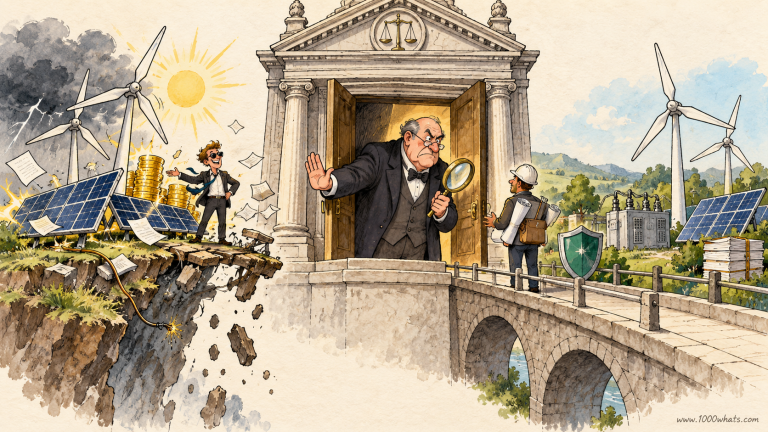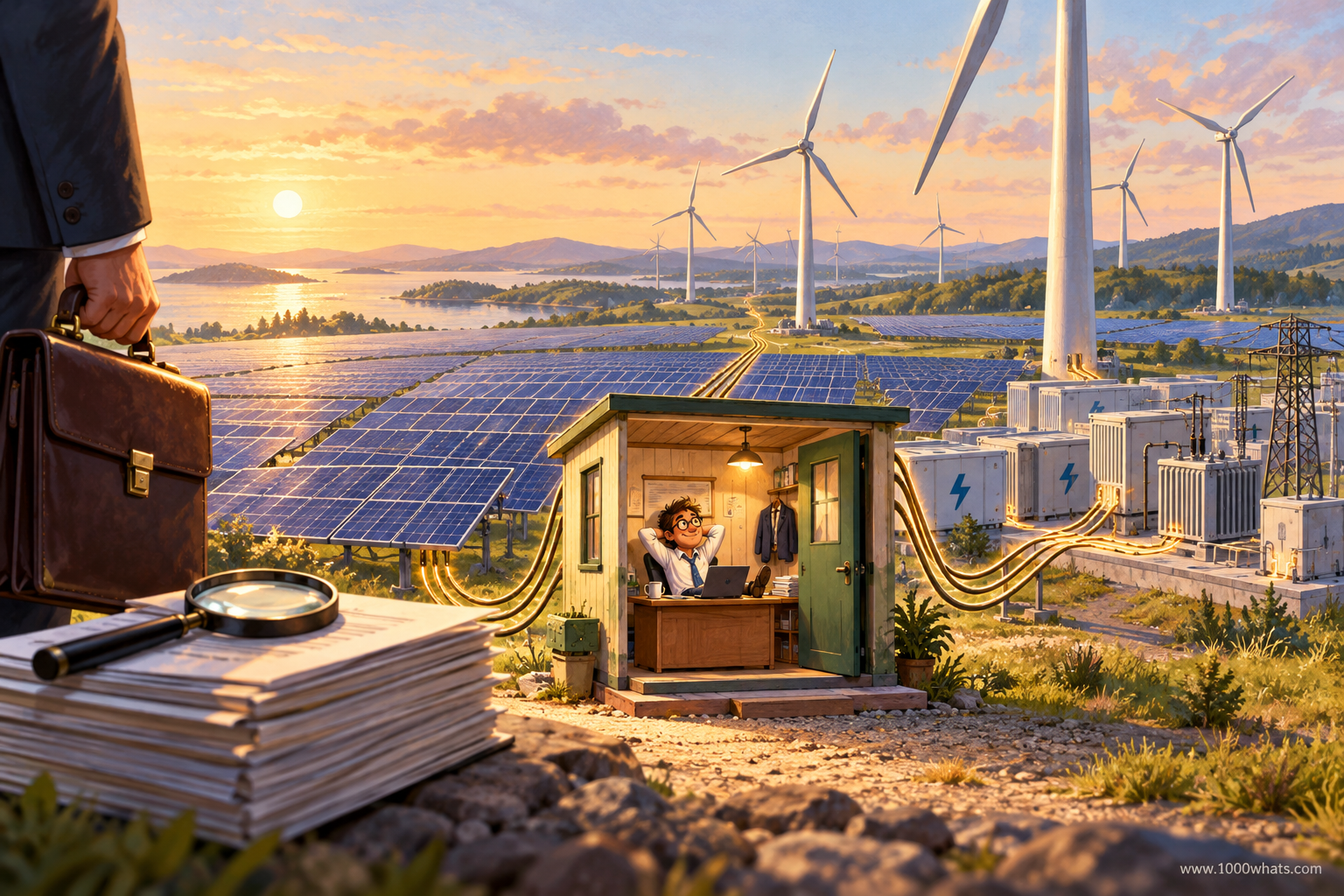
Suppose you want to build a wind farm.
You find a windy hill. Excellent start. Putting it somewhere windless would introduce a certain tension into the business plan.
Then come the turbines, land agreements, permits, cables, construction contracts, insurance, and several people who charge by the hour to explain why you need the other people who charge by the hour.
Eventually, someone asks:
“Who is actually building this thing?”
“We are.”
“Yes. But who is we?”
That sounds like a philosophical question. Unfortunately, it is a banking question, which means the answer needs a registration number.
So you create a company.
You call it Windy Hill Energy Ltd. It has one purpose: this particular wind project. It may have very few employees, no impressive headquarters, and a name nobody spent six months testing with a focus group.
Yet it may own assets worth hundreds of millions.
Welcome to the Special Purpose Vehicle, or SPV.
Despite the name, you cannot drive it. Although, given the legal fees, you might reasonably expect leather seats.
Welcome to 1000whats—where we occasionally open the company paperwork to find out where the power plant is hiding.
What is an SPV in renewable energy?
A Special Purpose Vehicle is a separate legal entity created for a defined purpose.
In renewable energy, that purpose is often to develop, build, own, and operate one project.
You may also hear project company or Special Purpose Entity. Finance has generously supplied several names in case understanding one was becoming too easy.
Imagine a developer planning a 200 MW solar farm. It establishes Sunshine Solar Project LLC.
That company may hold:
- Land leases or other site rights.
- Development rights and permits.
- Solar panels, inverters, and associated equipment.
- Construction and maintenance contracts.
- Grid connection agreements.
- Project bank accounts.
- Electricity sales contracts.
- Project financing obligations.
The developer owns shares in the company. The company owns the equipment or holds the rights needed for the project.
Here is a useful little test.
If the developer owns the SPV, and the SPV owns a transformer, can the developer take the transformer home?
No.
Besides the obvious difficulties with the elevator, a company’s assets are not its shareholder’s personal possessions.
That separation is the starting point of the whole arrangement.
Why create a whole company for one project?
Let’s try doing it the other way.
You own a development business with six solar projects, two wind farms, a battery project, and an office coffee machine that has already outlived three corporate strategies.
You put every contract, loan, expense, and payment into the same legal entity.
Now a bank wants to finance Wind Farm Number Two.
Which assets support its loan?
Which revenue pays it back?
Could money intended for that wind farm end up covering a problem at Solar Project Number Four?
And why is there a payment to someone called “Emergency Drainage Solutions”?
The bank would like answers. Ideally before lending €100 million.
A dedicated project company makes it easier to define what belongs to the project and which obligations sit with it.
This project. These assets. These contracts. This borrower.
You have given everyone a clearly labeled box.
The box does not improve the wind. But it makes the conversation about financing the wind considerably less chaotic.
How does an SPV work in a renewable energy project?
Let’s keep our fictional developer, Big Green Energy, and its new project company, Windy Hill Energy.
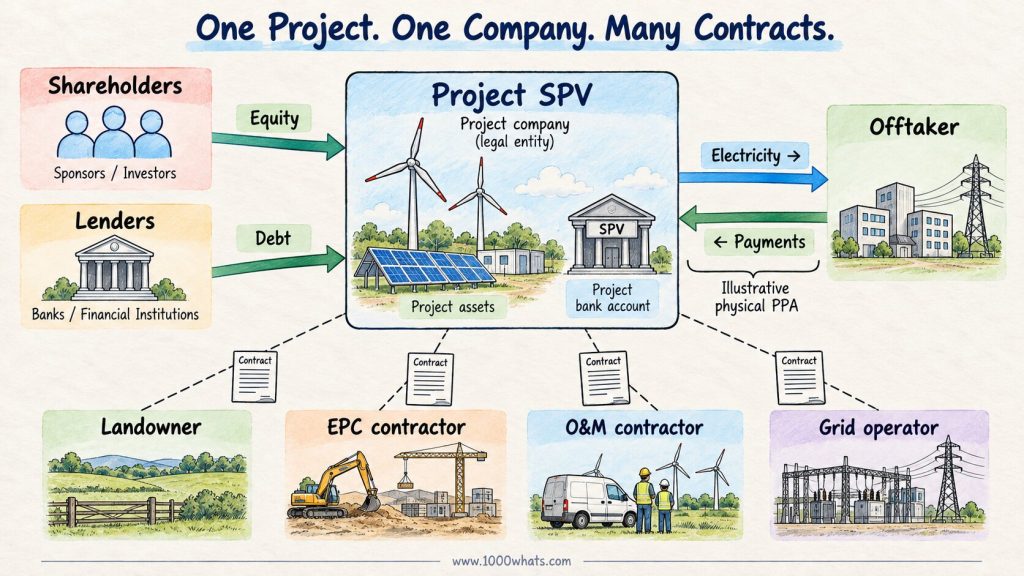
Big Green contributes equity. An investment partner may contribute more. If borrowing is arranged at project level, lenders provide debt to Windy Hill Energy.
The SPV then signs the agreements needed to get the project built and operating.
It secures land rights. It contracts for construction. It arranges maintenance and insurance. It enters into electricity sales arrangements.
Notice something: the SPV does not need to perform every activity itself.
It can own a wind farm without employing the person who climbs the turbine, manufactures the gearbox, or negotiates the insurance renewal.
Your house does not require you to manufacture bricks. Owning infrastructure works on a somewhat larger version of the same principle.
The company brings the necessary rights, services, assets, and obligations together.
| Party | What it typically contributes |
|---|---|
| Shareholders | Equity and ownership decisions |
| Lenders | Debt financing |
| Landowner | Site rights |
| EPC contractor | Engineering, procurement, and construction |
| O&M contractor | Operations and maintenance |
| Grid operator | Connection and relevant network arrangements |
| Offtaker | An arrangement to buy electricity or settle an agreed offtake contract |
| Insurers | Coverage for specified risks |
| Public authorities | Relevant permits and licenses |
The exact structure varies. Some projects use several construction contracts instead of one EPC contract. Some sell through a trader. Some have several investors.
The point is that the relationships have a common legal center.
The SPV is really a contract machine
Look at a solar farm from the highway and you see panels.
Look at it from a lender’s desk and you see contracts.
Same solar farm. Different species observing it.
The engineer asks whether the equipment works.
The lender asks what happens if it does not, who must fix it, who pays while it is broken, and whether that person has any money.
These are excellent questions. They also explain why a renewable energy project can require more documents than a modest international border dispute.
The SPV sits at the center of that contractual network.
Its value is not simply that it contains equipment. It connects the equipment to land rights, construction obligations, operating arrangements, customers, and financing.
A turbine standing in a field is a machine.
A turbine with the rights and agreements needed to operate and earn revenue is part of a business.
Wait—does an SPV automatically mean project finance?
No. This is where two different ideas often get stuffed into the same suitcase.
An SPV is a legal entity. Project finance is a way of financing a project.
You can establish an SPV and fund it entirely with shareholder money.
You can give it a loan backed by the parent company.
Or you can arrange financing that relies primarily on the project’s own assets and future cash flows.
The World Bank describes several such financing structures, including project companies supported by shareholder guarantees. The presence of an SPV alone does not tell you how far lenders can pursue the sponsors for repayment.
Creating an LLC on Tuesday does not make a bank lend you €200 million on Wednesday.
If it did, the energy transition would already be finished, and company-registration websites would be the world’s most important infrastructure.
Why do lenders like a dedicated project company?
Because it helps them ask a specific question:
Will this project generate enough cash to repay this debt?
That is much easier to investigate when the project’s finances are identifiable.
Lenders examine construction costs, expected production, operating expenses, revenue arrangements, and how the project behaves when assumptions become less cheerful.
Consider a wind farm.
The developer says: “We expect strong annual production.”
The lender says: “Wonderful. What happens in a weaker wind year?”
The developer says: “The turbines are highly reliable.”
The lender says: “Lovely. What happens when one breaks?”
This can sound pessimistic. It is simply what happens when someone lends money and would eventually like it back.
Production forecasts such as P50 and P90, financial ratios, reserves, and loan conditions help translate uncertainty into financing decisions. The World Bank’s discussion of project-financed transactions explains the importance of revenue certainty and financial covenants.
The SPV provides the subject for that analysis.
It does not turn a bad project into a good one. A windless wind farm inside a beautifully organized company is still a windless wind farm.
It just has better filing.
For the wider lending logic, read What is a bankable energy project?
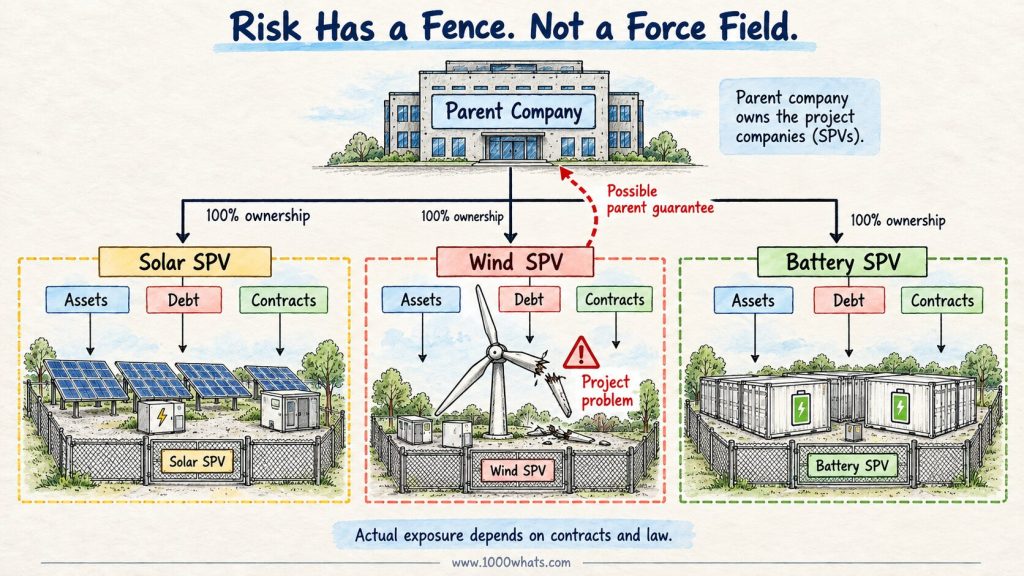
The big idea: ring-fencing risk
Now suppose Big Green owns ten projects, each in a separate SPV.
Project Seven runs into serious trouble.
Construction costs rise. Completion is delayed. Something expensive has arrived at the wrong port.
Separate companies can help keep Project Seven’s obligations distinct from those of the other projects.
This is called ring-fencing.
Under non-recourse project financing, lenders principally rely on the project company’s assets and cash flows. Limited-recourse arrangements permit specified additional claims against sponsors or other support providers, as explained in the World Bank’s project finance overview.
Think of compartments in a ship.
A leak in one compartment should not automatically flood every other compartment.
However, it helps to check whether somebody has installed a large connecting pipe.
In financial terms, that pipe might be a parent guarantee, a completion-support obligation, or another commitment linking the sponsor to the project’s obligations. Lenders often require such support in defined circumstances.
⚡ An SPV is a risk container—not a Harry Potter invisibility cloak for liabilities.
Shareholders can still lose their investment. They may have additional obligations. And even legally contained problems can damage a group’s reputation and future access to financing.
The boundary is useful.
Its strength depends on the law, the contracts, and what people have actually promised.
Does the project disappear from the parent company’s balance sheet?
No.
Putting debt in a subsidiary is not the accounting equivalent of hiding vegetables under your mashed potatoes.
Legal separation and accounting consolidation are different questions.
Under IFRS 10, control is the basis for consolidation, subject to the standard’s requirements and exceptions. A parent may therefore have to include a controlled SPV in its consolidated financial statements.
The company can be legally separate while its assets and liabilities still appear in the group’s consolidated accounts.
The accountant has, regrettably, looked under the mashed potatoes.
SPV vs. parent company: what actually changes?
The two companies perform different jobs.
| Parent company | Project SPV |
|---|---|
| May oversee many projects and activities | Has a defined project or investment purpose |
| Owns shares in project companies | Owns project assets or holds project rights |
| Allocates capital across the wider business | Uses funding for its defined activities |
| May raise corporate-level financing | May borrow directly or receive shareholder funding |
| Has exposure across the portfolio | Holds identifiable project obligations and cash flows |
| May sell its shares in a project company | Can continue operating under new ownership |
This separation is useful for financing, reporting, joint investment, and eventual sale.
It also gives meetings a fighting chance of discussing one project at a time.
No legal structure can guarantee that last benefit.
SPV vs. IPP: are they the same thing?
No.
SPV describes the dedicated legal entity.
IPP commonly means Independent Power Producer. In some contexts, it is also used for Independent Power Project.
A power producer may own several projects through several SPVs. An independent power project may be housed in an SPV.
There is no need to choose between the terms.
Asking whether a project is “an IPP or an SPV” is a little like asking whether your neighbor is “a dentist or a limited company.”
You need to establish which question you are asking before the answer becomes useful.
The project side gets its own explanation in What is an Independent Power Project?
Where does the money go?
Let’s follow the money. It generally attracts more attention than the company registration certificate.
There are two different phases.
Before operation: money builds the project
During development and construction, the SPV needs funding for studies, rights, equipment, contractors, and other project costs.
That funding may come from equity, shareholder loans, bank debt, grants, or other sources.
At this stage, the project is very good at consuming money.
Revenue remains an exciting future concept.
During operation: the project earns money
Once operating, the SPV may receive revenue from electricity sales, contracted payments, certificates, storage services, or other eligible activities.
That revenue must cover its obligations.
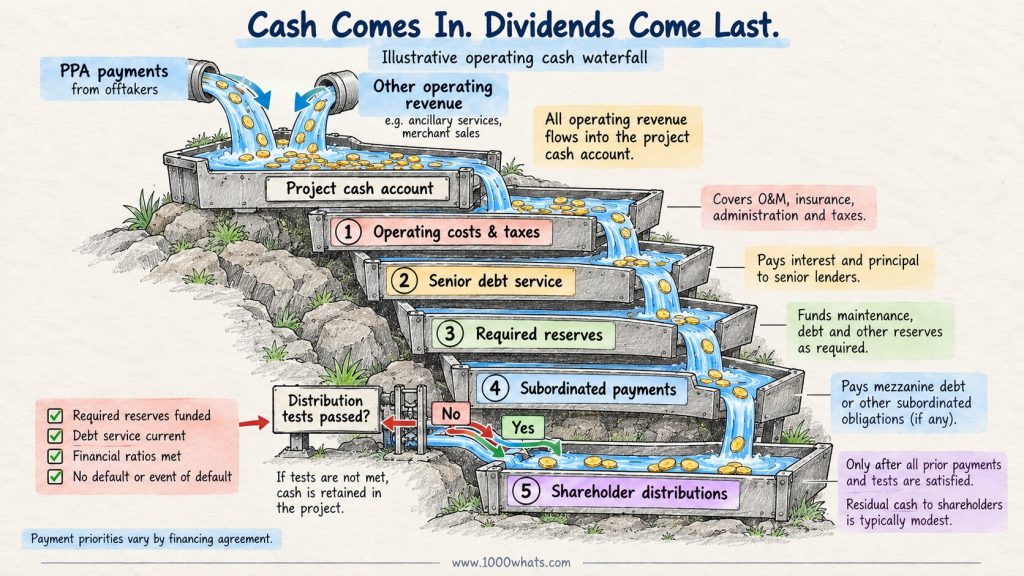
In project finance, the agreed payment priorities are often organized into a cash waterfall.
The name sounds scenic. The experience is mostly bank accounts.
An illustrative sequence is:
| Step | Where the cash goes |
|---|---|
| 1 | Operating expenses and taxes |
| 2 | Scheduled senior debt interest and principal |
| 3 | Required reserve accounts |
| 4 | Permitted subordinated payments |
| 5 | Eligible shareholder distributions |
The actual order depends on the financing documents. Reserve funding and particular payment categories may sit in different positions.
The important point is that shareholders receive money under agreed conditions, after the relevant priorities have been satisfied.
They cannot simply look at the account and announce:
“Good month. We’re buying a yacht.”
There may be cash in the account while distributions are prohibited because a financial test has failed, a reserve needs replenishing, or a default exists.
Cash in the company is not automatically cash available to its owners.
The yacht can wait.
Why does the PPA matter so much to the SPV?
Because electricity production and electricity revenue are related, but they are not the same thing.
A solar farm can generate beautifully.
The bank will still ask who is paying.
A Power Purchase Agreement, or PPA, can give the project greater visibility over its customer, pricing, contract duration, and payment obligations.
That helps lenders model future revenue.
But “we have a PPA” is the beginning of an explanation, not the end.
What volume has been committed?
What happens if production is lower?
Who carries curtailment or delivery risk?
What happens if the buyer does not pay?
Financing parties examine these provisions because the contract’s allocation of risk affects the reliability of cash flow. These issues are explored in Orrick and the Vance Center’s guide to energy-sector project agreements.
Depending on the arrangement, the project may still face production, balancing, profile, or market-price exposure.
A PPA does not instruct the weather to behave.
Nor does every project need one. Some rely on market sales, support mechanisms, or combinations of revenue sources.
The question is whether the expected revenue and retained risks support the financing.
The acronym itself has no magical properties, however confidently it is placed on slide seven.
For the broader idea of securing a buyer for future production, read What is an offtake agreement?
Real-world example: solar and storage in Egypt
The EBRD identifies Nefer Benban for Renewable Energy S.A.E. as the project company for a 200 MW solar plant and a 120 MWh battery energy storage system near Aswan.
Its project disclosure names the SPV as the borrower and identifies its shareholders as Infinity Power Holding, with 51%, and HAU Energy, with 49%. The company was established to develop, construct, and operate the project.
Notice how specific this becomes.
The investment is not merely “money for solar.”
It concerns named shareholders investing through a named company for a defined project.
You can identify the company, its purpose, its ownership, and the assets being developed.
That is considerably more useful to a lender than a photograph of sunshine.
Another example: Gvozd wind farm in Montenegro
Gvozd illustrates a different point.
The EBRD’s project disclosure describes the original financing of up to €82 million as a senior secured corporate loan to EPCG and Green Gvozd LLC, the project SPV, for the approximately 55 MW wind project.
There is an SPV.
There is also corporate financing.
Both can exist in the same transaction without causing a disturbance in the laws of finance.
This is why the company structure alone does not tell you who ultimately carries repayment risk.
For that, you need the loan arrangements.
Yes, the documents again. They do keep turning up.
What are the advantages of an SPV in renewable energy?
Once you understand the structure, the benefits become fairly practical.
Clearer project boundaries. Assets, contracts, obligations, and cash flows can be identified at the project-company level.
Defined investment interests. Investors can own agreed percentages of a particular project company instead of acquiring exposure to the developer’s entire business.
A basis for project-level financing. Lenders can assess a defined borrower and project, subject to the financing structure and any additional support.
More focused reporting. Project revenue, costs, debt, and returns can be tracked together.
A workable route for investment and exit. Investors can acquire or sell shares in the company holding the project.
Portfolio organization. Different projects can have different owners, lenders, contracts, and risk arrangements.
This last point matters as developers grow.
Twenty power plants are not simply one power plant multiplied by twenty. They may sit in different countries, sell under different contracts, and face entirely different problems.
One has excellent wind.
Another has an excellent lawyer.
You would prefer both, but separate project structures at least help you see what you have.
What are the disadvantages?
Every useful structure eventually sends an invoice.
More administration
An SPV needs corporate governance, accounting, tax filings, bank accounts, and the relevant compliance work. Audits and financing reports may add further requirements.
With one company, this is administration.
With thirty, it starts to resemble a small civil service.
Financing costs
Legal work, technical due diligence, financial advice, and negotiation can be expensive.
The World Bank notes that the transaction costs of non-recourse financing can make it less attractive for smaller projects.
A sophisticated financing structure is not automatically an economical one.
You do not hire an air-traffic control team to land a paper airplane.
Joint investors may have different views about dividends, refinancing, further investment, or when to sell.
Everyone agrees that the project should create value.
The discussion becomes livelier when someone asks for whom, how soon, and in cash or PowerPoint?
Limits to risk separation
Guarantees and other commitments can reconnect the project to the wider group.
The SPV also remains exposed to its own business risks.
A separate company does not repair a gearbox.
When is the SPV usually created?
Often relatively early, when the project needs an entity to hold rights and sign agreements.
The exact timing varies by jurisdiction and development strategy. A developer may undertake initial work before establishing the SPV, then transfer relevant rights where permitted.
As development progresses, the company accumulates the agreements required for construction and operation.
Land rights. Permits. Grid arrangements. Equipment contracts. Financing. Offtake.
By financial close, these pieces need to fit together well enough for the funding arrangements to become effective under the agreed conditions.
Think of assembling a machine whose components were designed by engineers, lawyers, bankers, landowners, and public authorities.
Naturally, everyone has brought a different instruction manual.
The SPV is the company around which the assembly happens.
For the full journey, from an interesting patch of land to an operating asset, see the six stages of renewable energy projects.
What happens after construction?
The company usually stays.
“Special purpose” does not mean “temporary until the turbines arrive.”
Once the project reaches Commercial Operation Date, or COD, under the relevant contractual conditions, the SPV moves into the operating phase.
It may then spend decades receiving revenue, paying expenses, servicing debt, maintaining reserves, and making permitted distributions.
This sounds unglamorous.
It is supposed to.
The investor did not finance a wind farm in the hope of receiving exciting emails every morning.
“Everything operated as expected and the payment arrived” is an excellent infrastructure story.
Difficult to turn into a thriller. Very easy to appreciate in a pension portfolio.
Can an SPV be sold?
Yes.
Suppose a developer specializes in finding sites, obtaining permits, arranging financing, and getting projects built.
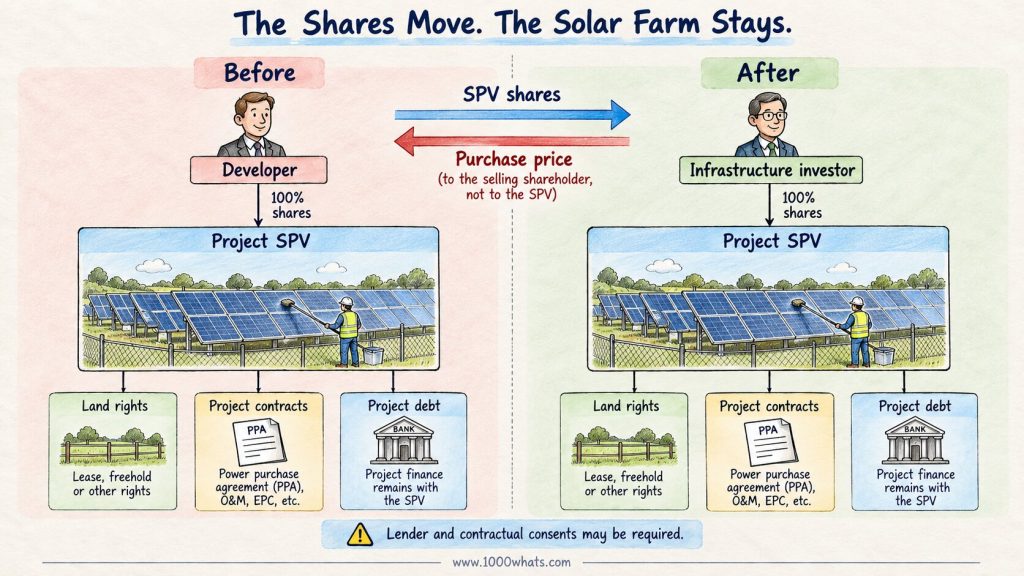
Once a project is operational—or at another agreed stage—it may sell some or all of its shares in the SPV.
The buyer might be a utility, infrastructure fund, or another investor.
In a share sale, the company generally remains the same legal entity. The ownership of that company changes.
The solar panels do not move.
Nobody arrives with a very large shopping bag.
The SPV continues to hold its assets and obligations, subject to the transaction and any required changes. Financing documents, permits, and contracts may require consent or impose conditions when ownership changes.
The buyer must also examine existing liabilities, disputes, and commitments.
You are buying a company with a history, not a freshly washed collection of panels.
Still, selling shares can provide a practical way to transfer ownership of an operating project without separately transferring every asset and agreement.
What risks still matter inside an SPV?
All the ones capable of affecting the project.
| Risk | What it can mean in practice |
|---|---|
| Construction | Delays, cost overruns, or contractor failure |
| Resource | Less wind, sun, or water than expected |
| Technology | Equipment failure or underperformance |
| Offtaker | The buyer fails to meet payment obligations |
| Market | Prices or other commercial conditions move against the project |
| Financing | Interest-rate changes or refinancing difficulties |
| Currency | Revenue and obligations move differently across currencies |
| Grid | Connection delays, outages, or curtailment |
| Regulatory and political | Changes affecting permits, revenues, costs, or operations |
| Environmental and social | Impacts or disputes involving land, communities, or biodiversity |
The company certificate does not make the sun brighter, the buyer richer, or the turbine more cooperative.
What the structure does is help identify where risks sit and how contracts allocate them.
An SPV organizes risk. It does not delete it.
That is a less spectacular promise than “risk eliminated.”
It also has the advantage of being believable.
And because a project operates inside a legal and market framework, understanding energy regulation matters alongside understanding the equipment.
Why do SPVs matter as renewable energy grows?
Because the energy transition is made of individual projects.
Each needs a site, equipment, permissions, capital, revenue, and people willing to accept particular risks.
SPVs provide a repeatable way to organize those ingredients.
A developer can retain one project, bring a partner into another, and sell a third. Lenders can assess specific investments. Buyers can acquire project companies with identifiable assets and obligations.
The projects are not identical.
The structure gives people a familiar starting point for understanding their differences.
We talk about the energy transition in gigawatts.
Someone still has to decide which company signs the land lease.
So, what is an SPV really?
Take a wind turbine.
Give it a site, the necessary rights, a way to connect, people to maintain it, a route to market, and enough financing to get built.
Now ask:
Who owns the equipment?
Who owes the money?
Who signs the contracts?
Who gets paid?
The SPV provides a common legal answer to those questions.
Its shareholders own the company. The company holds the project’s assets, rights, and obligations. Its contracts define how it deals with everyone else.
That is why this rather ordinary corporate invention matters so much.
Nobody drives past a wind farm and says:
“Look at that magnificent allocation of contractual obligations.”
They look at the turbines.
Fair enough. The turbines are doing the spinning.
But somewhere, usually under a deeply forgettable name, sits the company that helped make the whole arrangement possible.
Final thoughts
The funny thing about an SPV is that you can spend an hour discussing it without mentioning how electricity is actually generated.
No magnetic fields. No semiconductor physics. No blades catching the wind.
Just ownership, promises, responsibilities, and money.
Yet without organizing those things, your technically excellent power plant may remain a technically excellent drawing.
Physics tells you whether the turbine can produce electricity.
The commercial structure helps determine whether anyone will pay to put it on the hill.
Both questions need answers.
An SPV gives one project a legal identity and a place for its assets, contracts, obligations, and cash flows to belong. It can help separate risks, organize investment, support financing, and make a future sale more manageable.
It cannot manufacture wind, guarantee profits, or persuade a broken inverter to reconsider its attitude.
But it can make the project understandable to the people whose money and commitments are needed to build it.
Not bad for a company whose registered office might be less impressive than the turbine’s service elevator.
Tiny company.
Giant power plant.
That is the trick.
What surprised you more—the engineering needed to build a power plant, or the small legal universe needed to pay for one? Let me know in the comments.
Until next time, stay curious! 😎
Discover more from 1000whats
Subscribe to get the latest posts sent to your email.