Natural gas has a transportation problem.
Oil?
Pour it into a tanker.
Coal?
Put it on a ship.
Natural gas?
Well.😁
Gas has the deeply inconvenient property of being a gas.
At normal conditions, a useful amount of natural gas occupies an enormous amount of space. Pipelines solve this beautifully when the producer and customer can be connected by pipe.
But what if the gas is in Louisiana and the customer is in Japan?
Or Qatar and the customer is Germany?
Building a pipeline across the Pacific is generally considered excessive even by energy-infrastructure standards.
So engineers came up with another idea:
make the gas smaller.
Much smaller.
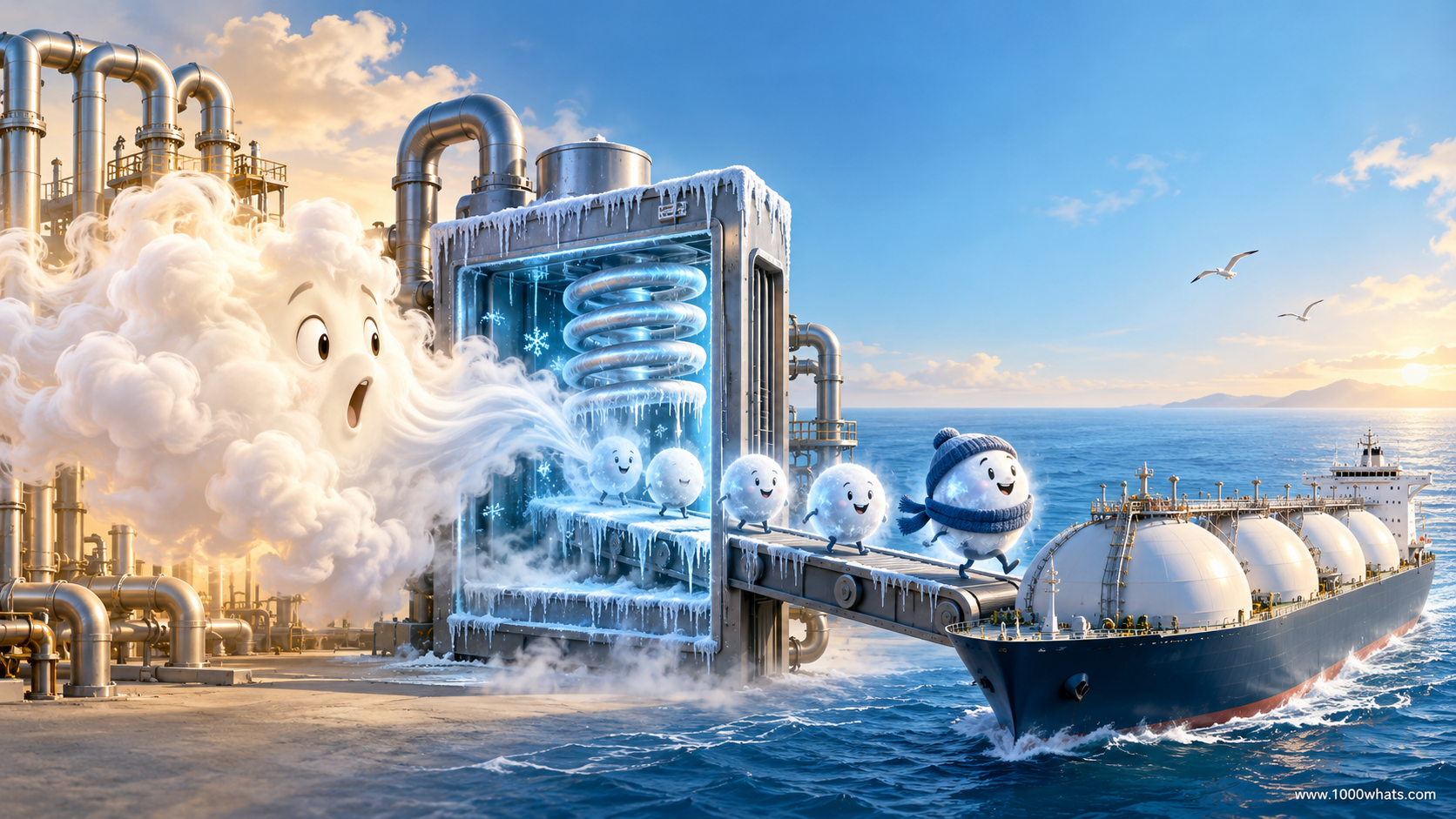
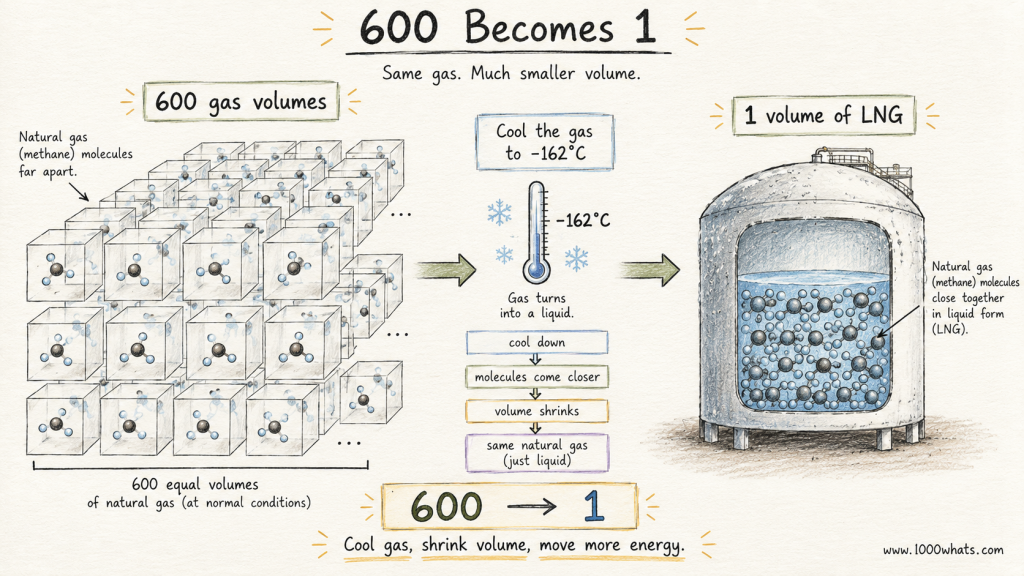
Cool natural gas to around −162°C and it becomes liquid.
Its volume falls by roughly:
600 times.
Now put it into an enormous insulated ship.
Cross the ocean.
Warm it back into gas.
Send it into the pipeline network.
Welcome to 1000whats — where today natural gas discovers international shipping by becoming extremely, extremely cold.
This is liquefied natural gas.
Or:
LNG.
⚡ “LNG does not change what natural gas is. It changes where natural gas can go.”
First, LNG is still natural gas
This distinction sounds embarrassingly obvious.
It is worth making anyway.
LNG is not a different fuel invented in a refinery.
It is mostly the same natural gas—predominantly methane—that would otherwise travel through a pipeline.
The difference is its physical state.
Gas:
natural gas
Liquid:
liquefied natural gas
The U.S. Energy Information Administration’s LNG overview explains the basic trick: natural gas is cooled to about −260°F, or roughly −162°C, where it becomes liquid.
Why bother?
Because the liquid occupies around 1/600th of the volume of natural gas in its gaseous state.
That is the entire reason LNG exists.
Imagine trying to ship gas without liquefying it
Suppose a certain quantity of pipeline gas occupies:
600 cubic meters.
Liquefy it.
Now, conceptually, it occupies roughly:
1 cubic meter.
| Same natural gas | Approximate relative volume |
|---|---|
| Gas | 600 |
| LNG | 1 |
Nothing magical happened to the energy.
The molecules simply packed much closer together.
And suddenly shipping becomes practical.
This is why LNG is fundamentally a logistics technology. 💡
We are not creating natural gas.
We are changing its physical form so civilization can move it somewhere inconvenient.
So how do we make LNG?
Start with natural gas from a gas field or pipeline network.
Before liquefaction, the gas normally needs treatment.
Depending on the source, operators may remove:
water,
carbon dioxide,
hydrogen sulfide,
mercury,
and heavier hydrocarbons.
Why?
Because cooling things to −162°C tends to reveal whether your process stream contains substances that freeze, corrode equipment, or otherwise object to becoming cryogenic.
Then comes the expensive part.
Liquefaction.
Large refrigeration systems progressively cool the gas.
Lower.
Lower.
Lower.
Eventually methane condenses into liquid.
The resulting LNG is stored in heavily insulated cryogenic tanks.
Then the ship arrives.
An LNG plant is basically a gigantic refrigerator
A spectacularly complicated refrigerator, admittedly.
But the principle is familiar.
Your kitchen refrigerator moves heat out of a cold compartment.
An LNG liquefaction plant removes enormous quantities of heat from natural gas until the gas becomes liquid.
That requires energy.
Quite a lot of it.
Compressors.
Heat exchangers.
Refrigeration cycles.
Pumps.
Controls.
Large industrial equipment.
So LNG does not come free simply because the gas itself already exists.
Part of the gas’s economic and energy value is spent making it transportable.
This will matter later when we compare LNG with pipeline gas.
Then comes one of the strangest ships in the energy system
An LNG carrier does not look quite like an oil tanker.
Inside are enormous insulated tanks designed to carry a liquid sitting at roughly:
−162°C.
That is not a normal shipping temperature.
At all.
Modern LNG carriers use specialized containment systems to keep the cargo cold while crossing oceans.
But even excellent insulation cannot completely prevent heat from entering.
A small portion of LNG continuously evaporates.
This is called:
boil-off gas.
Historically, that gas could be used as fuel for the ship’s engines.
Modern vessels can also reliquefy some boil-off or use increasingly sophisticated fuel-management systems.
So an LNG carrier is not simply:
ship + tank.
It is a moving cryogenic energy system.
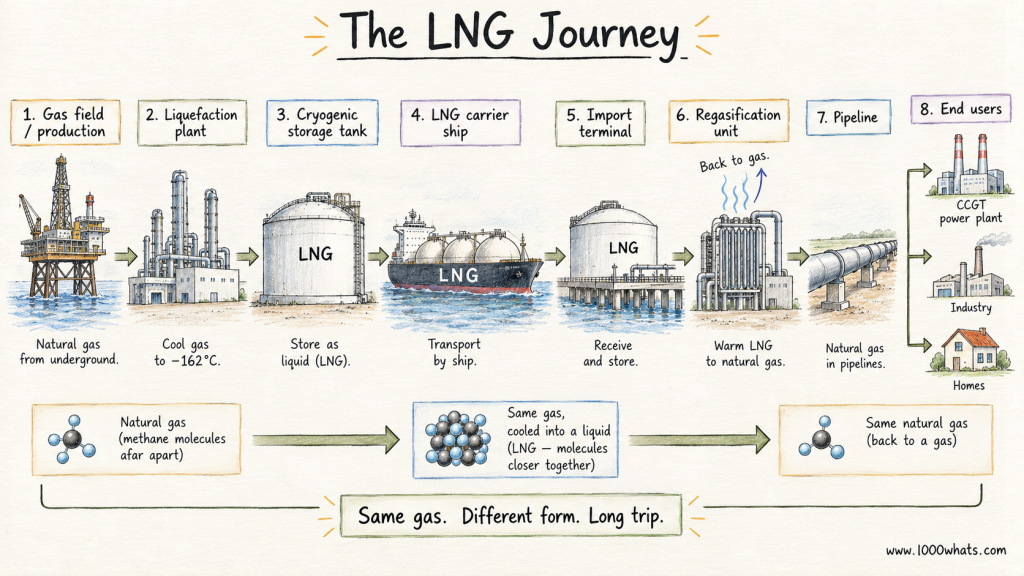
The complete LNG chain
Here is the whole journey.
| Stage | What happens |
|---|---|
| 1. Gas production | Natural gas is produced and processed |
| 2. Liquefaction | Gas is cooled to roughly −162°C |
| 3. Storage | LNG enters cryogenic tanks |
| 4. Shipping | LNG carrier transports it across the ocean |
| 5. Import terminal | Cargo is unloaded into storage |
| 6. Regasification | LNG is warmed back into gas |
| 7. Pipeline delivery | Natural gas enters the domestic network |
| 8. Final use | Power plants, industry, heating and other users consume it |
Notice something slightly ridiculous.
We start with gas.
Turn it into liquid.
Move it.
Then turn it back into gas.
Gas → liquid → ship → gas
Why?
Because the ocean was in the way.
Regasification is the surprisingly simple end
The LNG ship reaches the importing country.
Cargo is unloaded into storage tanks.
Then the LNG needs to become gas again.
That process is called:
regasification.
Essentially, heat is added.
The liquid warms.
It vaporizes.
Natural gas returns.
Then it can enter the normal pipeline system and become almost indistinguishable from gas arriving from another source.
The exotic part ends at the terminal.
After that, it is just gas again.
And this is where natural gas becomes global
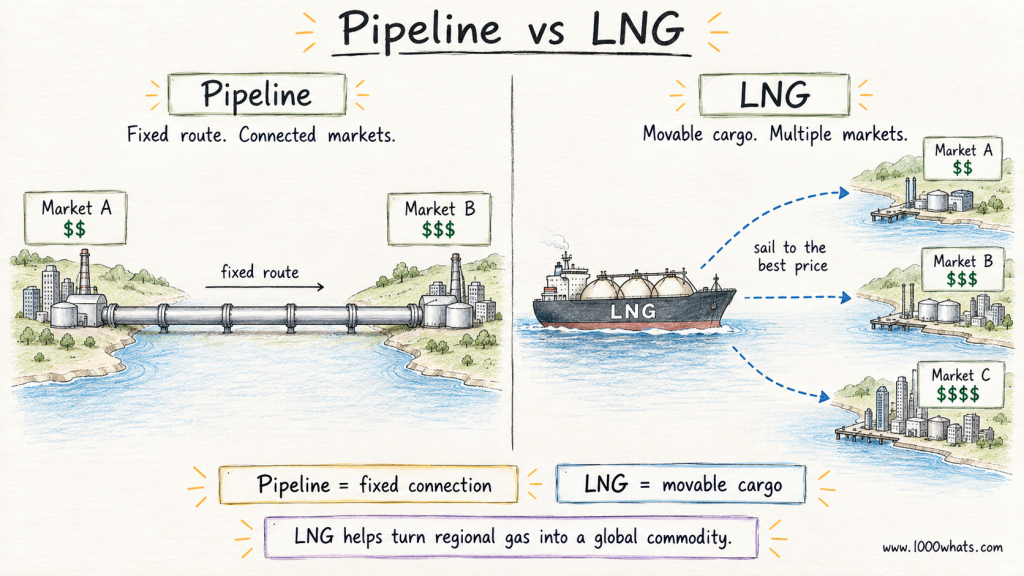
Before LNG, natural gas markets were heavily shaped by geography.
If Country A produced gas and Country B wanted it, they needed:
a pipeline connection.
That creates a fairly intimate relationship.
Pipelines are fixed.
They connect particular places.
Once built, they are exceptionally good at moving huge quantities of gas.
But they cannot suddenly decide:
Actually, prices look better in Korea today.
An LNG cargo can.
That changes everything.
A cargo leaving an export terminal may have a contractual destination.
But depending on contract terms and market conditions, cargoes can sometimes be redirected, resold, or optimized toward another market.
Gas becomes more like oil:
a globally tradable seaborne commodity.
Not completely.
But much more than before.
⚡ “Pipelines connect places. LNG connects markets.”
Pipeline gas vs. LNG
Neither is automatically better.
They solve different logistical problems.
| Pipeline gas | LNG | |
|---|---|---|
| Transport | Fixed pipeline | Ship |
| Geography | Connected markets | Can cross oceans |
| Infrastructure | Pipelines + compressors | Liquefaction + ships + import terminals |
| Energy needed for transport | Generally lower | Higher because liquefaction is energy-intensive |
| Flexibility | Low route flexibility | Higher cargo flexibility |
| Exposure | Pipeline/supplier dependency | Global LNG market and shipping |
| Best fit | Large stable flows between connected regions | Long-distance trade where pipelines are impractical |
If you have a large gas producer next door and an existing pipeline:
pipeline gas can be extremely efficient.
If the producer is:
5,000 kilometers away,
across an ocean,
the ship suddenly starts looking rather attractive.
Europe learned this distinction the expensive way
For decades, much of Europe received large volumes of natural gas from Russia through pipelines.
This made economic sense.
Huge gas reserves.
Large European demand.
Existing infrastructure.
Relatively cheap pipeline transport.
Then geopolitics arrived.
Russia’s full-scale invasion of Ukraine in 2022 radically changed Europe’s gas relationship with Russia.
The EU began reducing Russian gas dependence and replacing part of the lost pipeline supply with gas from elsewhere.
LNG became one of the most important tools.
The European Commission’s REPowerEU framework says Russian gas had supplied about 45% of EU gas imports before the war; that share had fallen to around 12% in 2025.
That transformation would have been vastly harder without LNG.
Why?
Because you cannot build a Qatar-to-Germany pipeline next Tuesday.
But you can receive a ship.
Europe did not merely replace one pipe with another
This distinction matters.
By 2025, according to ACER’s 2026 European LNG market analysis, the EU imported a record:
146 bcm of LNG
through roughly:
1,850 cargoes.
LNG had grown to nearly half of EU gas supply.
And the United States supplied:
58% of EU LNG imports.
That is an astonishing restructuring of an energy system in only a few years.
But it also illustrates something important.
Europe reduced one dependency.
It did not eliminate dependency.
It changed its shape.
LNG creates flexibility—and global competition
Imagine Europe needs additional gas.
An LNG cargo from the United States could potentially sail there.
Good.
Now imagine Japan also needs gas.
And South Korea.
And China.
And India.
The same flexible global market that gives Europe access to more suppliers also means Europe is now competing with buyers thousands of kilometers away.
This became particularly visible in 2025, when the IEA found that the correlation between European TTF and Asian spot LNG prices reached a record 0.955.
In plain English:
the two markets were moving increasingly together.
Why?
Because LNG links them.
If European prices rise sufficiently, cargoes have an incentive to move toward Europe.
If Asian prices rise higher, Asia becomes more attractive.
The ocean has become part of gas-price formation.
A wonderfully simple cargo example
Imagine an LNG producer has one uncommitted cargo.
Potential buyers:
| Market | Willingness to pay |
|---|---|
| Europe | $10/MMBtu |
| Asia | $12/MMBtu |
Ignore shipping differences for a moment.
Where does the cargo want to go?
Asia.
Now suppose cold weather hits Europe.
European price rises:
| Market | Willingness to pay |
|---|---|
| Europe | $15/MMBtu |
| Asia | $12/MMBtu |
The economics may reverse.
The cargo can move toward Europe.
This is simplified—real LNG contracts, shipping costs, destination clauses, terminal slots, boil-off, canal routes, hedging, and portfolio obligations make trading much richer.
But the mechanism is correct.
LNG allows gas to chase value across geography.
From a market perspective, that is its superpower.
And occasionally its curse.
This is why an LNG terminal does not guarantee cheap gas
Countries sometimes celebrate LNG import capacity as though the terminal itself produces natural gas.
It does not.
An import terminal gives you:
access.
You still need:
a cargo,
a seller,
a ship,
available global supply,
and a price you are willing to pay.
That distinction is crucial.
An LNG terminal improves supply optionality.
It does not abolish commodity markets.
A country can have enormous regasification capacity and still face expensive gas if the global LNG market is tight.
Infrastructure gives you the door.
You still have to buy whatever comes through it.
Floating terminals made LNG even more flexible
Building a conventional onshore LNG terminal can take years.
Then there is the wonderfully energy-industry acronym:
FSRU.
Floating Storage and Regasification Unit.
Essentially:
an LNG ship with regasification equipment.
It receives LNG.
Stores it.
Turns it back into gas.
Feeds that gas into the onshore network.
This can allow countries to add LNG import capability much faster than constructing a large conventional terminal from scratch.
Europe deployed additional floating regasification capacity rapidly after 2022 as part of its gas-supply diversification.
It is difficult to imagine a more literal piece of energy security:
a gas terminal that can float.
LNG also changed the economics of gas-fired power plants
Remember my recent CCGT explainer?
A CCGT needs natural gas.
Its marginal generation cost therefore depends heavily on:
gas price.
If the gas comes from a domestic field or stable pipeline contract, one price environment exists.
If the power system relies heavily on globally traded LNG, another may exist.
This matters because gas-fired plants often sit near the marginal part of electricity markets.
When gas becomes expensive:
gas-fired electricity becomes expensive.
When a gas plant sets the market-clearing price:
electricity can become expensive too.
So an LNG cargo arriving at a terminal may eventually influence the electricity price paid by consumers hundreds of kilometers away.
Gas markets and power markets are not separate planets.
They are roommates.
Why does LNG cost more than gas at the wellhead?
Because quite a lot happened between the gas field and your burner.
The value chain can include:
gas production,
processing,
pipeline transport to the liquefaction terminal,
liquefaction,
storage,
shipping,
insurance,
boil-off management,
import terminal fees,
regasification,
and pipeline transport after regasification.
Each step costs money.
Liquefaction also consumes energy.
Shipping takes time.
Ships cost money.
Terminals cost billions.
So LNG economics can be thought of approximately as:
gas price + liquefaction + shipping + regasification + commercial margin
The exact pricing structure varies enormously between contracts.
But the principle is useful.
An LNG price is not merely the price of methane.
It is the price of methane plus making methane travel.
Long-term contract or spot cargo?
Now LNG becomes a trading story.
A buyer can secure LNG through a long-term contract.
That can provide:
volume certainty,
pricing formulas,
supply planning,
and support financing of new liquefaction projects.
Or buyers can purchase cargoes in the spot market.
That offers more flexibility.
But spot prices can become spectacularly unpleasant when everyone wants gas at once.
This creates a classic energy-market trade-off:
security vs. flexibility.
Contract too much long term and you may pay for gas you eventually do not need.
Contract too little and you may discover that the spot market has developed a personality disorder during a cold winter.
There is no universally correct answer.
Portfolio design matters.
Why LNG projects love long contracts
Imagine building a liquefaction terminal costing billions.
You tell the bank:
We will cool natural gas to −162°C, load it onto enormous ships, and sell it somewhere in the world for the next twenty years.
The bank asks:
To whom?
This is where long-term LNG sale and purchase agreements become important.
Future contracted revenue can support financing.
This is conceptually similar to what happens in renewable projects with a bankable project structure.
Different commodity.
Same uncomfortable lender question:
Who pays us back if your optimistic market story stops being optimistic?
Energy infrastructure is extremely diverse.
Banks remain reassuringly repetitive.
What happens when LNG supply gets disrupted?
This is where the global network reveals its downside.
A pipeline disruption affects the markets connected to that pipeline.
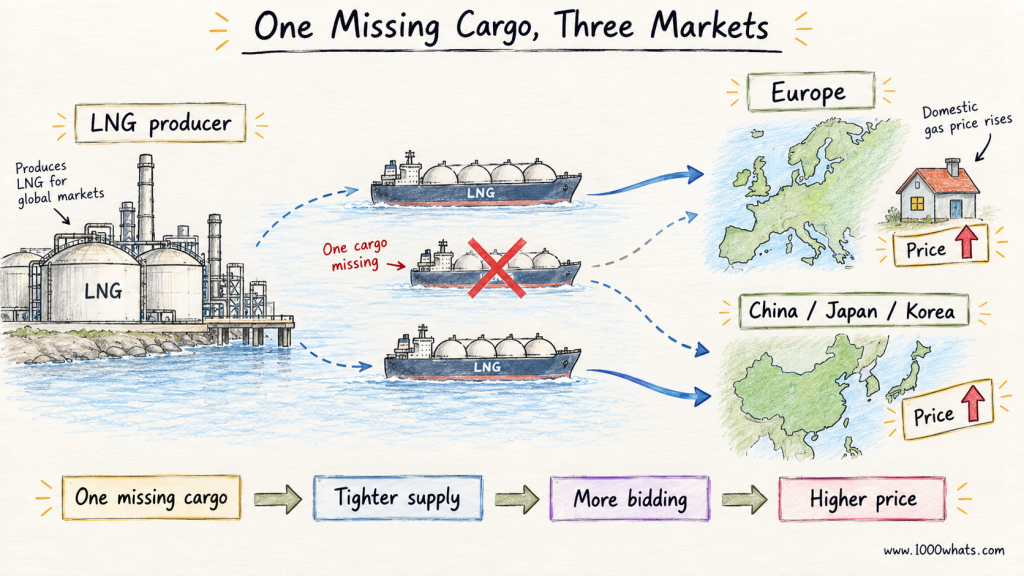
A major LNG disruption can affect:
every market competing for LNG.
The current 2026 Middle East disruption offers an unusually stark example. The IEA reported in April that interruptions to shipping through the Strait of Hormuz removed close to 20% of global LNG supply at one point, pushing European and Asian gas prices to their highest levels since January 2023.
ACER subsequently estimated that the Middle East crisis could affect around 20% of global LNG exports, demonstrating Europe’s continued exposure even though only a relatively small part of its LNG had come directly from Qatar.
That sounds contradictory until you understand LNG.
Europe does not need to buy Qatari LNG to be affected by missing Qatari LNG.
If Asia loses supply, Asian buyers compete harder for:
U.S. cargoes,
African cargoes,
Australian cargoes,
and other available supply.
Those are cargoes Europe may also want.
A missing LNG cargo in Asia can become a European gas-price problem.
That is what a global commodity market looks like.
⚡ “LNG reduces dependence on one pipeline by increasing exposure to the world.”
So is LNG good for energy security?
Yes.
And no.
Which is exactly why it deserves an article.
LNG can improve energy security by:
- diversifying suppliers;
- reducing dependence on individual pipelines;
- connecting previously isolated gas markets;
- allowing emergency cargoes to move toward shortages;
- giving importing countries additional supply routes.
But LNG can also create:
- exposure to global prices;
- competition with distant buyers;
- shipping-route risk;
- dependence on liquefaction capacity;
- dependence on import terminals;
- exposure to maritime chokepoints;
- new supplier concentration.
My existing energy-security article makes exactly this broader point:
energy security is not about eliminating dependence.
Modern energy systems cannot do that.
It is about managing dependency and resilience.
LNG is almost a perfect case study.
Is LNG cleaner than coal?
At the point of combustion, natural gas generally produces less CO₂ per unit of energy than coal.
Efficient gas-fired power plants can therefore emit substantially less CO₂ per MWh than coal plants.
But LNG has additional lifecycle emissions.
Natural gas production can leak:
methane.
Liquefaction consumes energy.
Shipping consumes energy.
Regasification consumes some energy.
And methane itself is a powerful greenhouse gas.
So saying:
LNG is cleaner than coal
without specifying the lifecycle and comparison is incomplete.
The climate impact depends on:
upstream methane leakage,
liquefaction efficiency,
shipping distance,
power-plant efficiency,
and what fuel LNG actually displaces.
A modern CCGT replacing an inefficient coal plant is one comparison.
LNG competing with renewables is another.
Same fuel.
Different climate question.
LNG is not the energy transition
Nor is it automatically the enemy of it.
This debate becomes unnecessarily theatrical.
Some countries use LNG to replace coal.
Some use it for industrial heat.
Some use gas plants to provide dispatchable generation while renewable capacity grows.
Others risk building gas infrastructure that may operate for decades and lock in fossil-fuel demand.
All can be true.
The relevant questions are:
What does the LNG replace?
How long will the infrastructure operate?
How much methane leaks?
What cleaner alternatives exist?
What security problem is being solved?
Calling LNG simply:
clean
or:
dirty
throws away most of the useful analysis.
Energy systems tend to resist bumper stickers.
The next LNG supply wave is enormous
This is another reason the concept matters now.
The IEA’s early-2026 gas outlook expected global LNG supply to grow by more than 7% in 2026, or over 40 bcm, its fastest expansion since 2019, led heavily by North American projects.
The geopolitical shock later changed the near-term balance, with the IEA’s Q3 2026 outlook showing large Gulf supply losses being offset substantially by new output from North America, Africa, Australia, and legacy projects.
That illustrates LNG’s peculiar strength.
Supply can disappear in one region.
New cargoes appear elsewhere.
Ships change direction.
Prices react.
Demand responds.
The system adapts.
Not painlessly.
But globally.
This is no longer a niche appendage to pipeline gas.
LNG is part of the architecture of the global gas market.
A surprisingly important distinction: capacity is not supply
Suppose a country builds an LNG terminal capable of regasifying:
10 bcm per year.
How much LNG will it receive?
Not necessarily:
10 bcm.
Maybe:
8 bcm
Maybe:
3 bcm
Maybe:
none.
Terminal capacity tells you what the infrastructure can process.
It does not tell you how much gas someone actually contracted or purchased.
This should sound familiar if you have read our resource adequacy explainer.
Energy is full of numbers describing theoretical capability that people accidentally treat as actual availability.
A 10 bcm LNG terminal is not 10 bcm of gas.
It is a 10 bcm door through which gas can enter.
Someone still has to send the gas.
LNG also created a much bigger trading business
Once cargoes can move between regions, companies can optimize entire portfolios.
Imagine a trader controls:
U.S. LNG supply,
shipping capacity,
European terminal access,
Asian customer contracts,
storage,
and financial hedges.
The question is no longer simply:
Where did this gas come from?
It becomes:
Where is this cargo worth most today?
That involves:
regional benchmark prices,
shipping costs,
canal fees,
boil-off,
terminal availability,
contract obligations,
weather,
storage levels,
and expected future prices.
The molecule remains methane.
The commercial system around it becomes extremely sophisticated.
This is what most people do not see when an LNG tanker appears in a news headline.
Behind the ship sits an entire optimization problem.
So, what is LNG in one sentence?
Liquefied natural gas is natural gas cooled to around −162°C so it becomes a liquid roughly 600 times smaller by volume, making long-distance storage and ocean transport practical before it is regasified for normal use.
Or, conceptually:
LNG is how natural gas escapes the pipeline.
That is the sentence worth remembering.
Final thoughts
Natural gas spent much of its history as a geographically stubborn fuel.
Find gas.
Build a pipeline.
Connect producer and consumer.
Those two places now have a relationship.
LNG changed that.
Cool the gas enough and it becomes compact.
Put it on a ship and the fixed pipeline becomes optional.
Build enough terminals and gas markets thousands of kilometers apart begin influencing each other.
That created extraordinary flexibility.
Europe could replace part of lost Russian pipeline supply with cargoes from the United States and elsewhere.
Asian buyers could compete for the same supply.
Producers could reach customers on another continent.
Gas became more global.
But globalization works both ways.
The same system that lets a cargo rescue one market lets another market bid it away.
A disruption in the Middle East can affect European prices.
A cold winter in Asia can affect Atlantic cargo flows.
A new U.S. liquefaction plant can change European gas economics.
The pipeline did not disappear.
It simply gained an ocean-going competitor.
And all of that happened because engineers discovered that if natural gas is inconveniently enormous…
you can cool it until it fits on a ship.
Until next time, stay curious! 😎
Discover more from 1000whats
Subscribe to get the latest posts sent to your email.