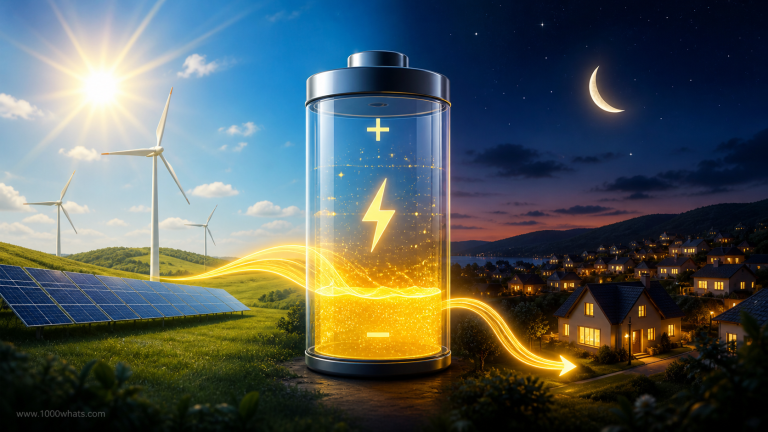
It’s 2:13 p.m. The sun is doing an excellent job.
Solar panels are producing electricity. Factories are running. Air conditioners are humming. Somewhere, a toaster is enjoying the best day of its career.
But the grid has a problem: there is more electricity available than people want at this particular moment.
By 7:00 p.m., the situation will reverse. The sun will be off duty, kitchens will come alive, and the grid will discover that humanity’s favorite time to use electricity is approximately when solar panels have gone home.
Electricity markets have a scheduling problem. The sun does not accept calendar invitations.
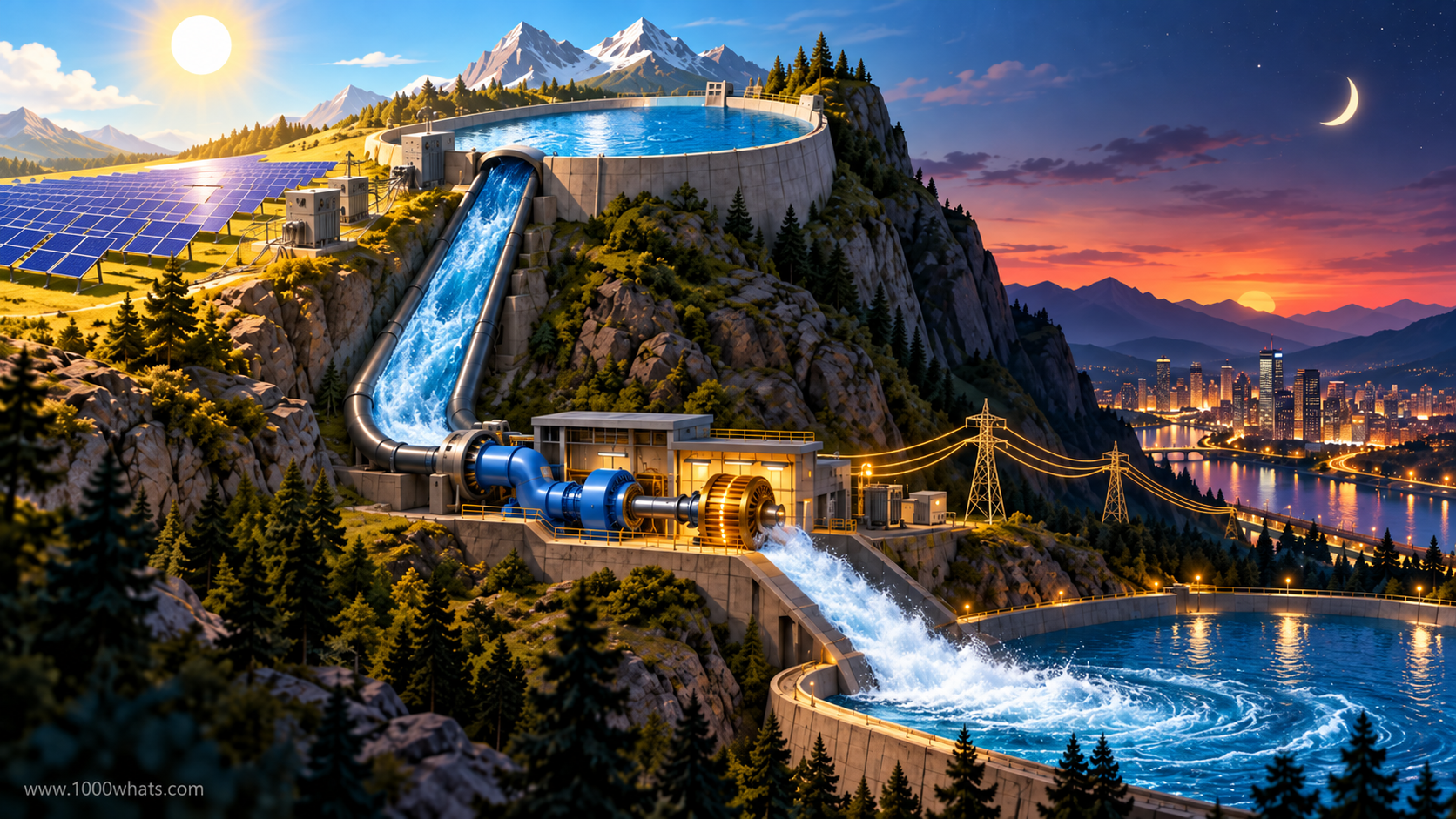
Fortunately, someone has found an employee willing to work both shifts: water.
During the cheap-electricity shift, we pay to push it up a mountain. During the expensive-electricity shift, we let it fall down. Gravity handles the return journey without asking for overtime.
This sounds like a scheme devised by an unusually ambitious plumber. It is actually one of the most established forms of large-scale electricity storage.
And welcome to 1000whats, where today’s rechargeable battery comes with a hillside, two lakes, and a construction budget that should probably be discussed sitting down.
First, the trick: a power plant that deliberately runs backward
A conventional hydropower plant takes water at a higher elevation, lets it flow downhill through a turbine, and generates electricity. Nature supplied the elevated water, usually through the water cycle. The plant takes advantage of gravity’s impeccable attendance record.
Pumped-storage hydropower adds a second act. It uses electricity to move water back uphill, so the same water can generate electricity again later.
The basic equipment is refreshingly unexotic: an upper reservoir, a lower reservoir, a waterway between them, and machinery that can pump, generate, or do both in different operating modes.
The water is not a fuel. It does not get burned, consumed in a chemical reaction, or persuaded to become electricity. It carries stored gravitational potential energy because it has been lifted above a lower elevation.
The U.S. Department of Energy explains the operating principle with two reservoirs at different heights. That is essentially the whole magic trick.
Admittedly, “build two lakes at different elevations and connect them with a giant reversible machine” is a magic trick with unusually demanding building permits.
Pumped-storage hydropower stores electricity indirectly by using it to lift water, then recovers part of that energy when the water flows back down through a turbine.
The three-act career of a very hardworking lake
Act I: the uphill commute
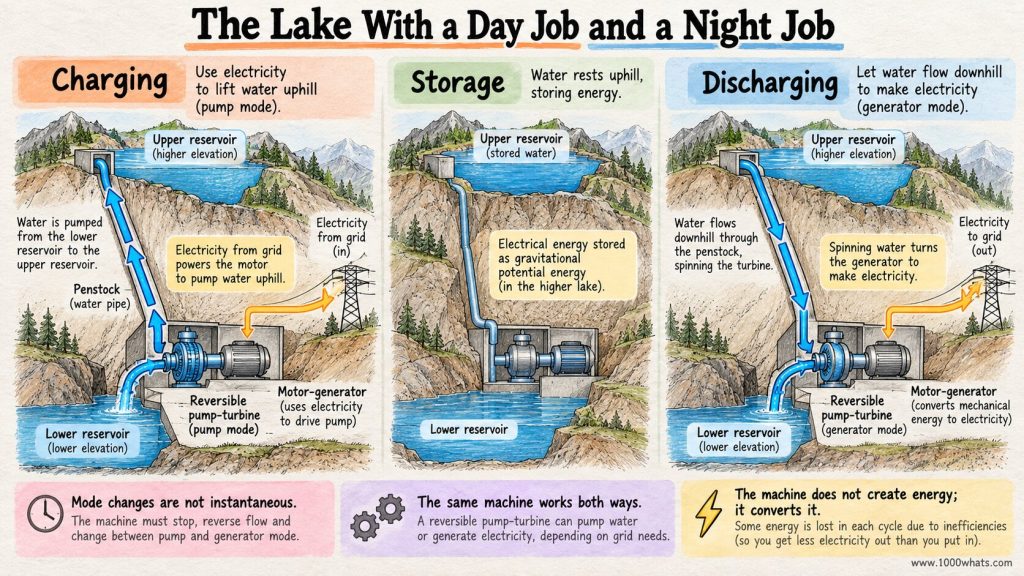
When electricity is cheap, plentiful, or otherwise worth storing, the plant operates in pumping mode.
Electricity drives a motor and pump. Water moves from the lower reservoir to the upper reservoir through a pipe or tunnel called a penstock or waterway.
Nothing about this is free. Lifting water requires work. The pump must overcome gravity and hydraulic resistance. The motor and electrical equipment also have losses.
Gravity is generous about letting water fall. It is distinctly less cooperative when asked to send it upstairs.
Act II: the world’s least exciting waiting room
Once the water reaches the upper reservoir, it can wait. Hours, days, and in suitable circumstances longer, subject to water losses, operating rules, reservoir levels, and other constraints.
Unlike a hot-water tank, it does not need to stay hot. Unlike an electrochemical battery, it is not holding energy in delicate chemical states. It is simply higher up.
The mountain does not require a battery-management app to remember which direction is downhill.
Act III: gravity clocks in
When electricity becomes valuable, gates open and water flows toward the lower reservoir. It drives a turbine connected to a generator, sending electricity back to the grid.
The water ends where it started. The electrical energy does not. Some was lost along the journey, mostly through conversion and hydraulic losses.
Then, if the economics and operating conditions justify another cycle, the plant pumps the water uphill again.
It is a spectacularly elaborate way to make a lake commute. It also solves a very real problem: electricity arrives when it arrives, but people want it when they want it.
Wait. We use electricity to make electricity?
Yes. And no, the engineers have not forgotten the first law of thermodynamics.
Imagine buying 100 megawatt-hours (MWh) of electricity to pump water uphill, then later getting 80 MWh back. The plant has not created 80 MWh from nothing. It has returned 80 MWh of previously purchased energy at a more useful time.
That makes pumped storage an energy storage system, not a primary energy source.
The difference is important. A river-fed hydropower plant may receive new energy from naturally arriving water. A closed-loop pumped-storage plant relies on electricity to restore the elevation of its working water.
Some real installations combine conventional hydro generation with pumping. In those cases, the accounts must distinguish energy from natural inflows and energy previously used for pumping. Mixing the two without explanation is a wonderful way to make a storage plant look like it has invented perpetual motion.
It has not. The accounting department would be delighted, but thermodynamics remains stubbornly employed.
How much electricity can you store in a mountain?
Here is where the entire operation reduces to a beautiful piece of school physics:
E = m × g × h
In this equation, E is gravitational potential energy in joules, m is the mass of water in kilograms, g is gravitational acceleration (about 9.81 m/s²), and h is the vertical elevation difference in meters.
More water means more stored energy. More height means more stored energy. That is the basic bargain.
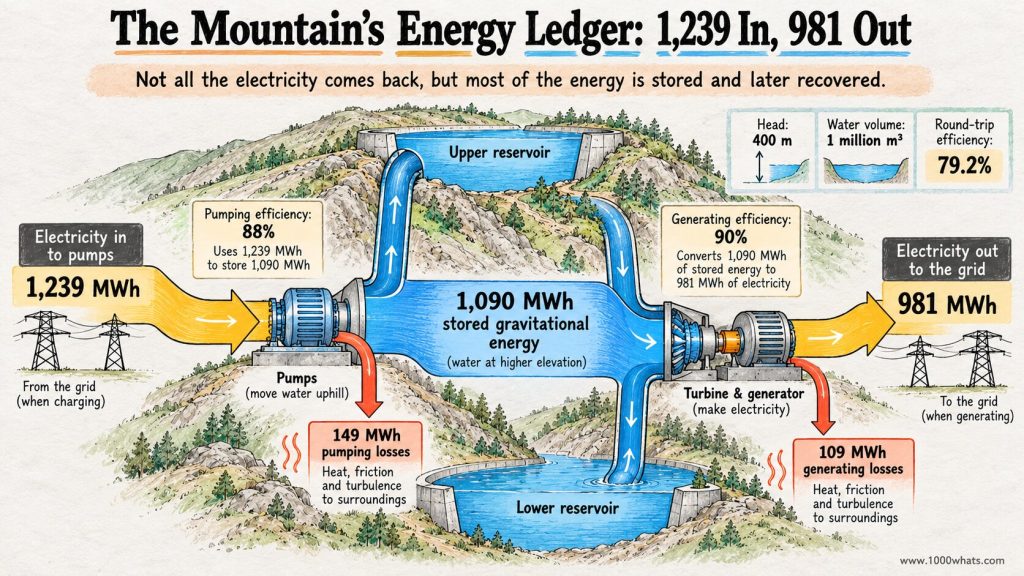
Let’s invent a pumped-storage project with 1 million cubic meters of usable water and an average hydraulic head of 400 meters.
Water has a density of roughly 1,000 kg/m³, so our usable water mass is approximately 1 billion kilograms.
E = 1,000,000,000 × 9.81 × 400 = 3.924 × 10¹² joules.
Divide by 3.6 billion joules per MWh, and you get 1,090 MWh, or about 1.09 GWh of theoretical gravitational energy.
That is the energy available from the change in elevation before accounting for generation losses. It is not a promise that 1.09 GWh will emerge at the grid connection.
If the turbine-generator side converts 90% of that potential energy into delivered electricity, the output is approximately 981 MWh.
And if pumping converts 88% of the electrical input into stored potential energy, lifting that water required approximately 1,239 MWh of electricity.
| Our imaginary mountain project | Value | What it means |
|---|---|---|
| Usable water volume | 1,000,000 m³ | Water moved between reservoirs |
| Average head | 400 m | Illustrative elevation difference |
| Theoretical stored potential energy | 1,090 MWh | Before generation losses |
| Electricity used to pump | 1,239 MWh | At 88% pumping-side efficiency |
| Electricity delivered later | 981 MWh | At 90% generating-side efficiency |
| Round-trip efficiency | 79.2% | 981 ÷ 1,239 |
These are illustrative, simplified numbers. Real head changes with reservoir levels, hydraulic losses vary with flow, and auxiliary equipment consumes power. A proper design uses operating curves, not a single convenient average and a hopeful expression.
Still, you can see the appeal. A million cubic meters sounds like a lot of water. It is. So is nearly a gigawatt-hour of electricity delivered when the grid needs it.
MW versus MWh: the size of the door and the size of the warehouse
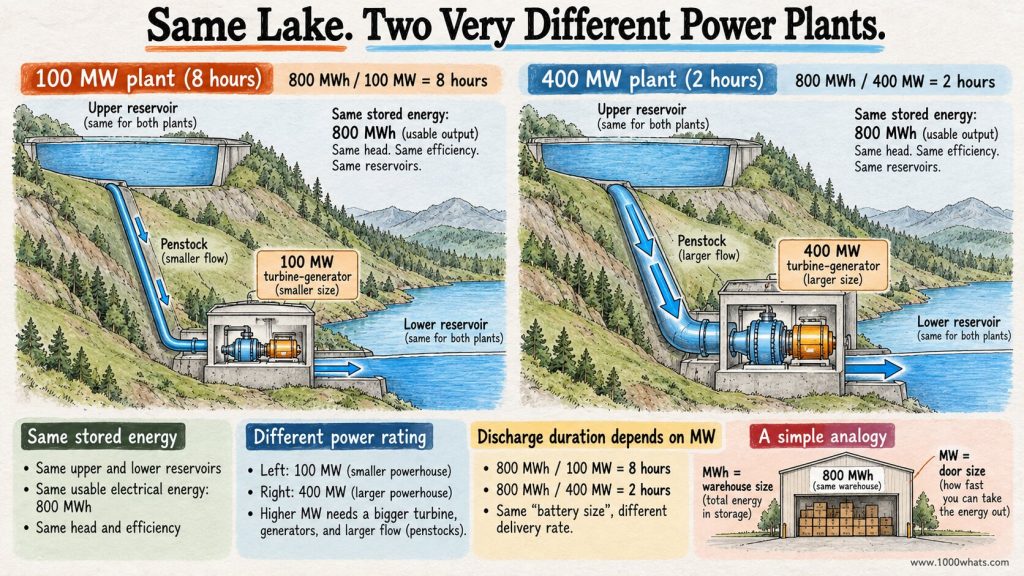
Two pumped-storage projects can have identical reservoirs and wildly different power ratings.
Why? Because stored energy and delivery rate are different engineering decisions.
Think of the upper reservoir as a warehouse. The amount of usable water and its elevation determine roughly how much energy the warehouse contains. The turbine, generator, waterway, and allowable flow determine how quickly you can ship that energy out.
A 400 MW plant delivering 800 MWh has roughly two hours of full-power discharge. A 100 MW plant with the same 800 MWh has roughly eight hours.
Same energy inventory. Very different loading dock.
For a hydropower turbine, a useful simplified relationship is P = ρ × g × Q × H × η, where Q is water flow in m³/s, H is net hydraulic head, and η is generating efficiency.
Increase the flow through appropriately sized machinery and you can deliver more power, but you also empty the usable upper reservoir faster.
This is the same distinction we explored in what power actually means. The grid does not merely ask, “How much energy have you got?” It also asks, “How quickly can you get it here?”
The warehouse manager calls the second question a logistics issue. The power engineer calls it a turbine rating. Both become unpleasant when somebody confuses them.
Why the water does not come back with all the electricity
Let’s return to our 1,239 MWh of pumping electricity and 981 MWh of generated electricity.
Where did the other 258 MWh go?
It was not stolen by a particularly ambitious fish.
Some energy became heat in motors, generators, transformers, and power electronics. Some was dissipated by turbulence and friction as water moved through pipes and turbines. Pumps and turbines are excellent machines, but they are not exempt from physics because they happen to be large.
The useful metric is round-trip efficiency:
Round-trip efficiency = Electricity delivered ÷ Electricity consumed for pumping × 100%.
For our example: 981 ÷ 1,239 ≈ 79.2%.
Real pumped-storage facilities commonly fall around 70% to 80% round-trip efficiency, although actual designs and measurement boundaries differ. The Penn State energy-storage teaching material gives a comparable typical range.
Do not confuse the efficiency of one turbine with the efficiency of the whole cycle. Pumping losses and generating losses multiply. Grid-side auxiliary consumption and measurement boundaries also matter.
There is a delightful irony here: the water completes the journey and returns to its original level, but the electricity comes back missing a few passengers.
That is not a design scandal. It is the price of moving energy through time.
So why would anyone buy 100 MWh and sell only 80?
Because the hour on the clock has a price tag.
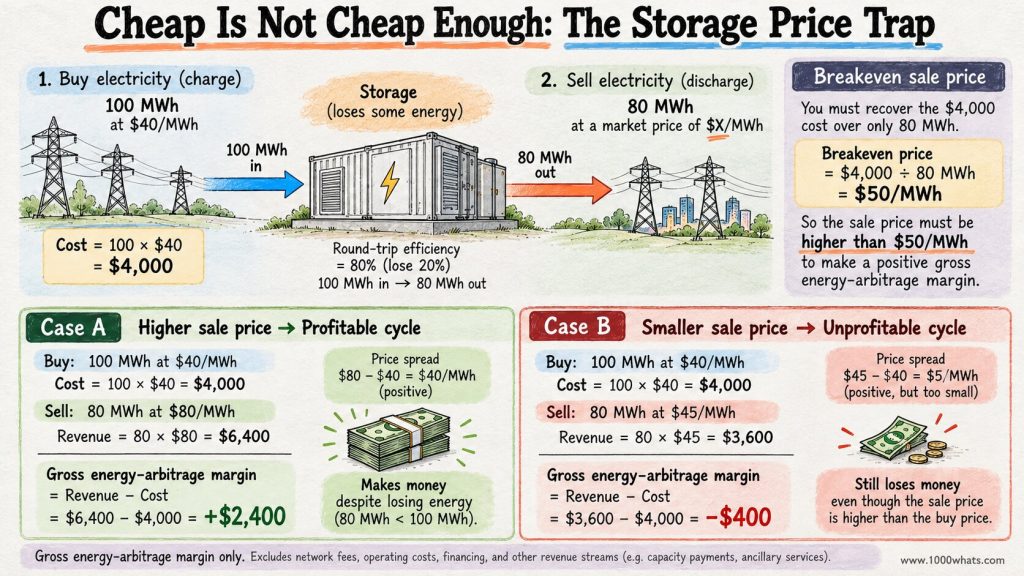
Suppose a plant buys 100 MWh of electricity at $40/MWh to pump water uphill. Its charging-energy bill is $4,000.
Later, it sells 80 MWh at $80/MWh. Revenue: $6,400.
The difference is $2,400 in gross energy-arbitrage margin, before other operating costs, network charges, fees, and the enormous question of paying for the plant itself.
Nothing about this violates energy conservation. The plant lost 20 MWh but gained a price difference. Kilowatt-hours and dollars are not interchangeable, although many electricity bills do their best to confuse the issue.
With 80% round-trip efficiency and a $40/MWh charging price, the discharge price must exceed $50/MWh just to recover the charging-energy cost, before everything else.
Here is the arithmetic: 100 MWh × $40 = $4,000. Divide by 80 MWh sold and you get $50 per delivered MWh.
If the later market price is $45/MWh, the plant loses money on that simple energy trade even though $45 is higher than $40. Buying cheap and selling dear is not enough. You must sell dear enough.
For the market mechanics, see my explanation of energy arbitrage. It is essentially a business built around the discovery that electricity does not have the same value at every hour.
Also, storage projects may earn money from capacity, reserves, and other grid services. Their economics are not always reducible to one heroic buy-low, sell-high spreadsheet.
The grid does not just need electricity. It needs someone who can change their mind quickly.
Picture the grid control room at 6:02 p.m.
Solar output is falling. Demand is rising. A generator trips unexpectedly. The dispatcher needs help now, not after a lengthy motivational speech from the boiler.
Pumped storage can provide flexible generation, reserves, and other system services, depending on the plant’s design and operating state.
In generating mode, a suitable unit can adjust output within its operating limits. In pumping mode, some designs can alter pumping consumption, while conventional fixed-speed units may have much less continuous flexibility. Switching between modes is not instantaneous and involves operational constraints.
This distinction matters. A brochure that says “fast response” without telling you whether the machine is stopped, pumping, generating, or changing modes has omitted the part engineers actually care about.
Storage can also help manage renewable generation that might otherwise be curtailed, and it can move energy from low-demand periods into evening peaks.
But it is not a universal cure for every grid problem. Transmission constraints still exist. A storage plant on the wrong side of a congested network cannot teleport power through an overloaded line. The laws of electricity are surprisingly unsympathetic to geography.
Nor does every pumped-storage facility automatically provide black-start capability. That requires appropriate equipment, controls, auxiliaries, and a restoration plan. A mountain is helpful. A mountain with a working control system is considerably better.
Is it one machine that pumps and generates?
Sometimes. Many conventional pumped-storage plants use a reversible pump-turbine connected to a motor-generator. The hydraulic machine operates as a turbine in one direction of energy transfer and as a pump in the other.
Other configurations use separate pumps and turbines, or more specialized arrangements. Variable-speed technology can expand the operating range and improve control in pumping mode, but it adds equipment and complexity.
“Reversible” does not mean the operator simply presses the world’s largest reverse button while water is rushing through the machine. Changing modes requires a designed sequence of valves, electrical operations, and hydraulic controls.
Water hammer and pressure transients are not theoretical inconveniences. They are what happens when a huge mass of moving water is informed, too abruptly, that management has changed its mind.
The engineering is old enough to be proven and complicated enough to remain interesting. A reassuring combination, provided you are not responsible for the penstock.
Open-loop or closed-loop: does the lake need a river?
Not necessarily.
Open-loop pumped storage maintains a hydrologic connection with a naturally flowing water body. Closed-loop pumped storage circulates water between reservoirs without a continuous connection to a naturally flowing river or lake.
That is the basic distinction used by the U.S. Department of Energy.
| Design | How water connects to nature | Important consideration |
|---|---|---|
| Open-loop | Ongoing connection to a river or other natural water body | Flow regimes, aquatic ecology, water rights, reservoir operations |
| Closed-loop | Two reservoirs without a continuous natural watercourse connection | Initial filling, replacement water, land use, groundwater, habitat and construction effects |
Closed-loop does not mean “water appears from nowhere and remains forever.” The reservoirs need an initial supply and may need make-up water for evaporation, seepage, and other losses.
It also does not mean “zero environmental impact.” The Pacific Northwest National Laboratory’s assessment emphasizes that impacts depend heavily on the particular site and design.
A closed loop is a hydraulic description, not a certificate of moral perfection.
Why not put one in every town?
Because the universe has stubbornly refused to supply every town with two convenient reservoirs separated by several hundred meters of elevation.
Good sites need a suitable height difference, enough usable water volume, practical waterways, stable geology, access roads, transmission connections, environmental acceptability, and a financing plan capable of surviving construction.
Building a pumped-storage project may mean excavating tunnels, constructing dams or embankments, installing large hydraulic machinery, and managing substantial geotechnical uncertainty.
That is a very different proposition from delivering battery containers to a prepared site.
Some locations can reuse existing reservoirs or infrastructure. Others would require almost everything to be built from scratch. The economics can be excellent in one valley and deeply embarrassing in the next.
Even a beautiful head-and-volume calculation does not guarantee a good project. The National Renewable Energy Laboratory’s technology baseline models storage duration, head, reservoir spacing, and other design variables because the physical layout drives the cost.
The cheapest mountain is not always the best mountain. Sometimes the cheapest mountain is 200 miles from the grid and made of rock that would rather not be excavated.
Pumped storage versus batteries: the heavyweight and the sprinter
A lithium-ion battery is compact, modular, and usually faster to deploy. Pumped storage is large, location-dependent, and often built for a long operating life and substantial energy capacity.
Both can respond quickly in appropriate operating modes. Both lose energy during charging and discharging. Both need real-world revenue streams to pay for themselves.
They are not opponents in a winner-takes-all sporting event, despite what energy conferences occasionally suggest.
| Question | Pumped-storage hydropower | Lithium-ion battery system |
|---|---|---|
| What stores the energy? | Elevated water | Electrochemical state |
| Typical round-trip efficiency | Often around 70–80% | Often higher; system boundaries matter |
| Physical footprint | Reservoirs, waterways, powerhouse | Battery containers and electrical equipment |
| Deployment constraint | Topography, geology, water, permits, civil works | Site, interconnection, equipment, safety and permits |
| Typical design strength | Large energy inventories and long-duration operation | Modularity, fast deployment, flexible siting |
| Lifetime consideration | Long-lived civil works with equipment refurbishment | Cell degradation and eventual replacement planning |
These are tendencies, not commandments. Some batteries run for many hours. Some pumped-storage plants are designed for relatively short discharge durations. Every project deserves its own comparison.
The practical question is not “Which technology is cooler?” It is “What service does this grid need, for how long, at what location, and at what total cost?”
If you want the electrochemical side of the story, my battery-storage explainer is waiting with considerably less water and substantially more chemistry.
Can we charge it with solar power?
Absolutely. We can also charge it with wind, nuclear, gas-fired generation, imports, or whatever mix of electricity the system is supplying at that moment.
That is why pumped storage should not automatically be labeled renewable generation simply because it uses water.
The storage mechanism is gravitational. The origin of the charging electricity determines the emissions associated with the charging cycle, together with losses and the counterfactual generation displaced later.
In a grid with abundant midday solar, pumping can absorb some of that output and return part of it in the evening. In another grid, the same plant might shift electricity from steady overnight generators into peak hours.
It can be extremely useful in both cases, but the climate benefit depends on the actual operating pattern and electricity mix.
Calling every MWh discharged from a pumped-storage plant “new renewable electricity” is like calling a rechargeable flashlight a new source of sunlight. Admirable enthusiasm. Questionable accounting.
Does the water disappear? Does the energy?
Water is cycled between reservoirs, but real systems can lose some through evaporation, seepage, leakage, and operational releases. Rainfall and natural inflows can also affect reservoir balances where applicable.
Energy behaves differently. The water may remain available for many cycles, but the stored energy is reduced whenever the plant generates electricity. Recharging requires fresh electrical input.
This is why a pumped-storage reservoir is not the same as a tank full of electricity. It is a tank full of water at a useful elevation.
If you open the turbine, the water descends and the stored gravitational energy decreases. If you pump it back, the gravitational energy increases. If you simply leave it there, it can retain that elevation for a long time, subject to water-management losses and operating conditions.
In other words, the energy is stored in a position, not in the water’s personality. Water has plenty of personality already. Ask anyone who has tried to waterproof a basement.
Could it store an entire season of electricity?
In principle, gravitational storage can hold energy for long periods. A reservoir does not spontaneously discharge because it has reached its 24-hour anniversary.
But long storage time and enough storage capacity for a season are very different claims.
Seasonal electricity shifting requires an enormous energy inventory if the goal is to cover weeks or months of system demand. The needed water volume, elevation difference, land, and capital costs can become formidable.
Our imaginary project stores about 1.09 GWh of theoretical gravitational energy. A city using 1 GWh every few hours would not regard that as an entire winter survival kit.
Pumped storage is therefore often attractive for daily and multi-hour balancing, with longer durations possible at suitable sites. That does not make every pumped-storage project a seasonal battery.
“It can wait for months” is not the same as “it can supply a city for months.” Your pantry can keep pasta for a year. That does not mean one box feeds a family for a year.
How green is a giant rechargeable mountain?
There are genuine environmental advantages and genuine trade-offs.
Pumped storage can help integrate variable renewable generation, provide flexibility, and avoid some higher-emission generation under the right operating conditions. Its civil infrastructure may operate for many decades with maintenance and refurbishment.
But reservoirs, roads, tunnels, and transmission lines change landscapes. Construction consumes concrete, steel, fuel, and other materials. Projects can affect habitats, cultural resources, water availability, groundwater, and nearby communities.
The impacts are highly site-specific. PNNL’s open-loop versus closed-loop comparison found that closed-loop designs can often reduce some impacts, but it also identified circumstances where groundwater or other impacts can be more significant.
So the right environmental question is not “Does it have a battery icon?”
It is: what does this project build, what does it change, where does its charging energy come from, and what alternative would provide the same service?
Physics gives us a storage method. Environmental assessment tells us whether this particular mountain is a sensible place to use it.
The developer’s reality check: the mountain has a lawyer
Before anyone announces a 1 GW pumped-storage project with a triumphant drone video, somebody has to answer the less cinematic questions.
- Head and water: What are the actual operating head range and usable reservoir volumes?
- Machines: What pumping and generating power can the selected units deliver across that head range?
- Grid: Can the network absorb pumping demand and export generation when needed?
- Environment: What water, habitat, land, cultural, and community impacts must be addressed?
- Construction: What geology is hiding inside the hill, and how much will it cost to find out?
- Market: Which services will earn revenue, under what rules, and with what price risks?
- Operations: How will the plant manage reservoir levels, maintenance, outages, and competing uses of water?
That list is not intended to frighten anyone. It is intended to frighten anyone who thinks a pumped-storage project is just a pump, a turbine, and two blue shapes on a PowerPoint slide.
Some projects will pass these tests beautifully. Others will fail on geology, economics, permitting, or a single transmission bottleneck.
The mountain may be free. The project most definitely is not.
Three things people get wrong about pumped storage
“It generates more electricity than it consumes.”
Not from the pumping cycle alone. Pumped storage returns less electrical energy than it uses to recharge. If a combined hydro facility also generates from natural inflows, keep those energy sources separate in the accounting.
“It’s inefficient, so it’s pointless.”
Efficiency is important, but timing, flexibility, duration, reliability, and system value also matter. Electricity at 7 p.m. can be more useful than electricity at 2 p.m., even if some energy is lost between the two.
“We can put it anywhere if we build big enough pumps.”
Pumps cannot negotiate a discount on gravity. Without suitable elevation, water, geology, and grid access, the project can become prohibitively expensive. The planet offers many hills, but surprisingly few are pre-approved energy-storage facilities.
Final thoughts
At first glance, pumped-storage hydropower seems absurd.
We use electricity to lift water. Then we let the water fall to make less electricity than we started with. The machines are enormous. The civil works can take years. The mountain has paperwork.
And yet, the idea is brilliant for a reason that has nothing to do with making extra energy.
It makes energy available at a better time.
The upper reservoir is not a new source of electricity. It is a reservation. A promise that some of the electricity available now can be delivered later, when the grid actually wants it.
Sometimes that promise is worth more than the energy lost along the way. Sometimes it is not. That is why engineers calculate head and efficiency, dispatchers calculate flexibility, and investors calculate everything twice.
Meanwhile, gravity keeps showing up for work. No contract renewal. No performance review. No motivational seminar.
We do have to pay for the elevator.
Until next time, stay curious! 😎
Discover more from 1000whats
Subscribe to get the latest posts sent to your email.