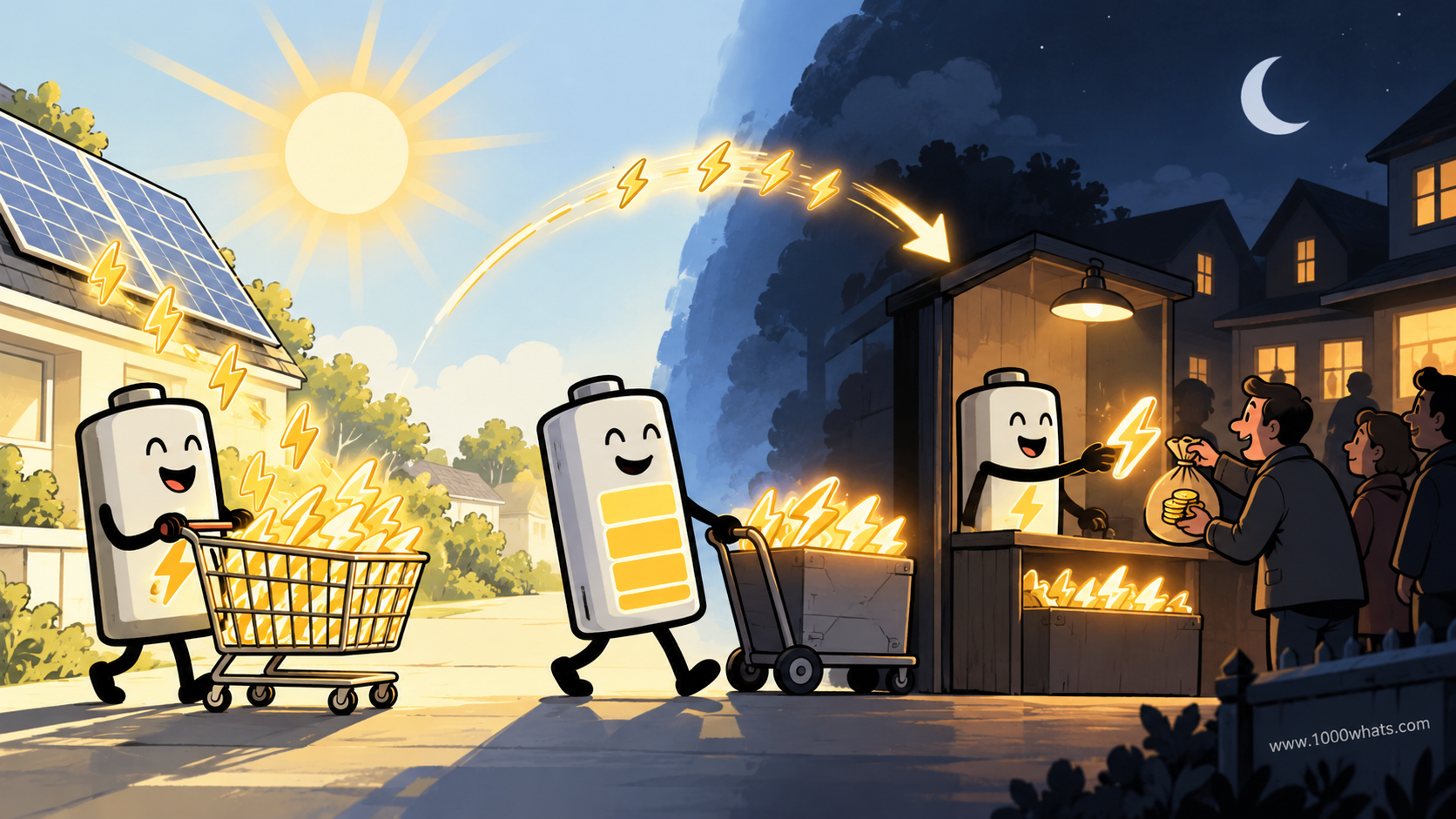
At 2 p.m., electricity costs:
€20/MWh.
At 8 p.m., the same market is paying:
€150/MWh.
You own a battery.
This is not the moment for a philosophical discussion.
Charge at €20.
Sell at €150.
Keep the difference.
Congratulations.
You have discovered one of finance’s oldest ideas and given it a very large inverter.
Welcome to 1000whats – where today “buy low, sell high” meets a commodity that cannot decide what it is worth from one hour to the next.
This is:
energy arbitrage.
And although the basic idea is almost embarrassingly simple, the actual business is not.
Because batteries lose energy.
Batteries age.
Prices move.
Forecasts fail.
Grid fees exist.
Market rules interfere.
And if everyone buys the same battery and discovers the same profitable hours, something deeply inconvenient happens:
the opportunity starts disappearing.
⚡ “Energy arbitrage makes money from one simple fact: electricity at 2 p.m. and electricity at 8 p.m. may be physically identical, but economically they are not the same product.”
First, why does electricity have different prices at different times?
Electricity is unusually obsessed with timing.
A barrel of oil produced today can sit in a tank.
A pile of coal can wait.
Natural gas can be stored.
Electricity traditionally had much less patience.
Generation and consumption have to remain closely balanced, which means the value of another MWh depends heavily on what the system looks like right now.
At noon, a solar-heavy system may have:
lots of generation,
moderate demand,
and very low wholesale prices.
A few hours later:
solar production falls,
people arrive home,
lights come on,
cooking starts,
air conditioners or heating systems keep running,
and more expensive generators may be needed.
The merit order explains how the marginal generator can help set the wholesale electricity price.
Change the generation-demand balance.
Change the marginal plant.
Change the price.
So electricity markets routinely create:
cheap hours
and:
expensive hours.
Energy arbitrage lives in the space between them.
What is energy arbitrage?
The clean definition is:
Energy arbitrage means buying or storing energy when its price is low and selling or using it when its price is higher.
For battery storage, the physical sequence is:
charge at low price → wait → discharge at high price
The U.S. Energy Information Administration describes battery energy arbitrage in essentially those terms: storage charges from the grid when electricity prices are low and sells electricity back when prices are higher.
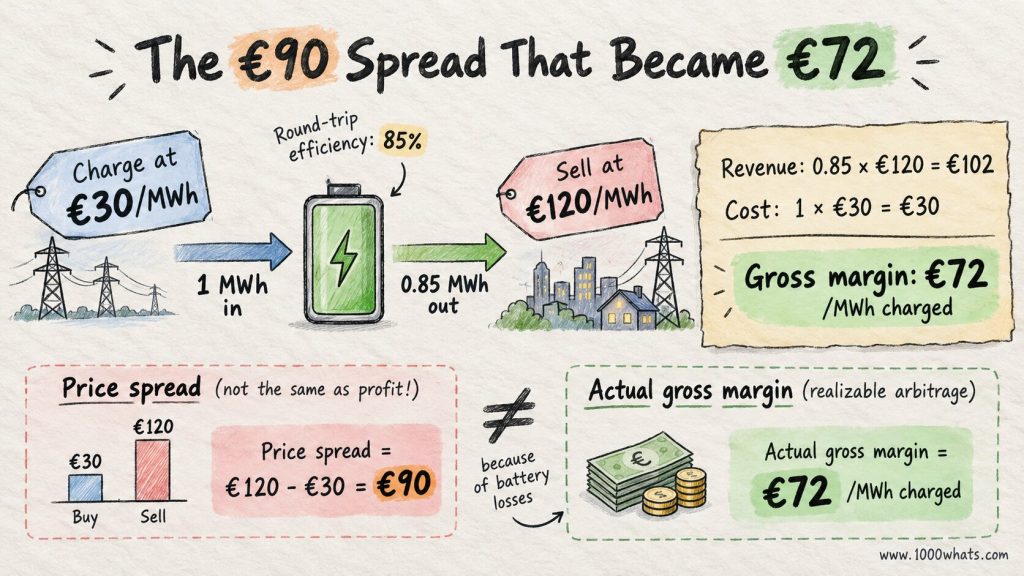
If electricity costs:
€30/MWh at noon
and:
€120/MWh in the evening,
the visible spread is:
€90/MWh.
Wonderful.
Do that every day.
Retire somewhere pleasant.
Except:
not so fast.
The €90 spread is not your €90 profit
Suppose our battery buys:
1 MWh at €30/MWh.
Charging cost:
€30.
Later, the market price reaches:
€120/MWh.
If batteries were perfect, we would sell the full:
1 MWh × €120/MWh = €120
Gross arbitrage margin:
€120 − €30 = €90
But batteries are not perfect.
Some energy disappears during charging, storage and discharge.
The NREL utility-scale battery assumptions use an illustrative 85% round-trip efficiency for utility-scale battery storage.
So if our battery buys:
1 MWh
it may return only:
0.85 MWh.
At €120/MWh, revenue becomes:
0.85 × €120 = €102
Now:
€102 revenue − €30 charging cost = €72
Still attractive.
But our beautiful €90 spread has already become:
€72.
And we have not yet paid for anything else.
Thermodynamics has entered the trade.
It would like its commission.
There is actually a minimum spread worth trading
This gives us a useful rule.
If the battery loses energy, the selling price must be sufficiently higher than the buying price merely to cover those losses.
Suppose:
charging price = €50/MWh
round-trip efficiency = 85%
To recover the €50 spent buying 1 MWh, the battery must sell its 0.85 MWh for:
€50 / 0.85 ≈ €58.82/MWh
So a later market price of:
€55/MWh
is higher than the charging price.
But the trade still loses money.
This is an important distinction.
Higher later price does not automatically mean profitable arbitrage.
Before degradation, fees and other costs, the rough break-even relationship is:
Selling price > Charging price / round-trip efficiency
That little denominator changes the whole game.
And then the battery ages
Every battery cycle has consequences.
Charge.
Discharge.
Repeat.
Battery cells gradually lose usable capacity and performance.
Temperature matters.
Depth of discharge matters.
Operating strategy matters.
Time itself matters.
The same NREL battery cost and performance framework explicitly accounts for degradation and augmentation over the asset lifetime.
So imagine the market offers a tiny profitable spread.
Technically, the battery could trade it.
But should it?
If cycling the battery consumes a small piece of its useful life, the operator should compare:
today’s arbitrage margin
with:
the economic cost of using the battery.
This is where the simple instruction:
charge whenever cheap, discharge whenever expensive
starts looking like advice from someone who does not own the battery.
A rational operator may deliberately ignore small spreads.
The battery can trade.
It simply has better things to do with its remaining life.
⚡ “A battery should not chase every spread it can see. Some profitable-looking trades are just depreciation wearing a fake mustache.”
So what really determines the arbitrage margin?
The simple version is:
selling price − buying price
The useful version is closer to:
discharge revenue − charging cost − energy losses − degradation cost − market fees − network charges − other operating costs
And even that can be incomplete.
Depending on market design and asset configuration, you may also need to consider:
taxes,
imbalance exposure,
state-of-charge constraints,
connection limits,
contractual restrictions,
and the value of keeping the battery available for another market.
That last one is particularly important.
Because the battery has options.
The battery may have something better to do
Suppose your battery can earn:
€8,000
from today’s expected energy arbitrage.
Nice.
But suppose holding some of its capacity available for frequency services could earn:
€12,000.
Now the arbitrage opportunity has an:
opportunity cost.
My ancillary-services explainer introduced this problem through the battery revenue stack.
A battery may potentially earn money from:
energy arbitrage,
frequency services,
balancing,
capacity,
local network services,
or contractual arrangements.
But the same MW cannot always be sold to everybody simultaneously.
If the battery is empty after an arbitrage discharge, it cannot promise unlimited upward energy.
If it is full, it has limited room to absorb additional electricity.
If 80 MW of a 100 MW battery is committed somewhere else, only part of the asset remains available for the next opportunity.
Physics remains strangely unimpressed by double booking.
Energy arbitrage is really time arbitrage
There is another useful way to think about this.
The battery is not moving electricity from:
Germany to France.
It is moving electricity from:
one time to another.
That makes storage unusual.
Transmission arbitrages geography.
Storage arbitrages time.
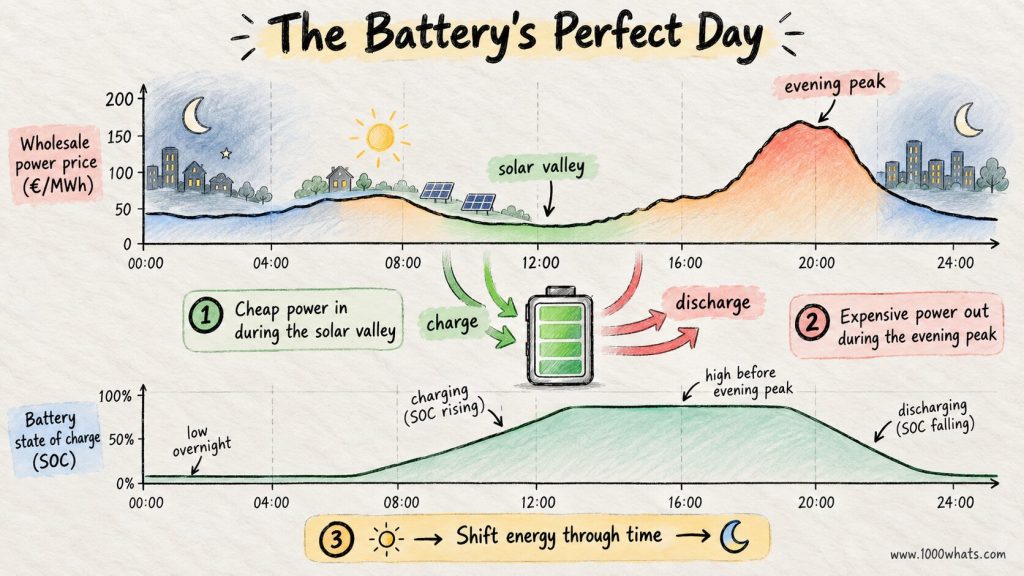
Imagine electricity is cheap at noon because solar production is abundant.
A battery charges.
Four hours later, solar output falls and electricity becomes expensive.
The battery discharges.
Conceptually:
noon electricity → battery → evening electricity
My battery-storage article calls storage a timing solution.
Energy arbitrage is the market expression of that physical capability.
The battery does not merely move MWh through time.
It tries to move them from:
low-value time
to:
high-value time.
That distinction is where the money lives.
Solar makes the daily pattern particularly interesting
Solar has a predictable habit.
It tends to produce when the Sun is up.
An outrageous business model, admittedly, but reliable in concept.
As solar penetration grows, large amounts of low-marginal-cost generation can enter the market around the middle of the day.
Prices can fall.
Sometimes dramatically.
Then the Sun sets.
Solar output disappears.
Demand may remain substantial.
More expensive generation becomes necessary.
Prices rise.
That creates a natural daily arbitrage pattern:
charge during solar-rich hours
↓
discharge into the evening
The EIA’s modeling of battery arbitrage describes exactly this behavior in solar-heavy systems, with storage commonly charging during daytime low-price periods and discharging later as prices rise. EIA battery arbitrage analysis
This is the commercial cousin of the famous duck curve.
The duck creates the shape.
Storage sees the spread.
Negative prices make the story even stranger
Now imagine the charging price is not:
€20/MWh.
It is:
−€20/MWh.
The battery consumes electricity.
And gets paid for doing it.
Welcome to electricity markets.
Negative wholesale prices can occur when generation is abundant, demand is relatively weak, flexibility is limited, and some generators are willing to pay to remain producing rather than reduce output.
They are no longer particularly exotic in parts of Europe. ACER’s wholesale-market data show that negative day-ahead prices occurred during 5.81% of hours in Germany-Luxembourg, 5.70% in the Netherlands, 4.89% in Belgium and 4.84% in Spain in the dataset updated in March 2026.
For a storage operator, negative prices can be delightful.
Suppose the battery charges 1 MWh at:
−€20/MWh.
Instead of paying €20:
it receives €20.
Later it sells 0.85 MWh at:
€100/MWh.
Revenue from discharge:
€85.
Charging economics:
+€20.
Before other costs:
€105 gross value.
The battery got paid to buy the product.
Then got paid again to sell it.
This sounds like an accounting error.
It isn’t.
The first payment reflects the value of removing electricity from an oversupplied system.
The second reflects the value of returning electricity when the system wants it.
The battery is being paid for:
timing.
A real European day can contain enormous spreads
This is where arbitrage stops being theoretical.
ACER’s market data show substantial differences between average minimum and maximum day-ahead prices across European bidding zones. In the dataset updated in March 2026, for example, average minima and maxima were around:
€40.50 → €217.57/MWh in Bulgaria
€35.68 → €207.71/MWh in Greece
€43.86 → €219.07/MWh in Romania
€44.60 → €217.70/MWh in Hungary
and:
€45.78 → €195.91/MWh in Slovenia.
Those are not necessarily directly capturable battery spreads – the minimum and maximum may not line up perfectly with an asset’s duration, state of charge, market position or operational constraints.
But they demonstrate the underlying point:
the value of one MWh can change dramatically within the same day.
ACER’s bidding-zone price dataset makes the economic landscape visible.
A storage asset looks at that landscape and asks:
Where is the valley?
Where is the peak?
Can I move energy between them cheaply enough?
That is arbitrage.
But perfect hindsight is cheating
Here is a detail that becomes painfully obvious in actual energy trading.
At midnight, after the day has finished, it is easy to identify:
the cheapest hour
and:
the most expensive hour.
Wonderful.
Unfortunately, the battery had to make decisions before knowing the future perfectly.
Suppose prices at 13:00 are €25/MWh.
Should the battery charge?
Maybe.
But perhaps 14:00 will be:
€5/MWh.
If you filled the battery too early, you missed the cheaper opportunity.
Now suppose prices reach:
€130/MWh at 18:00.
Discharge?
Maybe.
But 19:00 could reach:
€220/MWh.
The operator is constantly deciding whether today’s attractive price is:
the opportunity
or merely:
the opportunity before the better opportunity.
This is why battery optimization involves forecasting.
Weather.
Demand.
Renewable output.
Plant outages.
Transmission constraints.
Fuel prices.
Market positions.
Neighboring markets.
And increasingly:
algorithms.
The battery is simple.
Knowing when to use it is not.
Intraday markets make the decision move
Day-ahead prices are only one part of the story.
Europe’s wholesale electricity market operates across several timeframes, including forward, day-ahead and intraday trading, with balancing following closer to real-time operation. ACER’s overview of electricity-market timeframes explains how market participants can progressively adjust positions as delivery approaches.
That matters for storage.
A battery might initially plan:
charge at 14:00
discharge at 19:00.
Then:
weather forecast changes.
Solar production is revised.
A generator trips.
Demand changes.
Cross-border capacity becomes constrained.
Intraday prices move.
The optimal schedule changes.
So energy arbitrage is not necessarily one decision made in the morning.
It can be continuous optimization.
The asset is effectively asking:
What is the most valuable thing I can do with my next available MWh of storage capacity?
Again.
And again.
And again.
Duration determines which spreads you can capture
Consider two batteries.
Battery A:
100 MW / 100 MWh
Battery B:
100 MW / 400 MWh
Both can discharge at:
100 MW.
But Battery A can do so for roughly:
one hour.
Battery B can do so for roughly:
four hours.
That changes the arbitrage opportunity.
Suppose evening prices are high for four consecutive hours.
Battery A can attack the best hour.
Battery B can capture a much larger block of the expensive period.
But the larger battery also costs more.
So:
more duration ≠ automatically more profit.
The economic question becomes:
Are there enough hours of sufficiently large price spreads to pay for the additional storage capacity?
This is why MW and MWh matter separately.
MW determines how quickly you can trade.
MWh determines how much time you can move.
Energy arbitrage needs both.
Then something awkward happens: arbitrage destroys arbitrage
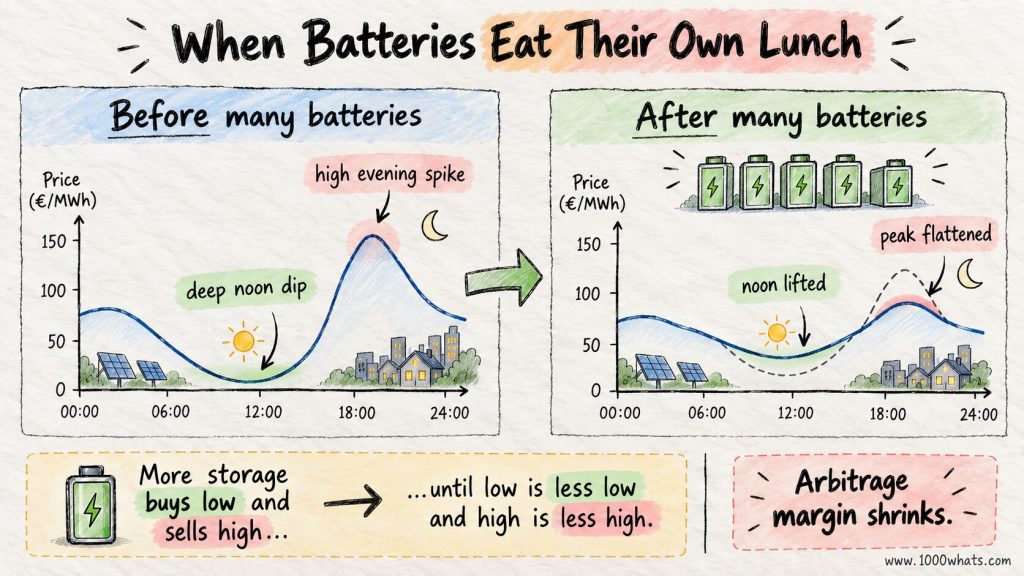
Imagine a market with:
huge solar output at noon,
very low noon prices,
high evening demand,
very high evening prices.
Battery developers look at this and think:
Excellent.
So they build batteries.
Battery 1 charges at noon.
Battery 2 charges at noon.
Battery 100 charges at noon.
Battery 1,000 charges at noon.
What happens?
All that new charging creates additional demand during cheap hours.
Noon prices rise.
Then all those batteries discharge during the evening peak.
That adds supply.
Evening prices fall.
The spread shrinks.
The batteries are successfully solving the price difference that attracted the batteries.
Beautiful.
Also commercially irritating.
⚡ “The better storage becomes at exploiting an arbitrage spread, the more storage tends to destroy that spread.”
This is one of the central economic features of flexibility markets.
A profitable opportunity attracts investment.
Investment changes the market.
The market changes the opportunity.
Capitalism meets Kirchhoff.
This is why yesterday’s spread is not tomorrow’s revenue forecast
Suppose historical data show:
€100/MWh average daily spread.
You build a financial model assuming:
€100/MWh forever.
Very neat.
Unfortunately, other developers have access to historical data too.
If several gigawatts of storage enter the same market, the price shape can change materially.
Solar may also keep growing.
Transmission may expand.
Demand patterns may shift.
Flexible loads may appear.
Gas prices may change.
Market rules may change.
The battery itself changes the market it is trying to monetize.
This makes long-term arbitrage forecasting difficult.
And it explains why a bankable storage project cannot simply take last year’s day-ahead prices, run an optimization model, multiply by twenty years and add a green gradient to the PowerPoint.
The spreadsheet has accidentally assumed:
nobody reacts to the spreadsheet.
Markets rarely extend that courtesy.
Arbitrage and renewable cannibalization are two sides of the same price shape
There is another useful connection.
Suppose thousands of solar plants produce simultaneously.
Their collective output pushes midday electricity prices down.
That hurts solar capture prices.
But those same low prices can create charging opportunities for batteries.
Then the battery discharges after solar output falls.
So the same market shape creates:
a revenue problem for solar
and:
a revenue opportunity for storage.
That is not coincidence.
They are two sides of the same temporal mismatch.
Solar says:
I have lots of electricity now.
The market says:
So does everybody else.
The battery says:
I’ll take some.
Then evening arrives.
The market says:
Actually, I would like that electricity now.
The battery says:
We should discuss price.
Storage does not eliminate the economics of variable renewable generation.
It responds to them.
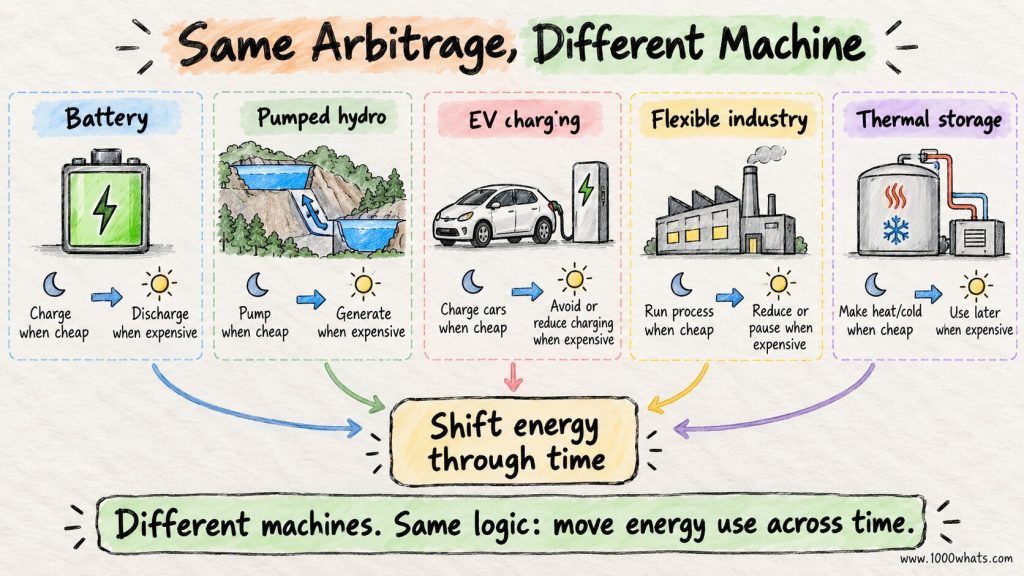
Arbitrage can also happen without batteries
Energy arbitrage is broader than lithium-ion storage.
Pumped-storage hydropower has been doing essentially the same thing for decades.
When electricity is cheap:
pump water uphill.
When electricity is expensive:
release water downhill through turbines.
The storage medium is not electrochemistry.
It is:
gravity.
Flexible consumers can also respond to time-varying prices.
An industrial process may shift electricity consumption toward cheaper hours.
An EV fleet may delay charging.
A thermal storage system can produce heat when electricity is cheap and use that heat later.
The economic logic remains:
move energy consumption or delivery from low-value time to high-value time.
The physical implementation changes.
The arbitrage does not.
Is arbitrage good for the grid or just good for traders?
Usually both – up to a point.
When a battery charges during low-price hours, it increases demand when electricity is abundant.
When it discharges during high-price hours, it adds supply when electricity is scarce.
That tends to:
raise very low prices,
lower very high prices,
reduce peak generation needs,
absorb some renewable surplus,
and flatten the price curve.
In other words, the battery earns money by doing something the power system generally finds useful.
This is one of those pleasant moments when:
private profit
and:
system flexibility
can point in roughly the same direction.
Not always perfectly.
Network constraints, market design and local congestion can complicate the picture.
A battery following the wholesale price may not always perform the action most useful for a particular distribution or transmission constraint.
But at system level, arbitrage broadly rewards shifting energy from abundance toward scarcity.
The price signal is doing its job.
Energy arbitrage is not the same as hedging
These ideas can look similar because both involve electricity prices.
But they solve different problems.
Arbitrage tries to profit from price differences.
Buy cheap.
Sell expensive.
Hedging tries to reduce exposure to uncertain future prices.
A generator may hedge by selling electricity forward.
A consumer may hedge by buying electricity forward.
The objective is not necessarily to exploit a spread.
It is to reduce risk.
My article on price risk sits on that side of the market.
So:
arbitrage monetizes price differences.
hedging manages price uncertainty.
The same trading desk may do both.
Please do not confuse the motivations while standing near the risk manager.
Energy arbitrage is also not free money
By now the pattern should be clear.
The phrase:
buy low, sell high
is correct.
It is simply incomplete.
Real arbitrage economics depend on:
the spread,
efficiency,
battery degradation,
duration,
power rating,
market access,
forecast quality,
fees and charges,
state of charge,
alternative revenue opportunities,
competition,
and future market evolution.
That is why storage valuation quickly becomes an optimization problem rather than a multiplication problem.
The asset is constantly choosing between:
charge now,
wait,
discharge now,
save energy for later,
or reserve capability for another service.
Sometimes the most profitable battery action is:
nothing.
That may be the hardest feature to explain to people who have just spent €50 million buying a machine specifically designed to charge and discharge.
So, what is energy arbitrage in one sentence?
Energy arbitrage is the practice of buying, storing or consuming energy when prices are low and selling or avoiding consumption when prices are higher, capturing value from the price difference over time.
But the better mental model is:
energy arbitrage sells timing.
The battery does not improve the MWh.
It improves:
when the MWh is available.
And electricity markets can value that difference enormously.
Final thoughts
There is something slightly strange about energy arbitrage.
Nothing new is produced.
The battery does not discover electricity.
It does not create fuel.
It does not add sunlight.
It takes an existing MWh and says:
Not now. Later.
And sometimes that is worth:
€20/MWh.
Sometimes:
€100/MWh.
Sometimes much more.
That tells us something important about electricity markets.
Energy does not have one value.
It has a value determined by:
where,
when,
and under what system conditions
it becomes available.
Storage turns when into a controllable variable.
That is why batteries are more than boxes full of chemistry.
They are machines that trade time.
But there is a final irony.
If enough batteries become very good at buying cheap electricity and selling expensive electricity, cheap hours become less cheap and expensive hours become less expensive.
The batteries flatten the very price differences they were built to exploit.
Which sounds like a problem.
From the grid’s perspective, it is rather the point.
A successful arbitrage market eventually starts arbitraging away its own easiest opportunities.
Buy low.
Sell high.
Repeat until:
low and high start meeting in the middle.
Until next time, stay curious! 😎
Discover more from 1000whats
Subscribe to get the latest posts sent to your email.