Imagine running a restaurant where every meal has to be cooked at exactly the same instant somebody takes a bite.
Not five minutes earlier.
Not five seconds later.
Exactly now.
Welcome to the electricity grid.
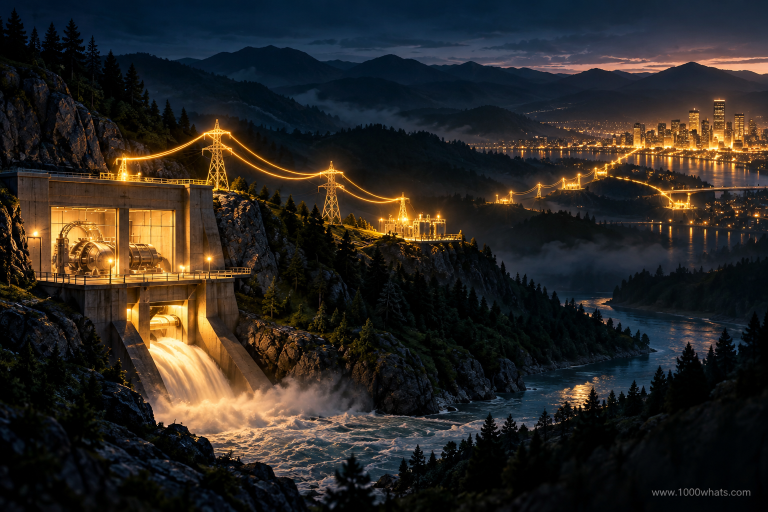
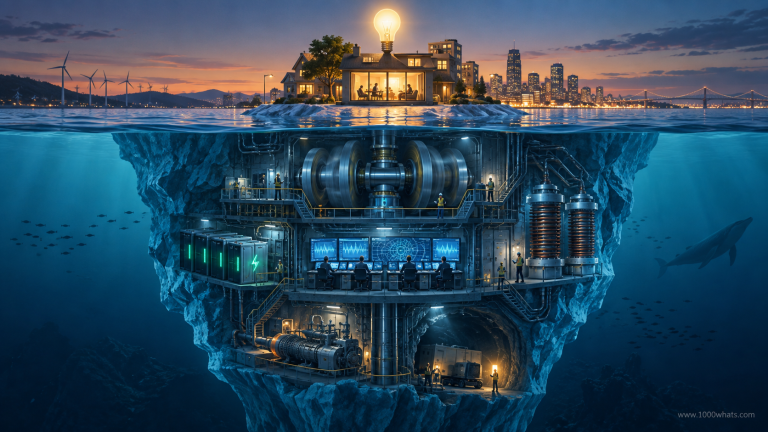
Power plants, wind farms, solar panels, batteries, factories, air conditioners, data centers, kettles, and millions of bored people opening refrigerators all participate in a giant balancing act every second of every day.
And somehow, this absurd machine stays remarkably stable.
How do grid operators know whether the balance is right?
They watch one little number:
Frequency.
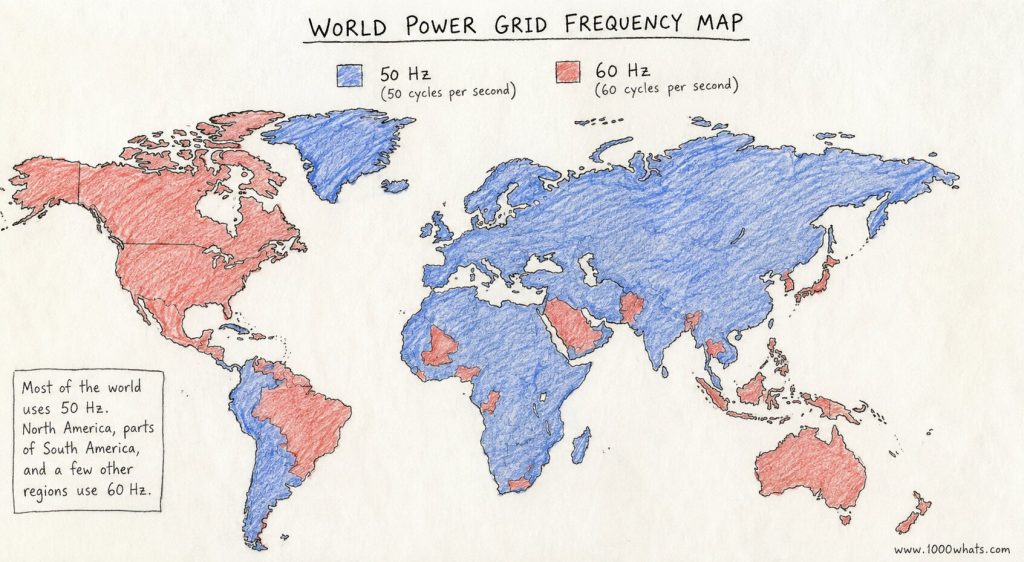
50 Hz in much of the world.
60 Hz in North America and some other regions.
And when that number starts moving, the grid is basically saying:
“Houston, we have a mismatch.”
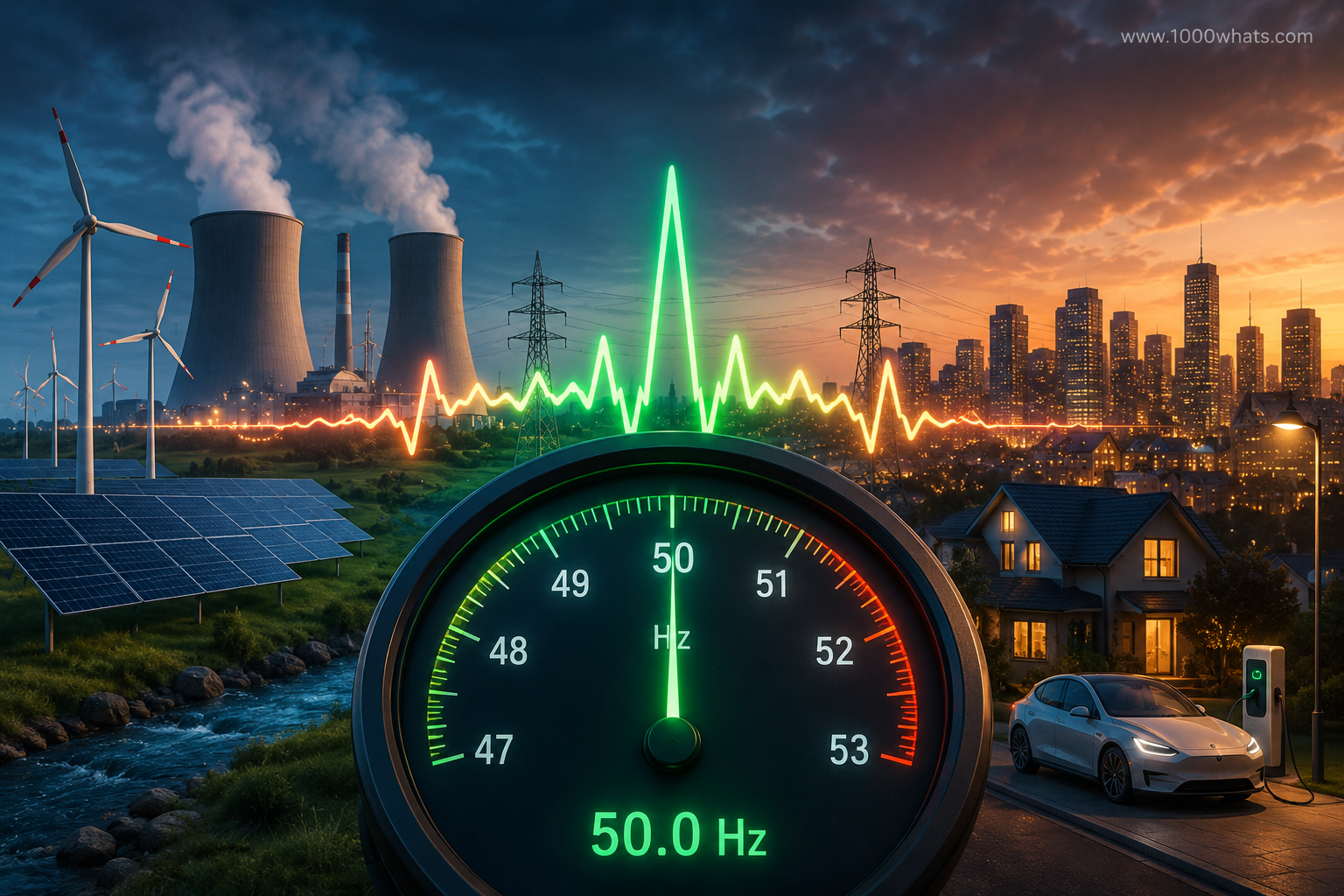
⚡ “Grid frequency is the electricity system’s heartbeat. When it changes, something underneath the grid has changed too.”
Welcome to 1000whats—where even a number like 50 Hz gets dragged out of the control room and forced to explain itself.
What is power grid frequency?
Power grid frequency is the number of cPower grid frequency is the number of complete alternating-current cycles occurring every second in an electricity system.
It is measured in hertz (Hz).
In a 50 Hz system, the AC waveform completes 50 full cycles every second. In a 60 Hz system, it completes 60.
Most of Europe and many other regions operate at 50 Hz, while North American power systems generally operate at 60 Hz.
If that whole “electricity changing direction” business sounds suspicious, start with my guide to alternating current (AC).
The important idea here is this:
Frequency tells us how quickly the AC electrical waveform is oscillating.
But on a large interconnected grid, it tells us something much more useful.
It gives operators a real-time clue about whether electricity generation and electricity demand are in balance.
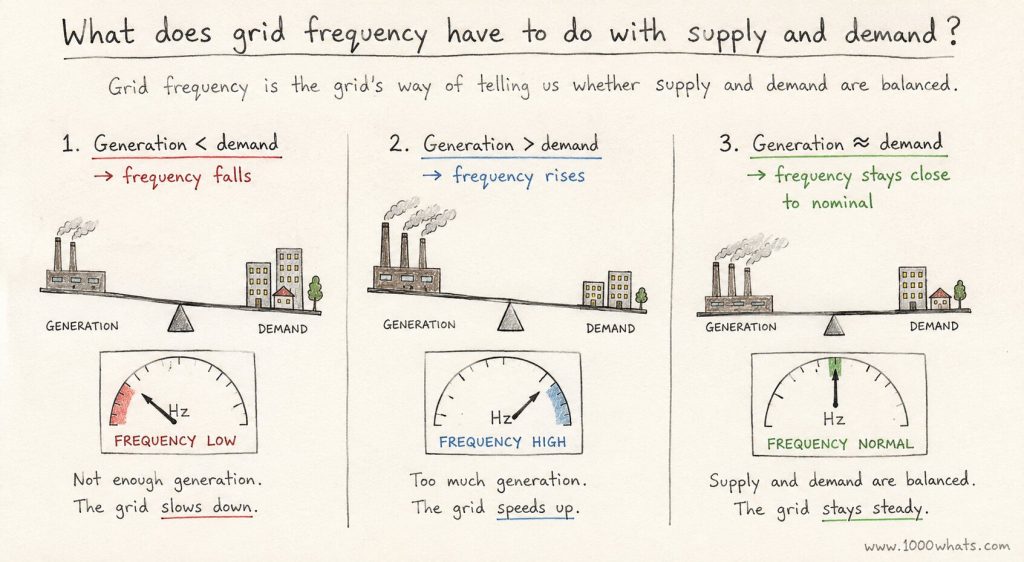
NERC explains that system frequency reflects the balance between generation and load: when generation is insufficient relative to demand, frequency falls; when generation exceeds demand, frequency rises.
That makes frequency much more than a physics number.
It is one of the grid’s vital signs.
Why does power grid frequency exist?
Frequency exists because our electricity system was largely built around alternating current and rotating electrical machines.
Inside a traditional power plant, a turbine spins a synchronous generator.
Coal, gas, nuclear, or hydro may provide the original energy, but eventually that energy turns a shaft.
Inside the generator, rotation and magnetism produce electricity through electromagnetic induction.
And here’s where the story gets interesting.
Generators connected to the same synchronous AC system have to operate together.
Not approximately together.
Synchronously.
In Great Britain, for example, the electricity system operates around a nominal frequency of 50 Hz. NESO describes frequency as the number of times per second that alternating current changes direction and explains why maintaining 50 Hz is essential to balancing the system.
Think of thousands of musicians playing inside one enormous orchestra.
Different instruments.
Different locations.
Different owners.
But everybody follows the same beat.
Frequency is that beat.
Why 50 Hz or 60 Hz?
There is nothing magical about either number.
Civilization would not collapse if Thomas Edison had woken up one morning emotionally attached to 57 Hz.
Different electricity systems standardized around different frequencies as AC power networks developed, and those choices became deeply embedded in generators, motors, transformers, protection equipment, appliances, and grid standards.
Today, changing them would mean redesigning a staggering amount of infrastructure.
So 50 Hz and 60 Hz are partly engineering standards and partly historical inheritance.
The 1000whats guide to AC electricity goes deeper into why alternating current became the backbone of modern grids.
What does grid frequency have to do with supply and demand?
This is the part worth remembering.
Imagine the electricity grid as a gigantic bicycle.
Generators are pedaling.
Consumers are applying resistance.
When the two match, the bicycle spins at the intended speed.
Now suddenly everybody turns on the air conditioning.
Demand increases.
But generation has not increased yet.
The electrical system needs more power than generators are currently supplying.
Something has to give.
Initially, rotating generators give up some of their stored kinetic energy. Their rotors slow slightly.
And because generator speed and electrical frequency are connected, frequency falls.
Now reverse the situation.
Demand suddenly disappears while generation remains high.
There is excess power.
Rotating machines accelerate.
Frequency rises.
So the fundamental relationship is beautifully simple:
- Generation < demand → frequency falls
- Generation > demand → frequency rises
- Generation ≈ demand → frequency stays close to nominal
⚡ “Frequency is basically the grid tattling on supply and demand.”
Wait—is frequency the same thing as voltage?
Nope.
And mixing these two up is one of the easiest ways to make electricity sound harder than it needs to be.
Voltage describes electric potential difference—the electrical push available to move charge.
Frequency describes how quickly the AC waveform repeats.
And electric current describes the rate at which electric charge flows.
They interact, but they are not interchangeable.
A useful mental shortcut is:
Voltage = push. Current = flow. Frequency = rhythm.
There. Electrical engineering survived.
What happens when power grid frequency drops?
A tiny movement around nominal frequency is normal.
The grid is alive.
People switch things on. Motors start. Generators change output. Wind changes. Clouds arrive. Industrial loads disappear.
Operators continuously correct those small movements.
The trouble begins when a large imbalance suddenly appears.
Suppose a major 1,000 MW generator trips offline.
Demand has not politely agreed to drop by 1,000 MW at the same moment.
Now the system has an instant power deficit.
Frequency starts falling.
How quickly it falls depends partly on the size of the imbalance and the inertia available in the system.
That speed of movement is known as the rate of change of frequency, or RoCoF.
If nothing stopped the decline, equipment protection could begin disconnecting generators or demand, potentially making the disturbance worse.
Eventually, parts of the system could separate or collapse.
That’s when “50 Hz” stops sounding boring.
How does the grid keep frequency stable?
This happens in layers.
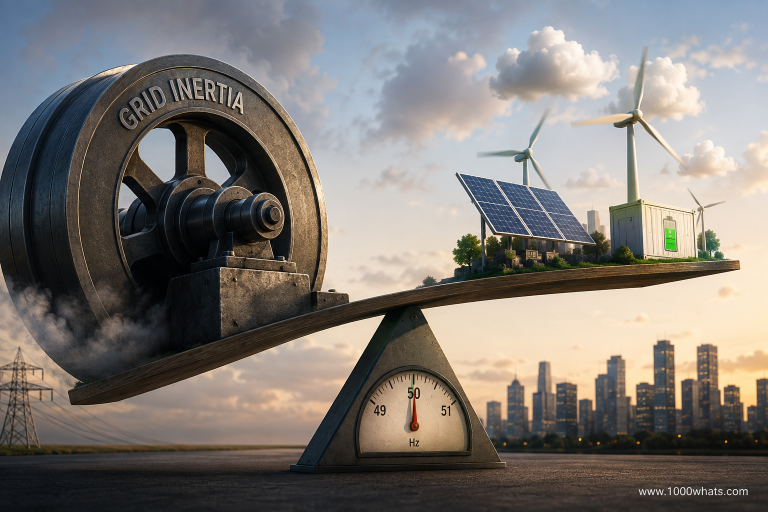
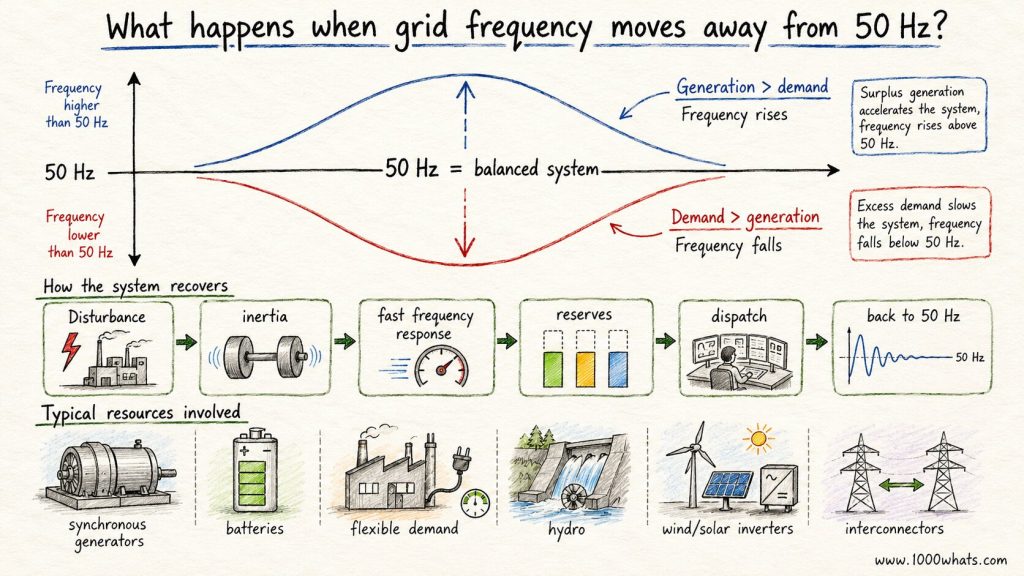
The first defense is inertia.
Traditional synchronous generators contain large spinning masses. Those rotors physically store kinetic energy.
When generation suddenly disappears, that stored motion slows the initial frequency decline, buying precious time for controlled responses to arrive.
Then other resources respond.
Grid operators maintain frequency-response and reserve services specifically so power can be increased—or demand reduced—when the system moves away from its target.
In Great Britain, NESO procures frequency-response services that are designed to react when system frequency deviates from its normal range.
A simplified sequence looks like this:
- First moments: physical inertia slows the frequency movement.
- Seconds: governors, batteries, flexible generation, and frequency-response resources react.
- Minutes: additional reserves and redispatch replace the emergency response and push frequency back toward nominal.
- Later: operators rebalance schedules, generation, storage, imports, and demand so the system is ready for the next surprise.
In practice, the clever part isn’t any one technology.
It is getting all of them to arrive in the right order.
Real-world example: When Britain hit 48.8 Hz
Want to see why frequency matters?
August 9, 2019 gave Britain a rather unpleasant demonstration.
At around 4:52 p.m., a lightning strike hit a transmission circuit.
The transmission protection operated correctly and cleared the fault quickly.
But around the same time, Hornsea offshore wind farm unexpectedly reduced output by about 737 MW, while a steam turbine at Little Barford gas power station tripped, removing another 244 MW.
Additional embedded generation also disconnected.
The generation deficit grew.
Frequency fell.
According to National Grid ESO’s official investigation into the August 9, 2019 power disruption, frequency response initially arrested the decline at around 49.1 Hz, but another Little Barford gas turbine subsequently tripped.
The cumulative loss grew to roughly 1,691 MW, and frequency fell to 48.8 Hz.
At that point, automatic Low Frequency Demand Disconnection kicked in.
About 931 MW of demand was disconnected, affecting roughly 1.1 million customers.
That forced reduction in demand helped arrest the problem, and frequency returned to 50 Hz within about five minutes.
Think about what happened.
Nothing about 48.8 Hz sounds dramatic when written on paper.
It is just 1.2 Hz below 50.
Yet that tiny numerical movement represented an enormous physical imbalance spreading through one of the world’s most sophisticated electricity systems.
That’s frequency.
A tiny number carrying a giant message.
What is grid inertia—and why is everyone suddenly talking about it?
For most of electricity history, inertia came almost free.
Coal plants had giant spinning turbines.
Gas plants had rotating generators.
Nuclear plants had them.
Hydroelectric generators had them.
All that rotating metal naturally stored kinetic energy.
Then the grid started changing.
Solar photovoltaics do not need giant turbine-generator shafts.
Many modern wind turbines connect to the network through power electronics.
Batteries do too.
These inverter-based resources behave differently from traditional synchronous machines.
Conventional grid-following inverter resources do not inherently provide the same physical synchronous inertia produced by rotating generators.
That does not mean renewable energy automatically destabilizes the grid.
That’s lazy analysis.
It means the engineering toolbox has to evolve.
ENTSO-E has published dedicated work on grid-forming capabilities and the role inverter-based resources can play in future power systems.
NREL has also researched grid-forming inverters and their role in future low-inertia power systems.
Modern wind turbines already rely on sophisticated power electronics to deliver electricity that meets grid voltage and frequency requirements, something I explore in What is wind power?.
Grid-forming inverters, batteries, synchronous condensers, fast frequency response, demand response, stronger interconnections, and smarter controls can all contribute to maintaining frequency in a system with fewer traditional synchronous machines.
The grid is not losing physics.
It is changing how it manages physics.
Batteries are ridiculously good at one part of this job
A giant steam turbine is impressive.
But it cannot teleport from zero to full response just because frequency twitched.
Batteries, meanwhile, are exceptionally fast electronically controlled resources.
That makes them useful for frequency response.
When frequency drops, a battery can increase active-power output quickly.
When frequency rises, it can reduce output or absorb power by charging.
That doesn’t make batteries magical, and it doesn’t mean every battery automatically provides every type of frequency service.
But fast grid support is one of the jobs where batteries genuinely shine.
That’s also why battery storage is becoming much more than “solar electricity saved for nighttime.”
Grid-scale batteries can support balancing and fast-response services as well as move energy between hours.
What most people don’t see is that energy capacity and response speed are different products.
A battery might not power a city for three days.
It can still be incredibly valuable if the grid desperately needs hundreds of megawatts for the next few seconds.
Do wind and solar make frequency control harder?
Sometimes.
But the usual explanation is badly oversimplified.
The challenge is not that renewable electrons are somehow less disciplined.
The challenge comes from the changing mix of generation technology, inertia, controllability, variability, and power electronics.
A solar farm connected through a conventional grid-following inverter behaves differently during disturbances than a huge synchronous generator.
Wind output also changes with weather.
Solar disappears every evening with admirable punctuality.
That increases the value of forecasting, flexibility, reserves, storage, interconnection, and advanced inverter controls.
I unpack that bigger balancing challenge in What is an intermittent renewable energy source? and What is energy forecasting?.
From a market perspective, this is one of the most important shifts happening in electricity today.
The value of a power plant is no longer just about how many megawatt-hours it can produce.
Speed, flexibility, reserve capability, system strength, and frequency response increasingly matter too.
Grid frequency versus capacity: Don’t confuse the two
Another distinction matters here.
Having enough power plants does not guarantee frequency will behave perfectly after a sudden fault.
A system might have plenty of theoretical generating capacity sitting somewhere in the country.
But frequency problems happen in seconds.
Resources have to respond fast enough.
This is why frequency-response services and capacity markets solve related but different problems.
A capacity market asks:
Will enough resources be available when the system needs them?
Frequency response asks:
Something just happened. Who can react right now?
The grid needs both preparedness and reflexes.
Owning an ambulance isn’t useful if it takes six hours to start.
What makes frequency such a useful grid signal?
Frequency has one brilliant advantage:
Physics calculates it for us in real time.
You don’t need to call every household and ask whether somebody turned on a kettle.
If total generation and demand move out of balance inside a synchronous system, the frequency responds.
That gives operators an extraordinarily fast signal about overall active-power imbalance.
But frequency is not a magical diagnostic tool.
It tells you that balance has shifted.
It does not automatically tell you why.
Was a generator lost?
Did a large load disconnect?
Did an interconnector trip?
Did inverter protection activate?
Did several events happen together?
Finding the cause requires measurements, telemetry, protection data, models, and operators who hopefully had their coffee.
So frequency is less like a full medical diagnosis and more like a pulse.
It tells you something important is happening.
Then you investigate.
Pros and cons of power grid frequency as a system-health indicator
The upside is huge: frequency is fast, system-wide across a synchronous area, continuously measurable, directly connected to active-power balance, and useful for automatically triggering corrective actions.
The limitation is equally important:
Frequency alone doesn’t locate or diagnose the disturbance.
Two completely different events can produce similar frequency movements.
And on modern inverter-heavy grids, engineers increasingly care not only about the absolute frequency but also about RoCoF, inertia, voltage behavior, system strength, and how inverter controls respond during disturbances.
ENTSO-E’s work on inertia and RoCoF reflects exactly this broader view of frequency stability.
In other words:
Watching frequency is essential.
Watching only frequency would be a terrible idea.
Why power grid frequency matters more today
Frequency control has always mattered.
What’s changing is the machinery behind it.
We are replacing some large synchronous power stations with wind, solar, batteries, interconnectors, distributed generation, smart loads, and millions of little inverter-connected devices.
Meanwhile, electricity demand itself is changing through EVs, heat pumps, data centers, electrified industry, and prosumers.
The old grid was centralized and mechanical.
The emerging grid is increasingly distributed, digital, electronic, and weather-dependent.
That makes balancing more sophisticated.
It also creates opportunities.
Batteries can respond incredibly quickly.
Renewable generators can provide advanced frequency services through controls.
Flexible industrial loads can reduce consumption.
Better energy forecasting lets operators anticipate imbalances before they happen.
And ENTSO-E’s work on grid-forming technology shows why inverter-based resources are increasingly expected to play a more active role in supporting grid stability.
The future grid may contain less spinning steel.
It will probably contain far more software.
⚡ “The old grid stabilized itself partly through heavy machinery. The future grid will increasingly stabilize itself through electronics, storage, data, and control.”
Quick answers about power grid frequency
What is normal power grid frequency?
Usually 50 Hz or 60 Hz, depending on the electricity system.
Great Britain operates at a nominal 50 Hz, as NESO explains in its guide to electricity-system frequency.
What causes grid frequency to fall?
A shortage of generation relative to demand.
This can happen if a power plant trips, an interconnector disconnects, generation suddenly falls, or demand jumps faster than supply responds.
NERC describes this generation-load relationship directly in its reliability guidance.
What causes frequency to rise?
Too much generation relative to demand.
Can low frequency cause a blackout?
Severe frequency deviations can trigger automatic protection and load shedding.
These systems deliberately disconnect some electricity demand to stop a deeper system collapse.
Britain’s 2019 event demonstrated exactly that when frequency reached 48.8 Hz, as documented in National Grid ESO’s official incident report.
Can batteries control grid frequency?
They can provide very fast active-power response and are increasingly valuable for frequency services.
Their exact role depends on inverter design, control systems, market rules, and how the battery has been configured.
Does solar electricity have frequency?
Solar panels initially produce DC electricity.
An inverter converts that power into AC suitable for the grid and synchronizes its output with the electrical system.
Final thoughts
Grid frequency might be one of the best examples of how the electricity system hides enormous complexity behind a ridiculously boring number.
You look at 50.00 Hz and see a decimal.
A grid operator sees millions of generators and consumers behaving themselves.
Then the number becomes 49.8.
Something changed.
49.5.
Something changed a lot.
And suddenly batteries are discharging, generators are responding, control-room instructions are flying, protection systems are watching, and engineers are wondering which piece of equipment just decided to ruin everyone’s afternoon.
That is why frequency fascinates me.
It turns the entire electricity system into one moving signal.
As the grid shifts toward renewables, batteries, inverters, EVs, and increasingly digital control, keeping that signal stable will become less about massive spinning machines alone—and more about speed, flexibility, electronics, and intelligence.
The heartbeat stays.
We’re changing the heart.
Until next time, stay curious! 😎
Discover more from 1000whats
Subscribe to get the latest posts sent to your email.