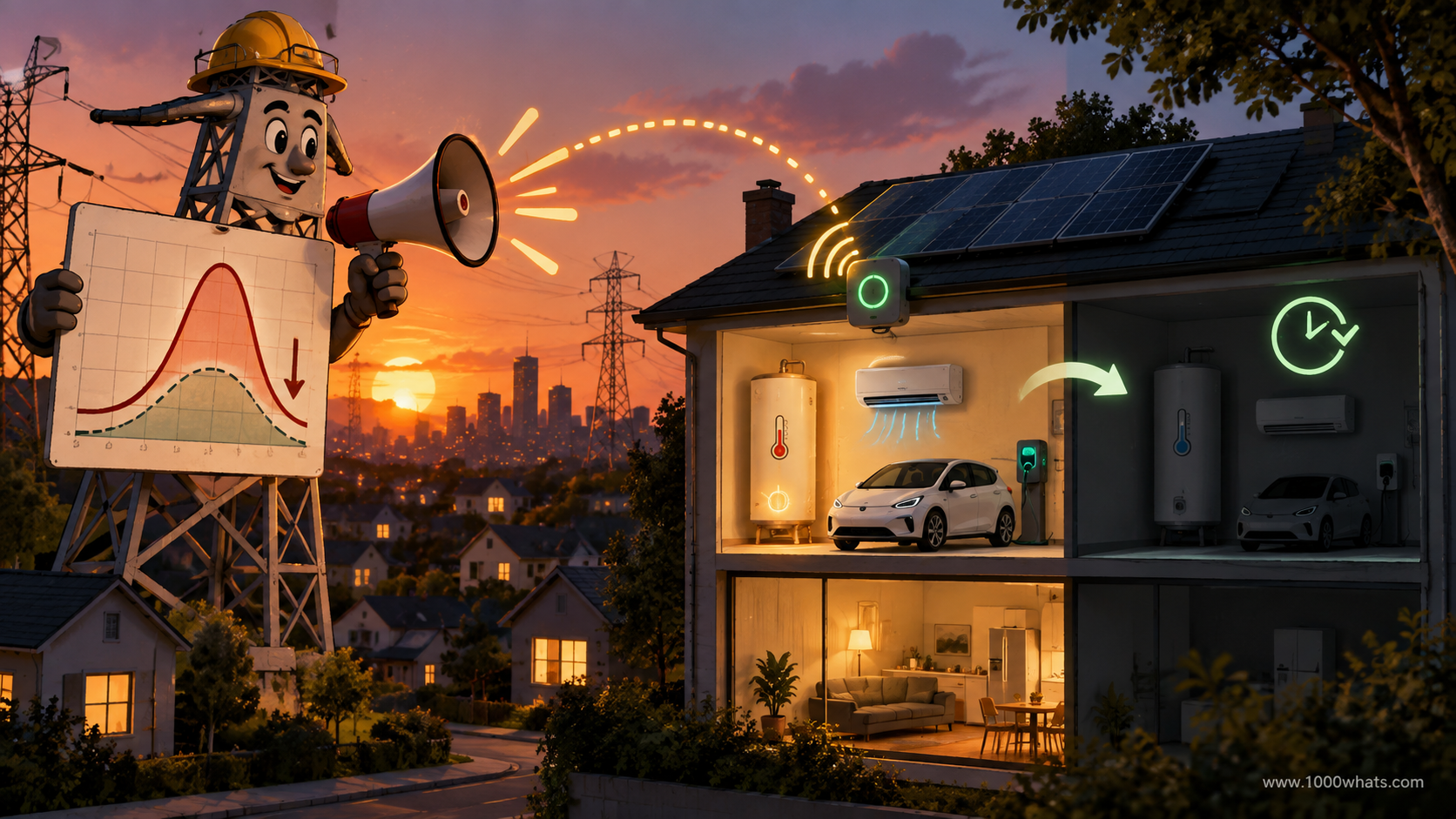
Imagine it is 6:30 p.m. on the hottest day of the year.
Millions of air conditioners are running.
Factories are still working.
People arrive home, switch on lights, start cooking, plug in cars, and generally behave as though the electricity system has unlimited patience.
Demand shoots upward.
Traditionally, the grid has one obvious response:
make more electricity.
Start another generator.
Ramp up a gas plant.
Release more water through a hydro turbine.
Import power.
Do whatever is necessary to make supply chase demand.
But there is another option.
What if, instead of producing another 500 MW for one difficult hour, we could persuade electricity consumers to temporarily use 500 MW less?
Same balance.
Completely different direction.
Welcome to 1000whats — where today the electricity consumer stops being scenery and starts doing grid work.
That idea is called demand response.
⚡ “The grid can balance itself by producing more electricity—or by needing less of it.”
And once you understand that, electricity demand starts looking much less passive than your monthly bill suggests.
First, remember the grid’s annoying rule
Electricity systems have a wonderfully inconvenient requirement:
supply and demand must remain balanced continuously.
If consumers suddenly need more electricity, something on the supply side normally has to respond.
Generators increase output.
Storage discharges.
Imports rise.
Reserves activate.
We built most electricity systems around this logic:
Demand happens. Supply reacts.
Your kettle does not phone the power station before switching on.
You simply press the button.
The system deals with your decision.
Multiply that freedom by millions of consumers and electricity demand becomes something grid operators spend their lives forecasting.
But what if some of that demand is not actually fixed?
What if some electricity consumption could move by:
five minutes,
half an hour,
two hours,
or perhaps disappear entirely during one critical period?
Now demand itself becomes part of the balancing toolbox.
That is demand response.
What is demand response?
Demand response means changing electricity consumption in response to electricity prices, financial incentives, or power-system conditions.
That change might mean:
- consuming less electricity;
- shifting consumption to another time;
- automatically adjusting equipment;
- temporarily interrupting an industrial process;
- delaying EV charging;
- changing a thermostat setting;
- or coordinating thousands of small devices through an aggregator.
ACER describes demand response as consumers—or aggregators acting on their behalf—adjusting consumption or generation in response to electricity-market prices or financial incentives.
The IEA uses the same basic idea: households and businesses shift or shed electricity use in response to grid or market signals, often receiving payments, rebates, or bill credits in return.
The important word is:
response.
Something changes in the system.
Demand reacts.
But isn’t that just energy efficiency?
No.
This distinction matters.
Suppose you replace an old 100-watt lightbulb with an LED that provides the same light using 10 watts.
You have reduced electricity consumption more or less permanently.
That is energy efficiency.
Now imagine an industrial cold-storage warehouse normally uses 5 MW at 6 p.m.
The electricity system becomes extremely tight.
The warehouse temporarily reduces its refrigeration load to 3 MW, allowing temperature to drift slightly within an acceptable range, then restores normal operation later.
That is demand response.
Efficiency asks:
How can we use less electricity to provide the same service?
Demand response asks:
Can we change when or how much electricity we use because the system needs flexibility right now?
Sometimes demand response also reduces total energy consumption.
Often it merely moves consumption through time.
That difference is crucial.
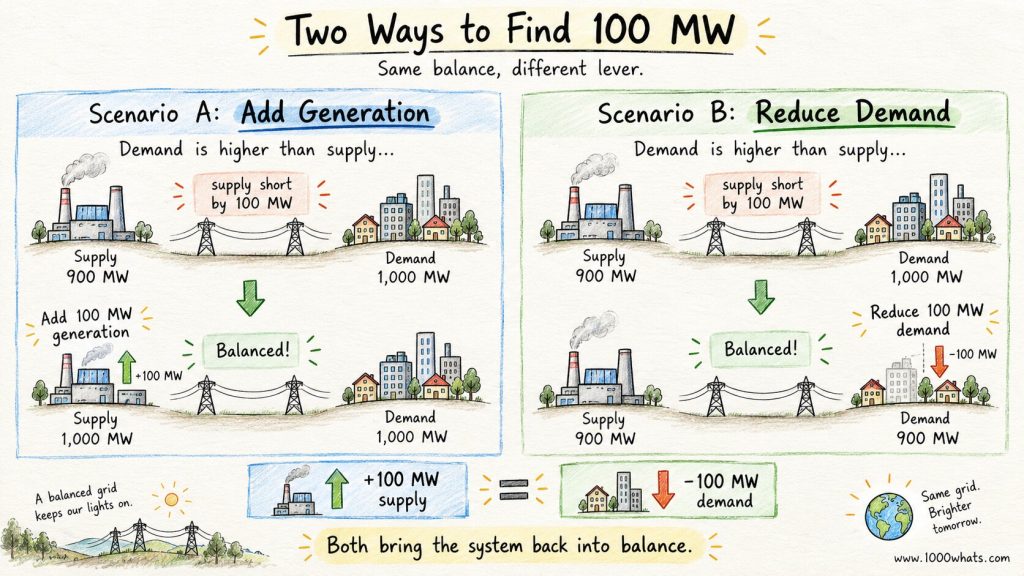
The wonderfully simple 100 MW trick
Imagine an electricity system where:
Demand = 10,000 MW
Available supply = 9,900 MW
We have a problem.
The traditional solution is:
find another 100 MW of generation.
But suppose a group of factories agrees to temporarily reduce consumption by:
100 MW.
Now:
Demand = 9,900 MW
Available supply = 9,900 MW
Balance restored.
From the perspective of the system balance, those two actions accomplished something remarkably similar.
One added supply.
The other removed demand.
This is why demand response can compete with generation in some electricity markets.
In the United States, FERC has explicitly developed market rules allowing qualifying demand-response resources to participate alongside generation where they can economically help balance supply and demand.
The grid does not care whether the balance improved because another turbine started spinning or because 20 factories stopped doing something for half an hour.
It cares that:
supply = demand.
⚡ “A megawatt you do not need can occasionally be just as useful as a megawatt you generate.”
Who can actually provide demand response?
This is where the concept becomes much bigger than turning off your kitchen light.
Some electricity demand is flexible.
Some absolutely is not.
A hospital cannot casually switch off life-support equipment because wholesale prices look unpleasant.
An aluminum smelter, cold-storage warehouse, water heater, EV charger, or commercial HVAC system may have more room to maneuver.
The most useful demand-response resources tend to have some combination of:
large electrical load + controllability + tolerance for timing changes.
Industry
Industry has historically been one of the biggest demand-response providers.
Large facilities may be able to temporarily reduce:
compressors,
pumps,
electric furnaces,
refrigeration,
electrolysis,
or certain batch processes.
The IEA estimates that industry provided roughly 75 GW of the approximately 100 GW of demand response utilized globally in 2024.
That makes sense.
Calling one industrial customer and asking for 50 MW of flexibility is operationally easier than negotiating individually with 50,000 households over their water heaters.
But digitalization is changing that equation.
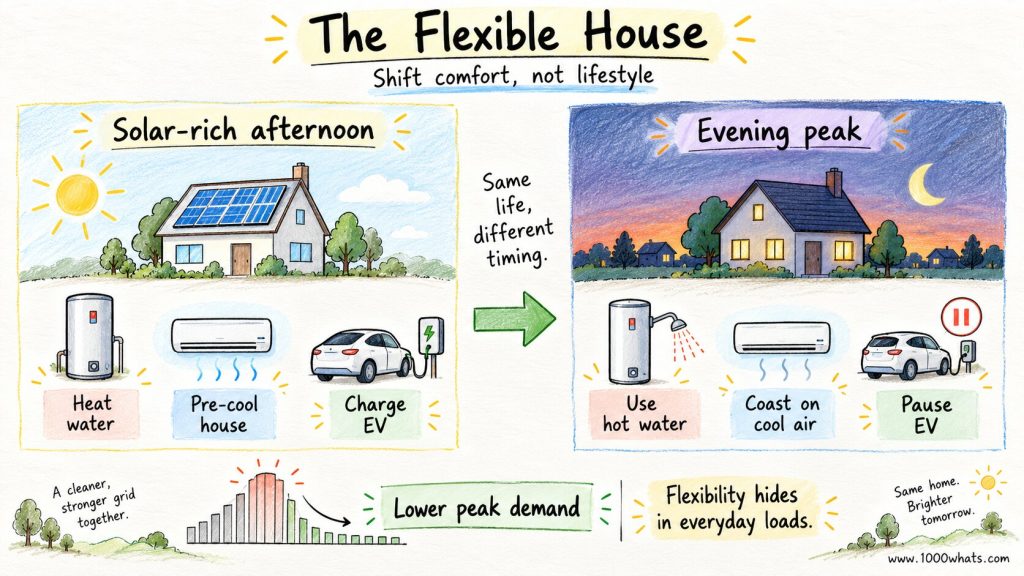
Buildings are full of tiny batteries that are not batteries
Consider your house on a hot afternoon.
The air conditioner switches on.
The room cools.
Then the compressor stops.
Does the temperature instantly jump back to 35°C?
No.
The building has thermal inertia.
Walls, furniture, air, floors, and insulation slow the temperature change.
That means the air conditioner does not necessarily need to run at precisely the moment it otherwise would.
Perhaps it can stop for ten minutes.
Or cool the house slightly earlier.
The occupant may never notice.
Water heaters behave similarly.
Heat the water before the evening peak.
Then stop heating during the expensive hour.
The hot-water tank stores thermal energy.
Again:
no giant lithium battery required.
The IEA estimates that buildings currently provide only around 30 GW of utilized demand response globally, despite enormous flexible loads in air conditioning, space heating, and water heating.
This is one of the deeper ideas behind demand response.
Flexibility can be hidden inside ordinary equipment.
A building does not look like an energy-storage device.
Thermodynamically, parts of it can behave like one.
Then EVs arrive
Electric vehicles create new electricity demand.
That sounds like a grid problem.
It can be.
Imagine millions of people arriving home at:
18:00
and immediately plugging in.
Wonderful.
We have just synchronized a giant new load with the existing evening peak.
But now ask a different question.
Does every EV need to begin charging at 18:01?
Usually not.
Suppose the car needs:
40 kWh
before its owner leaves at:
07:00.
The system has almost 13 hours to find a good charging window.
Maybe it charges at 22:00.
Maybe at 02:00.
Maybe during a windy night.
Maybe during a period of very low electricity prices.
The driver’s requirement is not:
Charge now.
It is:
Be charged by morning.
Those are very different grid instructions.
Smart charging can therefore turn EVs from an inflexible new load into a potentially enormous source of demand flexibility.
The IEA says transport currently contributes less than 5 GW of utilized demand response globally, but sees significant potential as EV fleets and smart charging expand.
The battery happens to have wheels.
The flexibility still counts.
Price does some of the work
Not all demand response requires a grid operator pressing a giant red button marked:
PLEASE STOP USING ELECTRICITY.
Sometimes the price signal does the work.
Imagine electricity costs:
€50/MWh at 3 a.m.
and:
€250/MWh at 7 p.m.
A flexible industrial consumer may decide to move production.
An EV charging system may wait.
A battery may charge earlier.
A building-management system may pre-cool before the expensive period.
This is often called implicit demand response or price-based demand response.
The consumer sees a changing electricity price and changes behavior accordingly.
Dynamic electricity tariffs and time-of-use pricing are designed partly around this idea.
ACER has identified stronger price signals and wider access to dynamic pricing as important ways to unlock demand flexibility in Europe.
But price signals only work if consumers actually see them.
And many do not.
ACER reports that more than 70% of EU households still lack dynamic-price contracts.
If your electricity costs exactly the same at 3 a.m. and 7 p.m., the market is giving you very little reason to care when you charge the car.
The grid may desperately care.
Your bill does not.
That is a design problem.
Or somebody can pay you directly
The other major model is explicit demand response.
Here, consumers commit flexibility directly to:
a utility,
an aggregator,
a system operator,
or an electricity market.
Suppose a factory agrees:
If the system becomes tight, I can reduce my load by 20 MW for up to one hour.
That flexibility has value.
The factory might receive:
a capacity payment for being available,
an activation payment when actually called,
a market payment,
or some combination.
Now the factory is not merely an electricity consumer.
It is selling a service to the power system.
This is where demand response begins to look strangely like generation.
A gas turbine says:
Pay me and I will inject 20 MW.
The factory says:
Pay me and I will stop withdrawing 20 MW.
From the grid balance:
+20 MW supply
and:
−20 MW demand
move us in the same direction.
Commercially and physically, they are not identical.
Systemically, the resemblance is extremely useful.
Meet the aggregator
There is one obvious problem.
Your water heater is tiny.
The electricity market does not want to negotiate a balancing contract with your bathroom.
Nor with your neighbor’s air conditioner.
Nor with somebody’s EV charger three streets away.
Enter the aggregator.
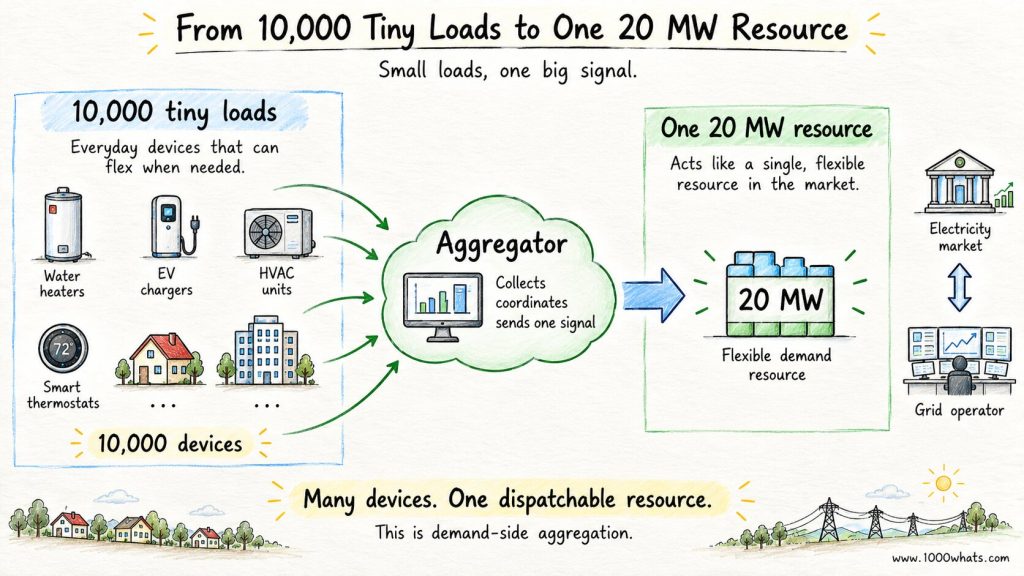
An aggregator combines many small flexible loads into a portfolio large enough to participate meaningfully in electricity markets or grid programs.
Imagine:
10,000 homes.
Each can temporarily adjust:
2 kW.
Individually:
irrelevant to a transmission-system operator.
Together:
20 MW.
Now we have something interesting.
Software can coordinate:
thermostats,
water heaters,
batteries,
EV chargers,
rooftop solar,
commercial refrigeration,
and other controllable equipment.
If this sounds familiar, it should.
It is one of the central ideas behind a Virtual Power Plant.
The individual devices remain distributed.
Coordination makes them behave like one resource.
The power plant is partly software.
Energy has become weird.
Demand response is not the same thing as a VPP
The concepts overlap.
They are not synonyms.
Demand response describes the flexibility action:
changing electricity consumption in response to system or market conditions.
A Virtual Power Plant describes a way of aggregating and coordinating distributed resources.
A VPP may include:
demand response,
batteries,
rooftop solar,
EVs,
small generators,
or combinations of them.
So:
Demand response = what flexible demand does.
VPP = one way many distributed resources can be organized to do it at scale.
That distinction is worth keeping.
Otherwise every smart thermostat eventually becomes a power plant in marketing material.
We have enough of those already.
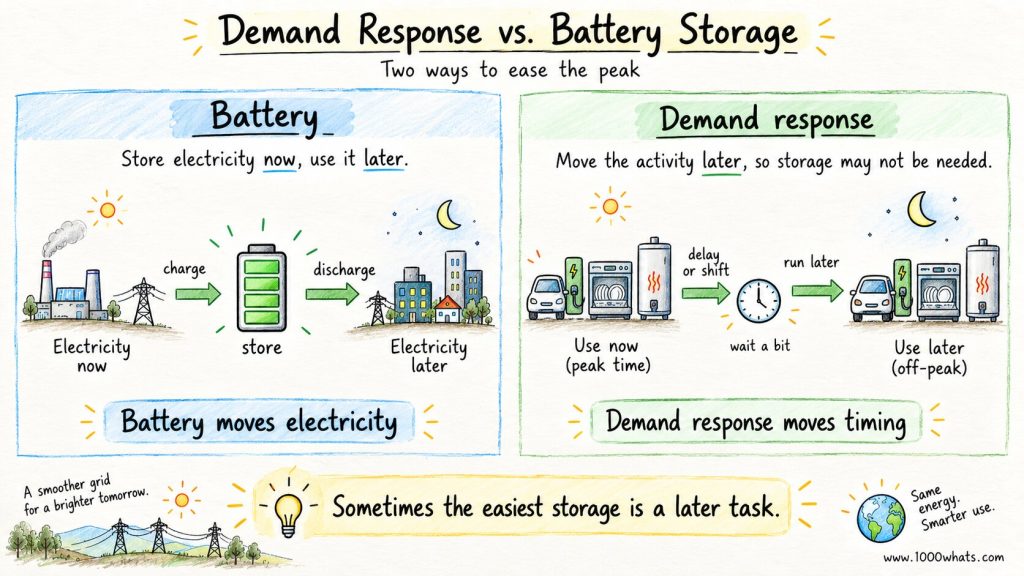
Why not just build a battery?
Sometimes that is exactly what we should do.
Battery storage is extraordinarily useful.
It can absorb electricity and release it later.
Demand response does something different.
It changes the load itself.
Suppose a water heater needs 10 kWh sometime between midnight and 6 a.m.
Option A:
Generate electricity now → charge battery → discharge battery later → heat water.
Option B:
Wait → heat the water later.
Option B may require no grid battery at all.
The flexible appliance simply moved its consumption.
This does not mean demand response replaces batteries.
Far from it.
Our article on battery storage explains why batteries are becoming such powerful short-duration flexibility resources.
But the comparison reveals something important:
Before storing electricity so we can use it later, it is worth asking whether some demand could simply wait.
Sometimes the cheapest battery is a schedule.
Demand response can help with grid congestion too
Now imagine a local substation.
At 18:00 it is overloaded because:
EVs are charging,
heat pumps are running,
homes are cooking,
commercial loads remain active.
One solution is obvious:
upgrade the substation.
Build more network capacity.
That may be necessary.
But suppose the overload occurs for only:
50 hours per year.
Could some EV charging move to 22:00?
Could water heating happen earlier?
Could commercial HVAC reduce load briefly?
Could a battery discharge locally?
Now the peak may fall enough to delay or reduce the network investment.
This connects directly to the problem we explored in grid congestion.
The IEA notes that demand flexibility can reduce peak capacity requirements, defer some grid investment, reduce renewable-integration costs, and help manage network constraints.
Again, demand response does not eliminate the need for grid expansion.
There is a dangerous version of this argument where flexibility becomes an excuse to never build infrastructure.
That would be silly.
Sometimes the road genuinely needs another lane.
But sometimes rush hour can also be managed better.
Both things can be true.
And then solar creates the opposite problem
Demand response is often explained as:
Use less electricity when the grid is stressed.
That is only half the story.
A renewable-heavy power system can also need consumers to use more electricity at certain times.
Imagine a sunny spring Sunday.
Demand is low.
Solar generation is enormous.
Wholesale electricity prices collapse.
Some renewable output may need to be curtailed.
What should flexible demand do?
Turn on.
Charge EVs.
Heat water.
Run industrial processes.
Charge thermal storage.
Shift flexible loads into the solar-rich hours.
The grid is now saying:
Please consume electricity. We have plenty.
That sounds bizarre only because we spent a century thinking of electricity conservation as:
less is always better.
In a variable power system, when electricity is consumed can become almost as important as how much is consumed.
The IEA’s 2026 flexibility analysis specifically highlights flexible demand as one of the tools for handling periods of abundant wind and solar output.
This is the demand-side version of teaching electricity to follow the weather.
A real-world example: the aluminum smelter nobody notices
Aluminum production is extremely electricity-intensive.
Globally, the IEA estimates aluminum production contributes around 160 GW of peak electricity demand.
That is an enormous electrical load.
Yet only a relatively small part is currently used for demand response.
Why is aluminum interesting?
Because industrial loads are not simply:
ON
or:
OFF.
Some processes can temporarily alter power consumption within technical constraints without shutting the entire factory.
That means a giant industrial consumer can potentially provide grid flexibility measured in tens or hundreds of megawatts.
No new power plant.
No new battery farm.
No mountain flooded for pumped hydro.
The flexibility was already sitting inside an existing industrial process.
The hard part is making that flexibility:
technically controllable,
commercially worthwhile,
contractually available,
and safe for the industrial operation.
That final point matters.
Grid flexibility is valuable.
Ruining a multimillion-dollar industrial process to provide it is generally considered poor optimization.
Why aren’t we doing much more of this already?
Excellent question.
Because the technology is often easier than the market design.
The IEA estimates only around 100 GW of demand response was actually utilized globally in 2024. Compare that with enormous potentially flexible loads from industry, buildings, cooling, heating, and eventually transport.
Why the gap?
Because demand response needs infrastructure around it.
Smart meters.
Automation.
Communication systems.
Market access.
Contracts.
Baseline methodologies.
Settlement rules.
Consumer incentives.
Aggregators.
Cybersecurity.
And regulation that actually allows flexible demand to compete.
ACER has identified persistent European barriers including restricted access to balancing and congestion-management services, limited incentives, market-entry restrictions, retail-price interventions, and inadequate frameworks for distributed flexibility.
This is a recurring energy-transition theme.
The machine often works before the rulebook does.
The baseline problem: How do you measure electricity that was never consumed?
Here is where demand response gets delightfully philosophical.
Suppose I promise to reduce my factory’s demand by:
10 MW.
The system operator activates me.
After activation, my meter shows:
40 MW.
Wonderful.
Did I reduce demand by 10 MW?
Maybe.
But what would I have consumed without the demand-response event?
50 MW?
45 MW?
40 MW anyway?
We cannot measure the counterfactual directly because it never happened.
So demand-response programs often need a baseline—an estimate of what consumption would have been under normal conditions.
Then:
baseline consumption − actual consumption = estimated demand response
This matters commercially.
If the baseline is too high, consumers can appear to provide flexibility they never actually provided.
If it is too low, genuine flexibility may go unpaid.
Suddenly the supposedly simple act of switching something off requires statistics.
Welcome back to electricity markets.
Does demand response inconvenience consumers?
It can.
That is the obvious downside.
A factory may lose production.
A commercial building may tolerate less cooling.
A household may dislike having equipment controlled remotely.
An EV owner may genuinely need the car charged immediately.
Demand response only works sustainably if the service being provided to the consumer remains acceptable.
This is why automation matters.
The ideal residential demand response event is often one you barely notice.
Your water heater shifts by 30 minutes.
Your thermostat changes slightly.
Your EV waits until later.
The freezer compressor pauses briefly.
Nothing dramatic happens.
The grid gets flexibility.
You continue watching Netflix.
Civilization survives.
The consumer needs a reason to care
Demand response creates value for the electricity system.
That does not mean consumers should donate it.
If shifting my factory’s production saves the grid money, some of that value needs to reach me.
If an aggregator controls my EV charging, I need:
a cheaper tariff,
a payment,
a rebate,
or some other benefit.
Otherwise the arrangement becomes:
Congratulations, your inconvenience has improved system economics for somebody else.
Not a brilliant customer proposition.
The IEA emphasizes financial incentives as a central part of successful demand-response participation, while ACER is pushing for stronger price signals and easier market access for flexible consumers and aggregators.
Flexibility has value.
Markets need a way to reveal and share that value.
Demand response and resource adequacy
Now we reach one of the most interesting connections.
Suppose an electricity system expects a shortage during:
20 extremely difficult winter hours.
One solution is to build a new power plant that sits mostly idle and waits for those hours.
Another possibility is to contract consumers who can reliably reduce demand during those same scarcity events.
That is why demand response appears in our article on resource adequacy.
Adequacy is not about having enough power plants.
It is about having enough resources to keep supply and demand balanced during difficult conditions.
A factory capable of reliably dropping:
50 MW
during scarcity is an adequacy resource.
It may not own a generator.
It does not need one.
Its product is:
not consuming.
This is one of the stranger things electricity markets sell.
Nothing.
At exactly the right moment.
⚡ “Demand response turns not using electricity into something the electricity system can actually buy.”
Why demand response matters more now
For most of the twentieth century, electricity demand was treated as largely passive.
Forecast it.
Then build generation and networks around the forecast.
That world is changing.
Electric vehicles add flexible charging.
Heat pumps add controllable thermal loads.
Smart meters make consumption more visible.
Home-energy systems can automate decisions.
Industrial processes become increasingly digital.
Solar and wind create larger differences between cheap and expensive hours.
Battery storage makes flexibility commercially visible.
And electricity demand itself is growing rapidly.
The IEA expects global electricity demand to rise by roughly 3.6% per year between 2026 and 2030, with EVs, cooling, data centers, heat pumps, and industrial electrification among the major drivers.
That creates an interesting choice.
We can build the electricity system assuming every new load is rigid.
Or we can make some of those loads intelligent.
The second system may need fewer rarely used assets.
Europe is starting to take this seriously
Demand response has spent years being described as:
promising.
Energy has several technologies permanently trapped in that adjective.
But Europe is now moving toward a much more formal flexibility framework.
ACER approved a common methodology for assessing national non-fossil flexibility needs in 2025. EU Member States were then required to conduct national assessments, with indicative national flexibility targets due by January 2027.
The European Commission is also developing an EU-wide Network Code on Demand Response, intended to improve access for demand-response resources to wholesale markets and local services such as congestion management and voltage control.
That sounds bureaucratic.
It is.
It is also important.
Because demand response does not scale merely because millions of flexible devices exist.
They need rules allowing them to participate.
A flexible water heater without market access is still mostly:
a water heater.
What are the benefits?
Demand response can do several useful things at once:
- reduce peak electricity demand;
- lower the need for rarely used generation capacity;
- reduce exposure to extreme electricity prices;
- help integrate wind and solar;
- support resource adequacy;
- provide balancing and other grid services;
- reduce local network stress;
- defer some grid investment;
- give consumers a way to earn from flexibility;
- make EVs, heating, and other electrified loads easier to integrate.
FERC also notes that effective demand response can reduce electricity-price volatility, mitigate market power, and improve reliability.
That is a surprisingly large résumé for something whose main activity is occasionally doing less.
And what are the drawbacks?
Demand response is not free flexibility.
Consumers may actually need the electricity
Some demand cannot move.
A factory has production targets.
A household has comfort requirements.
An EV may need to leave.
Flexibility has limits.
Measurement can be messy
Baselines and verification matter.
You need to know whether the promised response actually happened.
Automation requires infrastructure
Smart meters, controls, communications, software, and cybersecurity all cost money.
Price signals can create complexity
Dynamic pricing rewards flexibility but can expose consumers to more volatile electricity costs if badly designed or poorly understood.
Aggregation creates new coordination problems
Ten thousand devices behaving as one resource is powerful.
Ten thousand devices unexpectedly doing the same wrong thing is also powerful.
Consumers can simply say no
This one is frequently underestimated.
The energy transition eventually enters people’s homes.
Trust matters.
Privacy matters.
Comfort matters.
Good program design matters.
People are not merely distributed energy resources with Netflix subscriptions.
Is demand response about forcing people to switch things off?
It should not be.
Emergency load shedding exists.
That is different.
Demand response is generally voluntary, contracted, automated, price-driven, or incentivized flexibility.
The entire point is to identify electricity consumption that can move without destroying the service the consumer actually wants.
You do not care precisely when your water heater uses electricity.
You care that the shower is hot.
You may not care whether the EV charges at 23:00 or 03:00.
You care that the battery is ready in the morning.
The electricity system historically focused on supplying:
kilowatt-hours.
Demand response forces us to think more carefully about what consumers actually buy.
Often they are buying:
comfort,
mobility,
cold food,
hot water,
compressed air,
industrial output.
Electricity is the input.
If the input can move in time while the service remains intact, flexibility exists.
That is the deeper idea.
So, what is demand response in one sentence?
Demand response is the intentional adjustment of electricity consumption in response to prices, incentives, or grid conditions so that demand itself helps balance and operate the power system.
Sometimes that means:
use less.
Sometimes:
use later.
And increasingly:
use more when electricity is abundant.
The important thing is that demand stops behaving like an immovable object.
It becomes a resource.
Final thoughts
The electricity industry spent more than a century becoming extraordinarily good at one trick:
whatever consumers do, make supply follow them.
That made sense.
Electricity was difficult to store.
Consumers had little information about system conditions.
Appliances were dumb.
Power plants were large.
Demand was simply something to forecast.
Now almost every part of that picture is changing.
Meters can communicate.
Cars have batteries.
Buildings have controllable heating and cooling.
Factories can automate processes.
Aggregators can coordinate thousands of devices.
Solar can make electricity abundant at noon and scarce again a few hours later.
And suddenly the old assumption—
demand happens; supply reacts
—starts looking unnecessarily rigid.
The future grid will still need power plants.
It will still need batteries.
It will definitely need more networks.
But it may also discover that one of its largest untapped resources was sitting on the other side of the electricity meter all along.
Not another generator.
A consumer capable of saying:
I can wait.
Sometimes that may be worth a lot of money.
Until next time, stay curious! 😎
Discover more from 1000whats
Subscribe to get the latest posts sent to your email.