
Imagine buying exactly enough electricity for tomorrow.
Every expected MWh.
Every hour.
Beautiful forecast.
Beautiful schedule.
Beautiful spreadsheet.
At 14:03, a 1,000 MW power station trips.
The spreadsheet remains beautiful.
The grid has other concerns.
Demand has not suddenly fallen by 1,000 MW because a generator had a bad afternoon. Millions of motors, pumps, computers, factories, elevators, air conditioners, and refrigerators continue consuming electricity with magnificent indifference.
Something has to react.
Fast.
And this is where electricity stops being merely:
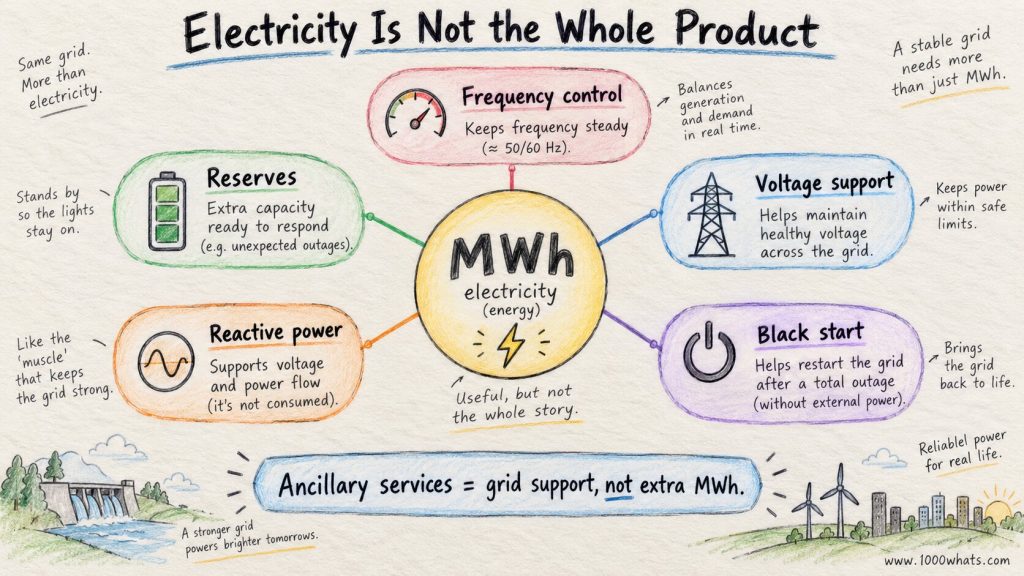
energy bought and sold in MWh
and becomes:
an entire collection of services required to keep those MWh usable.
Welcome to 1000whats — where today we discover that electricity apparently comes with optional extras.
Except they are not optional.
They are called:
ancillary services.
⚡ “The electricity market buys energy. Ancillary services help make sure the grid survives long enough to deliver it.”
Electricity is a surprisingly demanding product
Suppose you order:
100 MWh.
What exactly did you buy?
Energy.
Fine.
But the electricity system also needs someone capable of dealing with things such as:
a generator suddenly failing,
demand changing unexpectedly,
wind producing less than forecast,
solar output moving under clouds,
frequency drifting,
voltage moving outside acceptable limits,
or the deeply inconvenient event known technically as:
a blackout.
The U.S. Federal Energy Regulatory Commission’s ancillary-services overview describes ancillary services as services used to maintain grid stability and resilience, including frequency regulation, operating reserves, voltage support, reactive power, and black-start capability.
In plain English:
The grid needs more than electricity.
It needs electricity with manners.
The easiest way to understand ancillary services
Think about an airline.
You buy:
a flight from A to B.
But making that flight possible requires much more than jet fuel.
Air traffic control.
Ground handling.
Navigation.
Maintenance.
Backup systems.
Runway operations.
Weather monitoring.
You do not normally buy each one separately when purchasing seat 14A.
But remove them and the phrase:
“flight from A to B”
becomes considerably more adventurous.
Electricity works similarly.
The energy is the obvious product.
Ancillary services are the supporting capabilities that allow the interconnected power system to deliver that product reliably.
The exact definition and list vary between electricity systems and market designs, but the underlying idea remains the same:
some grid jobs are valuable even though they are not simply MWh production.
First problem: generation and demand refuse to stay perfectly matched
Electricity has an annoying operational requirement.
Generation and consumption must remain closely balanced in real time.
Not approximately next Thursday.
Now.
If generation suddenly becomes lower than demand:
frequency falls.
If generation becomes higher than demand:
frequency rises.
My existing article on grid inertia explains what happens immediately after a disturbance: rotating synchronous machines can slow the initial frequency movement, while fast-response resources then need to help restore the balance.
Inertia buys time.
But inertia does not replace the missing 1,000 MW.
Something eventually has to produce more electricity.
Or somebody has to consume less.
Preferably before the control-room coffee gets involved.
Meet the reserves
This is where frequency reserves enter.
European terminology can initially look as though somebody spilled alphabet soup onto a grid-code document:
FCR
aFRR
mFRR
and, historically in some systems:
RR
Do not panic.
The basic hierarchy is much simpler than the acronyms.
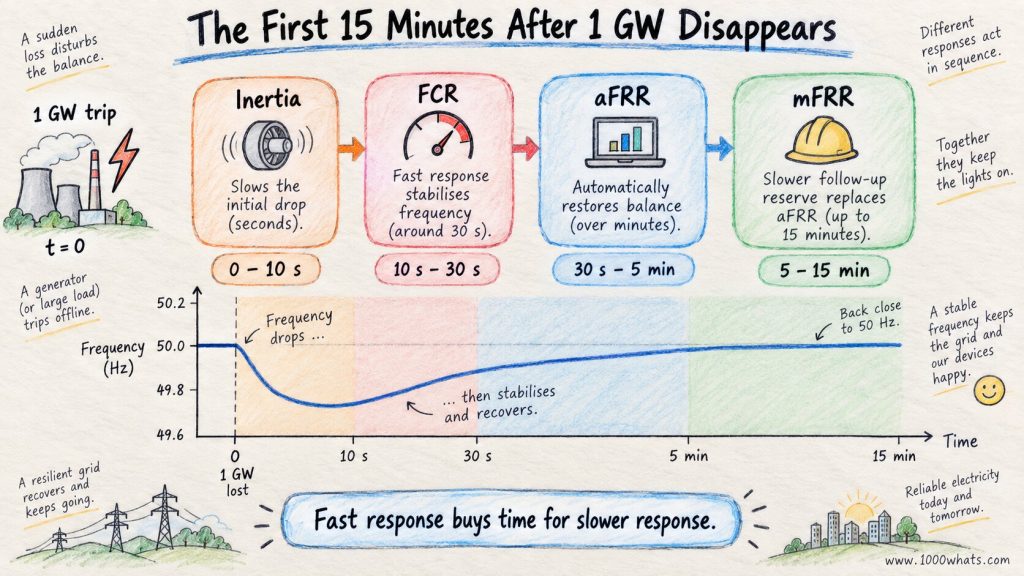
Different reserves respond at different stages after the system becomes unbalanced.
Very roughly:
| Service | Main job | Typical character |
|---|---|---|
| FCR | Arrest/stabilize frequency deviation | Very fast, automatic |
| aFRR | Restore frequency and area balance | Automatic |
| mFRR | Provide further restoration/balancing | Manually activated by TSO process |
| Replacement reserve | Replace earlier reserves where used | Slower |
ENTSO-E describes Frequency Containment Reserve, or FCR, as the reserve that stabilizes system frequency after a disturbance, while Frequency Restoration Reserve, or FRR, subsequently works to restore frequency and control-area balance.
Think:
Catch it.
Then:
bring it back.
Then:
make sure the first responders are not stuck doing this forever.
Electricity engineering has many acronyms.
The physics remains refreshingly uninterested in them.
Imagine a 1,000 MW generator trips
At 12:00:00:
generation = demand.
Frequency sits around:
50 Hz
in continental Europe.
At 12:00:01:
a 1,000 MW unit disappears.
Demand does not.
Now generation is short.
Frequency starts falling.
The rough response looks like this:
Disturbance
↓
inertia slows the initial frequency movement
↓
FCR reacts and helps contain the deviation
↓
aFRR helps restore frequency and control-area balance
↓
mFRR and other redispatch/balancing actions can provide additional or replacement response
That sequence is simplified.
Real systems overlap responses, national arrangements differ, and market design can become gloriously complicated.
But conceptually:
different services solve different parts of the same emergency.
FCR: stop the fall
Suppose frequency starts dropping.
The first job is not:
return instantly to exactly 50.000 Hz.
The first job is:
stop this from getting worse.
FCR responds rapidly to frequency deviation.
Resources providing it automatically adjust active power—or controllable demand—in response to frequency.
A generator can increase output.
A battery can inject power.
A flexible load can reduce consumption.
Different physical action.
Same balancing effect.
If the system is missing 100 MW, then:
+100 MW generation
and:
−100 MW demand
both improve the power balance by 100 MW.
This is one of those electricity concepts that sounds obvious only after someone points it out.
Then aFRR starts cleaning up
FCR helps contain the frequency deviation.
But we do not want frequency merely stabilized somewhere below its target forever.
Now the system needs to restore the balance more fully.
Enter:
automatic Frequency Restoration Reserve.
aFRR is automatically activated according to control signals from the transmission system operator.
In Europe, cross-border exchange of aFRR balancing energy is increasingly organized through the wonderfully named:
PICASSO.
No relation to cubism.
Although European electricity-market design occasionally has similar visual properties.
ENTSO-E’s PICASSO platform is the European platform for exchanging balancing energy from aFRR across participating systems.
Instead of every TSO relying only on balancing bids inside its own borders, integrated platforms allow balancing energy to be exchanged across participating systems when network capacity and market conditions permit.
The balancing market starts becoming European.
And then there is mFRR
mFRR means:
manual Frequency Restoration Reserve.
The word manual can be slightly misleading if you imagine a man in a control room dramatically pulling a giant lever marked:
MORE ELECTRICITY.
Activation processes are heavily automated operationally.
The distinction is about the reserve product and activation logic rather than somebody physically sprinting toward a turbine.
mFRR provides another layer of balancing capability and can help address larger or more persistent system imbalances.
Europe’s common platform for exchanging mFRR balancing energy is called:
MARI.
ENTSO-E describes MARI and PICASSO as key European platforms for integrating mFRR and aFRR balancing-energy markets.
So Europe now has:
PICASSO.
MARI.
And electricity.
Apparently naming market platforms after things people can actually pronounce was considered too dangerous.
Wait—are balancing and ancillary services the same thing?
Not exactly.
They overlap heavily.
And terminology differs across markets.
Balancing services specifically deal with keeping generation and consumption balanced and restoring that balance when deviations occur.
Ancillary services is the broader umbrella and can also include things such as:
- voltage support;
- reactive power;
- black-start capability;
- operating reserves;
- other reliability services.
This distinction matters because not every grid problem is a frequency problem.
Sometimes the grid has enough MW.
And still needs help.
⚡ “A power system can have enough electricity and still not have enough of the electrical properties required to move that electricity safely.”
Welcome to reactive power.
Reactive power: electricity doing useful work without doing the work you recognize
Most consumers think electricity has one job:
power things.
Turn motor.
Heat kettle.
Light lamp.
Charge phone.
That useful energy transfer is associated with:
active power.
Measured in:
watts.
But AC power systems also involve:
reactive power.
Reactive power does not perform net useful work over a complete AC cycle in the same way active power does.
Yet it is essential for maintaining voltage and supporting electromagnetic fields in equipment such as motors and transformers.
FERC includes reactive power and voltage support among key ancillary services needed for reliable grid operation.
So reactive power occupies one of the electricity industry’s favorite categories:
extremely important thing that sounds fake when first explained.
You can have plenty of active generation and still face voltage problems.
Because:
MW is not the whole grid.
Why can’t voltage support just come from anywhere?
Because voltage is strongly local.
Frequency is a system-wide phenomenon across a synchronous area.
Voltage behaves differently.
Reactive power does not travel efficiently over long distances.
That means voltage support often needs to come from resources located reasonably close to where the network needs it.
Generators can provide reactive power.
So can:
synchronous condensers,
capacitor banks,
STATCOMs,
some wind and solar inverter systems,
battery inverters,
and other equipment.
This creates a very different market-design problem from ordinary energy.
If the grid needs reactive power in one particular location, having enormous reactive capability 800 kilometers away may be emotionally supportive.
Electrically?
Less impressive.
This is one reason some ancillary services are naturally more local than energy markets.
Then there is black start
Imagine the worst case.
Not:
one generator trips.
Not:
frequency moves.
The grid is down.
Large parts of it have gone dark.
Now someone says:
Start the power plants.
Excellent idea.
Small complication:
large power plants often need electricity to start.
Pumps.
Fans.
Fuel systems.
Control systems.
Lubrication.
Auxiliary equipment.
So:
the grid needs power plants.
The power plants need the grid.
Everybody looks at everybody else.
This is where:
black-start capability
becomes extremely useful.
A black-start resource can start without relying on the external grid and then help energize other equipment and progressively rebuild the power system.
Hydropower has traditionally been particularly useful for this in many systems because certain hydro units can start relatively simply without large external auxiliary supplies.
Other technologies can provide black-start capability too.
FERC lists black start among the core ancillary services required to help restore an electricity system after a major outage.
It is essentially the electrical equivalent of keeping one match outside the locked match factory.
Who actually provides ancillary services?
Historically, many came from conventional power stations.
Coal.
Gas.
Nuclear.
Hydro.
Large synchronous generators naturally possessed useful characteristics:
inertia,
frequency response,
reactive power,
voltage support,
short-circuit strength,
and controllable output.
For decades, electricity systems received many of these capabilities almost bundled with generation.
Buy the giant turbine.
Receive several useful grid properties at no additional conceptual charge.
Then the generation mix changed.
Solar arrived.
Wind expanded.
Batteries exploded.
Power electronics became everywhere.
Coal plants retired.
Gas plants began operating differently.
And suddenly system operators started noticing that:
MWh were never the whole product.
We simply spent a century buying machines that quietly provided several other services at the same time.
Batteries are absurdly good at some of this
A battery can change output extremely quickly.
That makes it particularly attractive for fast frequency services.
Suppose the grid asks for:
+20 MW.
A thermal generator may need to alter valves, fuel input, steam conditions, or turbine output.
A battery inverter can change electrical output extraordinarily quickly within its operating limits.
No boiler negotiation required.
FERC explicitly notes that grid-scale batteries can provide frequency regulation because of their rapid response and accuracy.
This is one reason my existing battery-storage article only tells part of the battery story.
Batteries do not merely:
charge cheap → discharge expensive.
They can sell:
speed.
And speed can be a product.
But a battery has to keep something in reserve
Here is where the economics become interesting.
Imagine a:
100 MW battery.
It is currently discharging:
100 MW
into the energy market.
How much additional upward reserve can it provide?
Potentially:
zero.
It has already hit its power limit.
To sell 20 MW of upward reserve, it may need to operate at no more than:
80 MW
so it can move to:
100 MW
when called.
That unused 20 MW is:
headroom.
And headroom has an opportunity cost.
The battery could potentially have earned money selling that capacity into the energy market.
Instead, it keeps some capability available in case the TSO needs it.
That is why ancillary services are not simply:
free bonus money for batteries.
The asset is reserving flexibility.
From a market perspective, that flexibility competes with other uses of the same machine.
The same problem applies to generators
Suppose a 500 MW gas plant is producing:
500 MW.
Can it offer:
100 MW upward reserve?
No.
The turbine has not discovered 600 MW because the market created a new product.
To provide 100 MW upward capability, it might operate around:
400 MW
and hold:
100 MW
available.
Again:
headroom.
That may mean giving up energy-market revenue.
So ancillary-service bids can reflect:
operating costs,
opportunity costs,
wear,
fuel,
efficiency changes,
start costs,
and the probability of actual activation.
This is where the apparently technical world of frequency control turns into:
trading.
It usually does eventually.
Demand can provide reserves too
Remember my demand-response article?
A factory consuming:
50 MW
can potentially provide balancing help by reducing consumption.
Suppose it can reliably cut:
10 MW
when called.
From the grid’s perspective:
10 MW less demand
has the same immediate balancing direction as:
10 MW more generation.
This opens ancillary-service markets to:
industrial loads,
aggregated buildings,
EV chargers,
water heaters,
batteries,
and other flexible demand.
FERC specifically identifies demand-side resources as potential providers of operating reserves, while distributed resources can participate in frequency regulation, reserves, and voltage support where market and technical rules allow.
The power plant of the future may occasionally be:
a factory agreeing not to do something for fifteen minutes.
Energy is becoming weird in productive ways.
And this is where the Virtual Power Plant returns
One thermostat is irrelevant to a transmission system operator.
Ten thousand thermostats?
Now we should talk.
One EV charger waiting thirty minutes means almost nothing.
Fifty thousand coordinated chargers can become a substantial flexible resource.
That is precisely the logic behind the Virtual Power Plant.
Aggregation allows many small devices to behave like one controllable resource.
That resource may then participate in:
energy markets,
capacity markets,
demand response,
or ancillary services,
depending on market rules and technical qualification.
The physical machine is becoming distributed.
The market product does not particularly care.
So how do ancillary-services markets work?
Rules vary significantly between systems, but the general logic is straightforward.
The system operator determines:
How much of each service do I need?
Qualified resources offer capability.
The market or procurement process selects resources according to its rules.
Winning resources are then required to remain available and respond if activated.
Payment structures differ, but may compensate resources for:
capacity — being available;
activation/energy — actually responding;
performance — how accurately or quickly they respond;
or some combination.
FERC describes organized ancillary-services markets in broadly this way: system operators determine reliability requirements, qualified resources submit offers, and selected providers are compensated for keeping capability available and/or performing when called.
So you can be paid for electricity.
Or you can be paid for the credible promise:
I can change what I am doing very quickly if you need me.
That promise has value.
Energy market vs. capacity market vs. ancillary-services market
This distinction is worth making explicit.
| Market/product | What are we basically buying? | Main question |
|---|---|---|
| Energy | MWh | Who should produce electricity now? |
| Capacity | Future availability | Will enough resources exist when needed? |
| Ancillary services | Operational capability | Can the grid remain stable and respond to disturbances? |
FERC makes essentially this distinction: energy markets compensate energy production, capacity markets procure future capability, and ancillary-services markets support grid reliability and stability.
1000whats already has a dedicated capacity-market explainer, so the important point here is not to collapse these products into one generic bucket called:
electricity stuff.
The same physical asset can potentially earn revenue from several different services.
And that creates the:
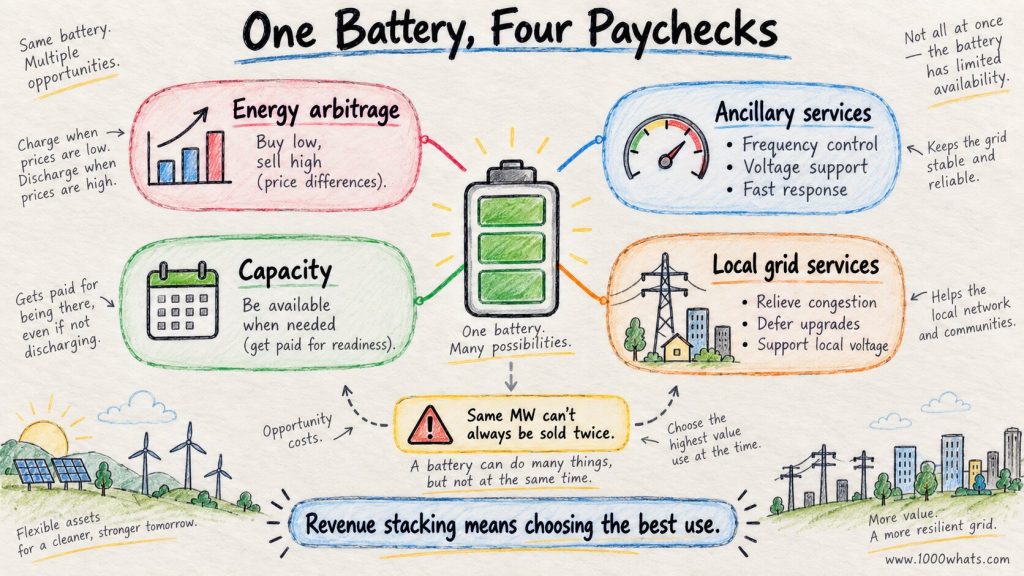
revenue stack.
The battery revenue stack
Imagine a battery.
During one part of the day it charges when electricity is cheap.
Later it discharges when electricity is expensive.
That is:
energy arbitrage.
But during other hours it may reserve some power capacity for:
frequency response,
aFRR,
mFRR,
or another ancillary service.
It might also participate in a capacity mechanism.
One asset.
Several potential revenue streams.
Conceptually:
Energy arbitrage
Ancillary services
Capacity
possibly other local/grid services
=
revenue stack
But there is a catch.
You cannot always sell the same MW five times.
If 50 MW is committed to one service, the battery’s remaining ability to perform elsewhere changes.
If the battery is empty, upward energy capability becomes limited.
If it is full, downward charging capability becomes limited.
If it promises everything to everybody simultaneously, eventually physics discovers the business plan.
And physics has excellent lawyers.
Europe is turning balancing into a cross-border market
Historically, balancing was largely national.
A TSO needed balancing energy.
It activated resources in its own system.
But Europe already interconnected national day-ahead and intraday electricity markets.
Why stop there?
The Electricity Balancing framework created common European platforms allowing participating TSOs to exchange balancing energy across borders.
The major platforms include:
PICASSO — aFRR
MARI — mFRR
and:
IGCC — imbalance netting
ACER’s balancing-platform overview explains that participating TSOs can use the common platforms to access eligible balancing bids from across Europe rather than relying solely on balancing service providers connected to their own system.
That creates a larger pool of flexibility.
And a very interesting economic idea.
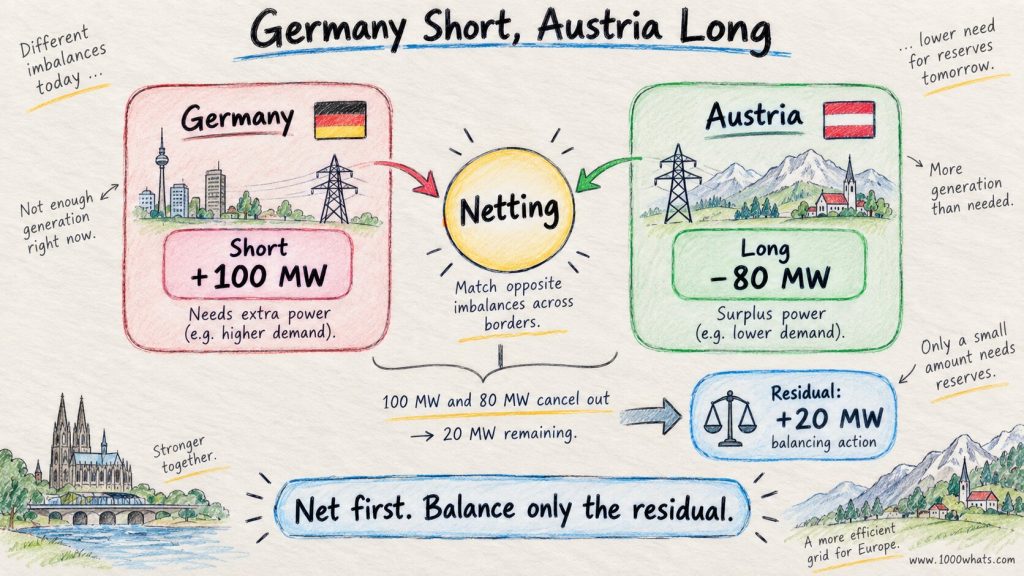
Imagine Germany needs +100 MW while Austria needs −80 MW
Without coordination:
Germany activates:
+100 MW.
Austria activates:
−80 MW.
But step back.
One system is short.
The other is long.
Before activating two separate resources, perhaps part of those imbalances can simply:
cancel each other.
That is the logic behind:
imbalance netting.
Instead of paying one resource to increase generation while simultaneously paying another somewhere nearby to decrease it, connected TSOs can offset opposing needs where the system permits.
The electrons were already trying to tell us this.
Market design eventually caught up.
ENTSO-E’s IGCC platform exists specifically to coordinate this imbalance-netting process across participating European systems.
Sometimes the cheapest balancing action is:
do less balancing.
Cross-border balancing creates competition for flexibility
Now imagine your TSO needs:
100 MW of upward balancing energy.
Domestic offers:
€180/MWh.
Across the border, an eligible provider offers:
€110/MWh.
If:
the platforms are connected,
the product qualifies,
and cross-border transmission capacity is available,
the cheaper flexibility may potentially help balance your system.
That is the same basic economic logic that made coupled electricity markets powerful:
increase the pool of competing resources.
ENTSO-E says the European balancing platforms are designed to improve efficiency, liquidity, competition, and cross-border exchange while supporting operational security.
The grid remains physical.
The market for keeping it balanced becomes increasingly international.
But ancillary services are not all becoming one giant European market
This is important.
Some services travel well across borders.
Others are much more location-specific.
Frequency restoration can benefit enormously from interconnected balancing markets.
Voltage support can be intensely local.
Black-start capability depends on restoration strategy and network topology.
System strength depends on where equipment sits.
Reactive power has geographical limitations.
So the future is not necessarily:
one giant ancillary-services market for everything.
It is more likely:
some products highly integrated,
some regionally procured,
some locally procured,
some contracted,
some market-based,
and some still embedded in technical requirements.
Which sounds messy.
Because it is.
The power system is under no obligation to make its physics convenient for market designers.
Renewables did not create the need for ancillary services
This misconception deserves killing early.
The grid needed reserves before solar panels existed.
Generators tripped in 1985 too.
Demand forecasts missed.
Transmission lines failed.
Voltage needed support.
Blackouts needed restoration.
Ancillary services are not a repair kit invented because renewable energy ruined an otherwise perfect grid.
What renewables and power electronics have changed is:
who provides those services, how much is needed, and how explicitly we need to procure them.
Traditional generators often supplied several useful characteristics automatically or as part of normal operation.
As those machines operate less or retire, system operators may need to procure equivalent functions deliberately from:
batteries,
inverter-based renewables,
synchronous condensers,
demand response,
flexible generators,
or new technologies.
This is the same deeper transition I explored in Grid Inertia.
The old grid bundled services together.
The new grid increasingly unbundles them.
⚡ “The energy transition is not only replacing power plants. It is discovering all the invisible jobs those power plants were doing.”
Why this matters commercially
This is where ancillary services stop being obscure control-room terminology and become very relevant to project economics.
Suppose you are developing a battery.
Energy-arbitrage revenue may look attractive.
Then everyone builds batteries.
The arbitrage spread changes.
Ancillary-service revenue may be attractive too.
Then more batteries enter that market.
Competition increases.
Prices can fall.
The project therefore needs assumptions about:
market depth,
qualification rules,
future competition,
activation frequency,
price cannibalization,
state-of-charge management,
availability requirements,
penalties,
and revenue stacking.
Suddenly:
“Battery earns money from ancillary services”
is not a financial model.
It is the beginning of one.
This is exactly the sort of detail that connects technical flexibility with the bankability problem.
Banks remain stubbornly interested in whether the revenue still exists after the PowerPoint presentation ends.
Why ancillary services matter more now
Electricity systems are changing in several directions simultaneously.
More:
wind.
Solar.
Batteries.
EVs.
Heat pumps.
Data centers.
HVDC interconnection.
Distributed energy.
Power electronics.
Flexible demand.
At the same time, conventional synchronous generators may operate fewer hours or retire.
That does not mean the grid becomes uncontrollable.
It means control becomes more deliberate.
Instead of receiving:
energy + inertia + reactive power + reserves + voltage support
from one conventional power station,
the future system may assemble those capabilities from:
five different technologies,
three markets,
two contracts,
one grid code,
and approximately 400 pages of acronyms.
Progress rarely arrives with less paperwork.
So, what are ancillary services in one sentence?
Ancillary services are the operational capabilities that support reliable electricity-system operation beyond simply producing electrical energy, including frequency control, reserves, voltage support, reactive power, and black-start capability.
But the better sentence is:
Ancillary services are everything the grid needs besides the MWh to make the MWh actually work.
That is the idea worth remembering.
Final thoughts
For most of electricity history, consumers bought electricity and almost nobody outside the control room thought about what came with it.
Frequency stayed close to 50 Hz.
Voltage behaved.
Generators responded.
Reserves waited.
Reactive power moved around doing its deeply unglamorous job.
And if the system collapsed, somebody had a plan for starting it again.
All of that sat behind:
the light switch works.
Now the power system is changing.
And as conventional generators retire, batteries multiply, renewables connect through inverters, demand becomes flexible, and balancing markets cross national borders, those hidden services are becoming visible.
That is a good thing.
Because once we can see them, we can value them.
Procure them.
Trade some of them.
Engineer better ways to provide them.
And perhaps stop pretending that electricity is merely a commodity measured in MWh.
The MWh is the star of the show.
Ancillary services are the crew making sure the stage does not collapse.
Nobody buys a ticket to see them.
Until they disappear.
Until next time, stay curious! 😎
Discover more from 1000whats
Subscribe to get the latest posts sent to your email.