
At 7:58 p.m., the theater is full. Every seat is sold. The orchestra is tuning up. The leading actor is about to deliver a performance that will, according to the posters, change lives and possibly justify a €14 glass of wine.
Backstage stands an understudy.
The understudy knows every line. Has rehearsed every scene. Can step into the spotlight at a moment’s notice. Tonight, however, the star feels fine. So the understudy does absolutely nothing.
Now imagine the theater has invented a brilliant new payment system: actors get paid only for the minutes they spend onstage.
The star is delighted. The understudy has some questions about rent.
On opening night, the arrangement looks wonderfully efficient. Nobody is being paid for standing around. By the third season, the theater has no understudies, and one unfortunate bout of laryngitis can cancel the entire show.
Electricity markets have a version of this problem. It is called the missing money problem. And unlike our imaginary theater, the power system cannot ask the audience to come back tomorrow when the lead generator loses its voice.
Welcome to 1000whats, where today we discover why a power plant can be essential, perfectly functional, and financially miserable at the same time. We will also discover why simply throwing money at it is not necessarily the answer.
The first surprise: electricity is sold in MWh, but reliability needs MW
Start with two units that look almost identical and cause an astonishing amount of confusion.
MW measures power: how much electricity a resource can deliver at a given moment. MWh measures energy: how much it actually delivers over time.
A 100 MW plant operating at full output for one hour produces 100 MWh. Run it for ten hours and it produces 1,000 MWh. Keep it ready but switched off for ten hours and it produces exactly zero MWh.
Yet that last, apparently unproductive plant may still be valuable. If another generator fails or a heat wave pushes demand beyond expectations, its ability to start and deliver power can prevent an extremely expensive shortage.
| Question | Unit | What the answer tells you |
|---|---|---|
| How much can this resource deliver at once? | MW | Its instantaneous capability, subject to availability and constraints. |
| How much electricity did it actually produce? | MWh | Its delivered energy over a specified period. |
| How much dependable capacity can planners count on? | MW of accredited capacity | Its contribution to adequacy under the relevant assessment, not necessarily its nameplate MW. |
| How much revenue did it earn? | € | What the applicable energy, service and contractual settlements actually paid. |
An energy market primarily pays for delivered electricity. Reliability planning asks whether enough deliverable capability will be there when demand is high and other resources are unavailable. Those questions overlap, but they are not identical.
The understudy may never deliver a line. The theater still wants the understudy to exist.
A power plant can sell a lot of electricity and still have an expensive problem
Before we accuse the market of stinginess, we need to understand how a conventional power plant earns money.
In a simplified uniform-price wholesale market, generators offer electricity. The market clears, and accepted generation is typically paid the relevant market-clearing price. A plant with a low variable cost may receive more per MWh than it costs to produce that MWh.
The difference is its contribution margin from energy sales, before fixed costs. Economists also talk about inframarginal rents, a term that sounds like an apartment dispute but is really about the gap between market price and a generator’s operating cost.
Suppose a plant receives €100/MWh for electricity that costs €60/MWh to produce. The €40/MWh difference helps pay staff, maintenance contracts, insurance, financing and eventually the investment itself. It is not automatically profit.
That distinction matters because fixed costs keep arriving even when the turbine does not run. Debt does not accept “the weather was mild” as a payment method.
The plant therefore needs enough contribution margin, from energy and any other legitimate revenue streams, over enough hours to cover the costs of remaining in business.
A baseload plant might collect that margin across thousands of operating hours. A plant needed mainly for rare peaks has far fewer chances. The less often it performs, the more each performance may need to earn.
Meet the 100 MW understudy with a €6.5 million problem
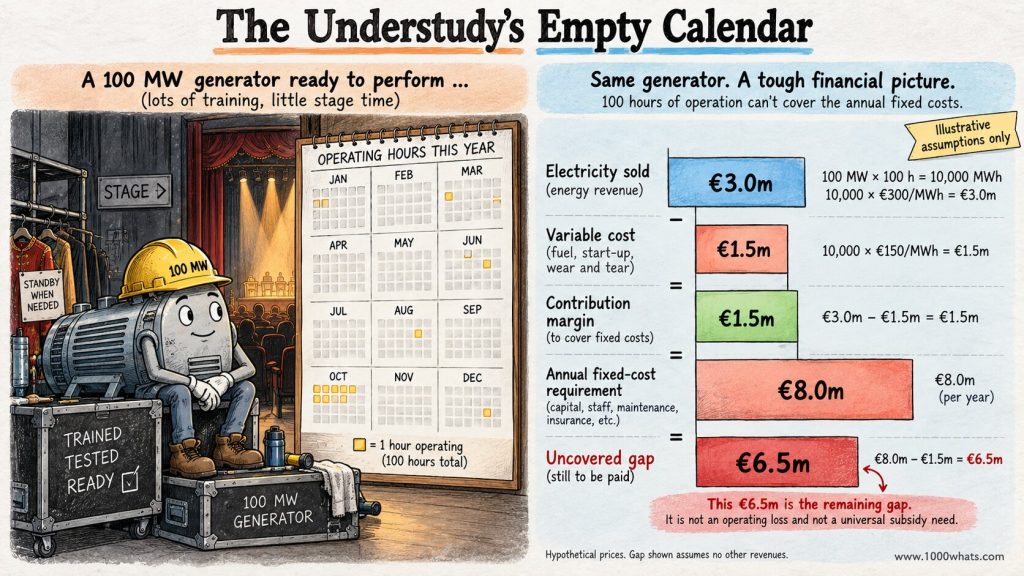
Let’s build a deliberately simple example. This is a teaching model, not a quote from any real European power plant or electricity market. All prices and operating hours are invented.
Imagine a 100 MW flexible generator. It has annual fixed costs, including the relevant annualized investment and fixed operating costs, of €8 million. Its short-run variable cost is €150/MWh. It runs for just 100 hours during the year, always at full output, and the electricity price during those hours averages €300/MWh.
The plant sells 100 MW × 100 hours = 10,000 MWh. Its energy revenue is 10,000 × €300 = €3 million. Fuel and other modeled variable costs consume 10,000 × €150 = €1.5 million.
That leaves €1.5 million of contribution margin toward an €8 million annual fixed-cost requirement.
| Illustrative annual account | Calculation | Result |
|---|---|---|
| Capacity | Given | 100 MW |
| Energy generated | 100 MW × 100 h | 10,000 MWh |
| Energy sales | 10,000 MWh × €300/MWh | €3,000,000 |
| Variable generation costs | 10,000 MWh × €150/MWh | €1,500,000 |
| Energy contribution margin | Sales minus variable costs | €1,500,000 |
| Annual fixed-cost requirement | Assumed | €8,000,000 |
| Uncovered requirement | €8m minus €1.5m | €6,500,000 |
The plant did not lose €6.5 million by generating those 10,000 MWh. It earned a positive contribution margin on them. The problem is that the margin was nowhere near enough to support the whole business for the year.
If it has no other revenue, no contractual support and no reason to expect better future returns, it may retire or never be built. And if planners genuinely need its capability, the system may have a reliability problem.
“A power plant can be worth keeping available even when the electricity it actually sells does not pay the bill.”
This €6.5 million is the illustrative missing-money gap for our plant under these assumptions. In real adequacy studies, the relevant gap is more complicated: expected net revenues, risk, fixed and investment costs, resource accreditation, and the cost of an efficient new entrant all matter. You cannot read the missing money off one bad year of accounts.
Why an energy-only market is supposed to pay the understudy eventually
At this point, the obvious question is: why not let the market solve the problem?
That is precisely the idea behind an energy-only market. Resources earn enough from selling electricity and, depending on the design, related services. When capacity becomes scarce, prices can rise sharply. Those rare high-price periods help recover fixed costs that ordinary operating hours cannot cover.
Think of a concert promoter. Most nights are modest. A handful of sold-out festivals may pay for the stage, sound system and a surprisingly large quantity of cables that somehow disappear between gigs.
In a well-functioning theoretical energy-only market, scarcity prices signal that dependable capacity is valuable. High prices encourage generators to remain available, batteries to discharge, flexible consumers to reduce demand and investors to consider new resources.
This is not a promise that every generator will be profitable. Competition should allow inefficient or unnecessary plants to exit. The point is that a market capable of valuing scarcity can, under suitable conditions, support the amount and type of capacity consumers are willing to pay for.
For an introduction to how prices can move in the opposite direction, my article on negative electricity prices explores the hours when electricity is so abundant that producers may pay to stay online. Scarcity pricing is the mirror image: the system is running short of options, and the price is supposed to make that shortage visible.
The awkward part: people hate the prices that are supposed to make the model work
Imagine our 100 MW plant needs another €6.5 million of contribution margin. If it could earn that entire amount in just ten additional scarcity hours, the arithmetic would require an extra €6,500/MWh of margin during those hours, assuming full 100 MW output and no change elsewhere.
That is not a forecast, a recommended tariff or a realistic description of a particular market. It is a demonstration of how brutally concentrated fixed-cost recovery becomes when an asset operates very rarely.
Now picture the political conversation when wholesale electricity reaches several thousand euros per MWh. Consumers are furious. Politicians want explanations. Regulators investigate market power. The press discovers that electricity has a price chart and immediately requests a brighter shade of red.
High scarcity prices can be economically meaningful. They can also create severe affordability, risk-management and political challenges. Market rules therefore contain price limits, mitigation measures and reliability interventions. Those rules can be justified for good reasons, including protecting consumers from abuse.
But if prices are prevented from reflecting genuine scarcity, some revenue that would otherwise help support capacity may never appear. The U.S. Federal Energy Regulatory Commission has discussed shortage pricing and price formation precisely because settlement rules affect the incentives to provide energy and reserves when the system is stressed.
A price cap is not automatically bad, and an uncapped price is not automatically efficient. The missing-money question is whether the whole market design still delivers enough dependable resources at an acceptable cost.
The ten-hour experiment: how a price limit changes the annual account
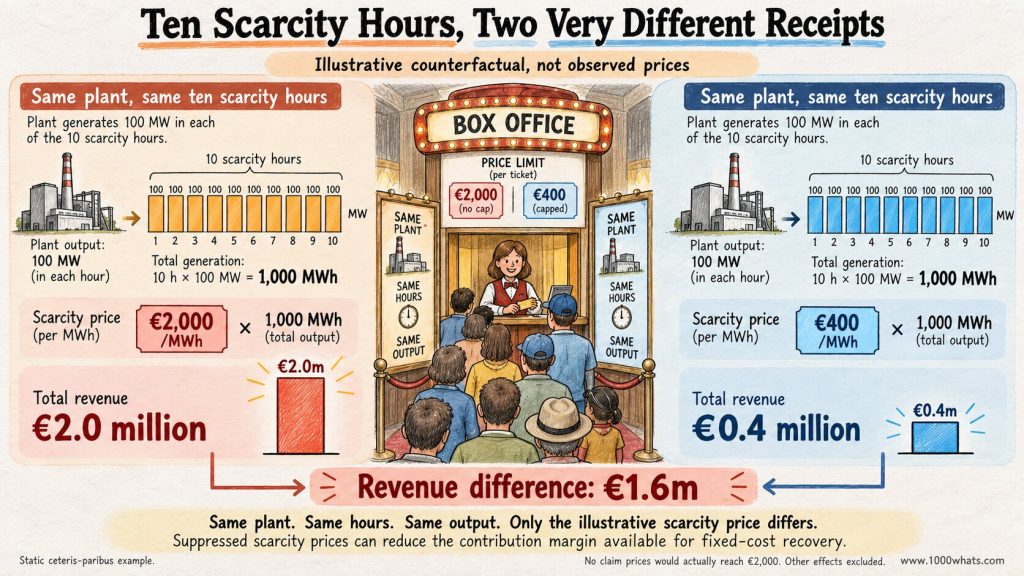
Let’s isolate the effect with another hypothetical calculation. Assume a resource is available and generating at 100 MW during ten scarcity hours. In an unrestricted counterfactual, the relevant price is €2,000/MWh. Under an illustrative cap, it is €400/MWh. All other market conditions are held constant solely to make the arithmetic visible.
The difference is €1,600/MWh. Across 100 MW × 10 h = 1,000 MWh, that means €1.6 million less gross energy revenue.
| Same ten hours | Illustrative higher price | Illustrative capped price |
|---|---|---|
| Energy sold | 1,000 MWh | 1,000 MWh |
| Electricity price | €2,000/MWh | €400/MWh |
| Gross energy revenue | €2,000,000 | €400,000 |
| Revenue difference | €1,600,000 less |
This is not proof that a particular price cap caused €1.6 million of missing money. In reality, offers, demand response, dispatch, hedges, reserve procurement, and investment decisions may all change when market rules change. The calculation isolates one channel, nothing more.
Still, the economic mechanism is important: if the system needs rare standby capability, suppressing the hours that would reward that capability creates pressure to find another payment route.
The theater has kept ticket prices low. Excellent. Now somebody must explain how the understudy is supposed to pay for acting lessons.
Not all missing money is caused by a price cap
It would be convenient if the entire problem could be blamed on one villain in a regulatory office. Unfortunately, electricity markets are more inventive than that.
Revenue adequacy can be affected by reserve procurement, out-of-market dispatch, reliability interventions, market-power mitigation, inflexible demand, poor price signals, network constraints and differences between modeled and actual scarcity. Contract design and risk also matter.
There is another complication: the amount of capacity that is economically viable is not necessarily the amount of capacity that society wants for reliability. Electricity interruptions can be extremely costly, and customers cannot always express their willingness to pay for reliability through ordinary hourly energy bids.
Even without an explicit price cap, a market may therefore fail to deliver a politically chosen reliability standard. Or it may deliver that standard, but through very volatile revenues that investors struggle to finance.
Conversely, a plant that fails to recover its costs might simply be too expensive, inefficient or badly located. Its losses are not a national emergency. Sometimes the market is not missing money. The plant is missing a competitive advantage.
That distinction is the line between sensible reliability policy and an expensive retirement home for generators.
What changes when wind and solar become a larger part of the cast?
Wind and solar often have low short-run operating costs, so their output can push wholesale prices down in the hours when they generate heavily. That can reduce the energy-market margins available to some conventional plants. My explanation of capture price shows why the timing of generation matters just as much as the annual average price.
But do not leap from “more renewables” to “every generator needs a subsidy.” That conclusion skips several chapters.
More variable renewable generation can also create hours of greater residual-demand scarcity, stronger price swings, new opportunities for batteries and flexible consumption, and changes in the value of dispatchable capacity. Better interconnection, demand response and storage can reduce the need for some standby generation.
The economic question is not whether yesterday’s plant fleet can keep earning yesterday’s revenues. It is whether tomorrow’s resource mix can provide reliable service, including the hard hours, at reasonable total cost.
The understudy may be a gas turbine. It may be a battery. It may be a factory that agrees to reduce demand. It may be an interconnector bringing power from somewhere less stressed. Different roles, different constraints, different contracts.
And some performers who were essential in Act One may no longer be needed in Act Three. That is not market failure. It is the plot moving forward.
Can a resource earn money without selling electricity? Absolutely.
The phrase energy-only is a useful market-design label, but real resources may earn money from several products and contracts. Electricity sales are not necessarily their only paycheck.
A flexible plant might sell energy, receive payments for reserve availability or balancing services, hold bilateral contracts, hedge forward prices, or participate in a capacity mechanism where one exists. A battery may earn from energy arbitrage and certain system services, subject to physical and contractual limits.
My article on ancillary services explains why keeping the grid stable involves more than selling MWh. My guide to energy arbitrage shows how storage can monetize differences between hours.
The important accounting rule is that the same capability cannot be promised twice when those obligations conflict. If a battery commits to provide reserve, that commitment can constrain its energy-market dispatch. If a plant receives an availability payment, the capacity contract may also impose penalties, settlement adjustments or revenue-sharing obligations.
“The plant gets paid for being ready” is therefore only the beginning of the contract. The interesting clauses begin when it is not ready.
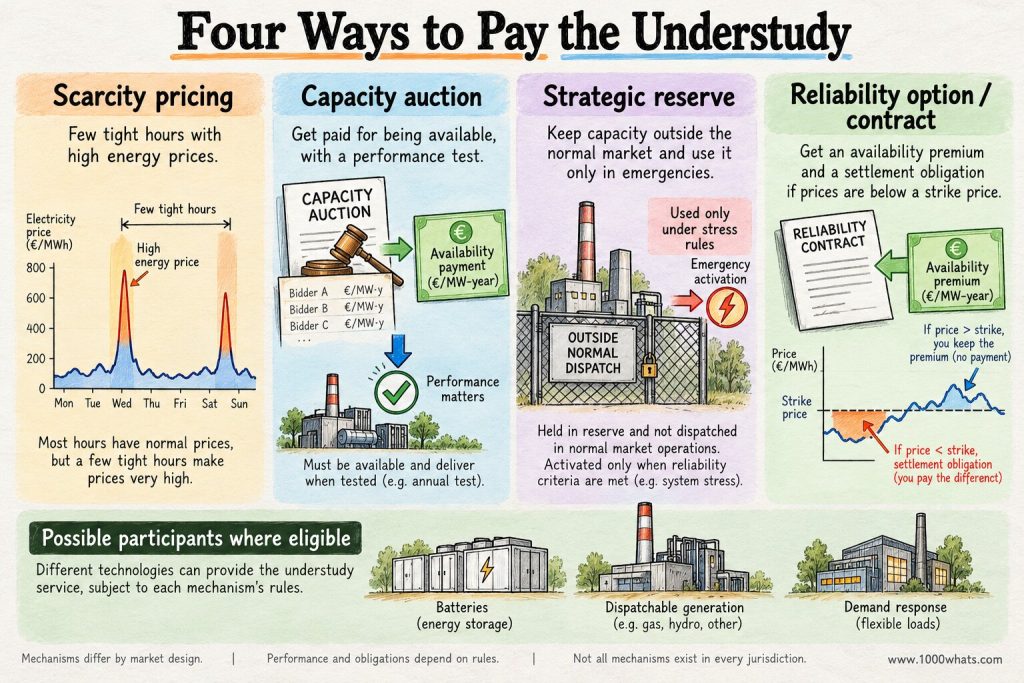
Four ways markets try to pay for reliability
There is no single universal cure. Market designers have several instruments, and each shifts risk, cost and incentives differently.
| Approach | What creates the incentive? | Main design risk |
|---|---|---|
| Better scarcity pricing | Energy and reserve prices reflect tight conditions more accurately. | Extreme price exposure, market power and revenue volatility. |
| Capacity market or obligation | Qualified resources receive payments or contractual value for dependable capability. | Overprocurement, distorted energy incentives and paying for capacity that is not deliverable. |
| Strategic reserve | Selected resources are kept outside ordinary dispatch and called under defined stress conditions. | Poor trigger design can distort energy prices or leave the reserve underused. |
| Long-term contracts or reliability options | A counterparty pays for availability or an agreed reliability payoff structure. | Bad strike prices, performance terms or risk allocation can transfer too much cost to customers. |
The European legal framework does not treat capacity payments as a magic first step. Regulation (EU) 2019/943, as amended, links resource-adequacy measures to market reforms and sets design principles for capacity mechanisms, including competition, proportionality and openness to qualifying technologies such as storage and demand-side resources.
The details differ by country. A capacity market in one jurisdiction is not the same contract, product or auction as a mechanism elsewhere. Even two programs with the same name can make very different promises.
That is why my existing article on capacity markets is the natural companion to this one. This article asks why a revenue gap might exist. The capacity-market article explains one family of ways to procure the missing capability.
The €6.5 million cure: a capacity payment is not free money
Return to our illustrative 100 MW plant. It has €6.5 million of uncovered annual fixed costs after its modeled energy contribution margin. Dividing the gap by 100 MW gives €65,000 per MW-year, or €65 per kW-year.
If an appropriately designed mechanism paid exactly that amount for all 100 MW of fully qualified, deliverable capacity, it would close our simplified annual gap: 100 MW × €65,000/MW-year = €6.5 million.
But that is a thought experiment, not an auction-price recommendation. In reality, resources have different costs, different expected energy and ancillary-service revenues, different accreditation, different risks and different performance obligations. Competitive procurement should seek the reliability service the system needs at the lowest efficient total cost.
Economists often use the concept of net cost of new entry (net CONE): the annualized cost of an efficient reference resource minus the expected net revenues it can earn elsewhere. This is a design input in some capacity markets, not a universal invoice from every generator.
A 100 MW battery with only four hours of stored energy cannot automatically be treated as identical to a 100 MW plant with adequate fuel for a multi-day shortage. Conversely, a flexible industrial load might deliver a valuable reliability service without generating a single MWh.
The purpose is not to pay every available megawatt for existing. The purpose is to buy a credible contribution to adequacy.
The most expensive mistake: paying twice for the same promise
Imagine the market adds a generous capacity payment, but the energy market already provides strong scarcity revenues. If the capacity payment ignores those expected earnings, customers may pay more than necessary for reliability.
The opposite mistake is possible too: an auction assumes enormous future scarcity revenues that never materialize under actual market rules, leaving capacity financially exposed.
Good design therefore connects expected energy-market earnings, ancillary-service revenues, availability obligations, penalty regimes, accreditation and the reliability target. It also asks whether cheaper demand response, storage or interconnection could deliver the same service.
A capacity mechanism can solve a genuine adequacy problem. It can also lock in an expensive generation mix, weaken competition or protect resources that should retire. Those outcomes are not unavoidable, but they are not imaginary.
The EU Agency for the Cooperation of Energy Regulators (ACER) reported that capacity mechanisms across the EU cost €6.5 billion in 2024, more than twice their 2020 level, and warned that weak coordination and widely diverging auction prices can undermine efficiency. That is a real-world reminder that reliability policy comes with its own price tag.
The theater finally decides to pay its understudies. Excellent. It should probably check whether it has hired seventeen people for the same role.
Why a 100 MW label is not a 100 MW reliability guarantee
If you want to pay resources for dependable capacity, you need to decide how much dependable capacity they actually provide.
A gas plant can trip. A hydro plant can face water constraints. A battery can run out of charge. Solar panels cannot promise sunshine at 9 p.m. A demand-response customer may have limits on how often or how long it can curtail.
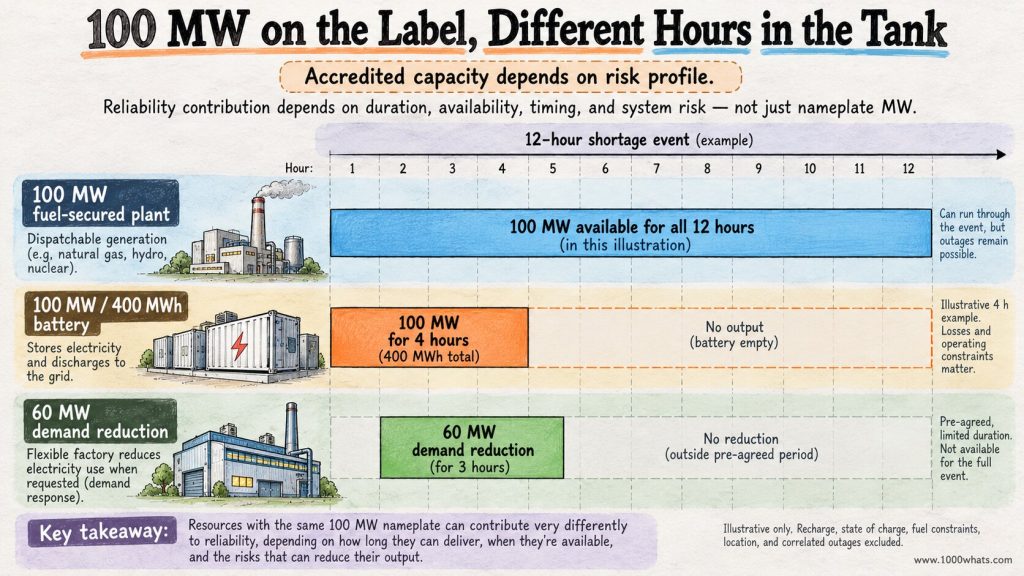
That is where capacity accreditation enters. It estimates the contribution a resource can make to reliability under the relevant system conditions, rather than simply reading its nameplate rating.
My article on capacity credit explains the distinction in detail, including why the effective load-carrying capability of a resource depends on the rest of the system.
Suppose two projects each advertise 100 MW. One can deliver for twelve hours with fuel secured; the other stores 400 MWh and can deliver 100 MW for four hours before accounting for operating constraints. Depending on the system’s risk hours, their accredited contributions may differ substantially.
That does not make the battery inferior. It makes the question specific. If the critical shortage lasts two hours, the battery may be an excellent performer. If the system faces a prolonged multi-day shortage, the calculation changes.
A market that buys raw nameplate MW instead of reliability contribution may end up with a beautiful spreadsheet and a very uncomfortable evening.
Reliability has a price, but it is not written on a single electricity bill
The hardest part of the missing-money problem is deciding how much reliability the system should buy.
Engineers and planners use concepts such as loss of load expectation (LOLE), expected energy not served (EENS) and the value of lost load (VoLL). These are different quantities: an expected frequency or duration of shortfall events, an expected volume of unserved energy, and an estimate of the economic value of avoiding interruptions.
They help compare the cost of additional capacity against the expected cost of shortages. But they are not interchangeable, and a single average value cannot capture every customer’s experience.
A short interruption at a refrigerated warehouse may spoil stock. At a hospital, backup systems and safety requirements change the stakes. At home, the same interruption might be an inconvenience or a serious problem depending on the circumstances.
A power system should not blindly buy infinite reliability at infinite cost. Nor should it assume that the cheapest annual energy mix will be adequate during a rare but severe stress event.
Reliability is a decision about risk. Market design is the method for turning that decision into investment, availability and operational incentives.
What the missing money problem does not mean
There are several tempting shortcuts worth refusing.
- It does not mean every loss-making plant deserves support. A resource can be genuinely unnecessary or inefficient.
- It does not mean energy-only markets must fail. Their outcomes depend on price formation, demand flexibility, market rules, risk and the chosen reliability standard.
- It does not mean capacity markets are free insurance. Customers ultimately finance the system through one route or another.
- It does not mean only fossil-fuel plants provide adequacy. Storage, demand response, hydro, imports and other qualifying resources can contribute.
- It does not mean all MW are interchangeable. Duration, availability, location and correlated risks matter.
- It does not mean one profitable year proves the problem is solved. Investment decisions depend on expected returns over time, not a single price spike.
And perhaps the most important distinction: a missing-money calculation is not the same as an adequacy assessment. The first asks whether resources can recover their costs. The second asks whether the system has enough dependable resources under uncertain conditions. You need both to justify a reliability intervention.
A practical checklist for spotting a real revenue-adequacy problem
When someone says “we need a capacity mechanism,” the interesting conversation begins with evidence, not with the mechanism’s name.
First, is there a demonstrated resource-adequacy risk under credible scenarios? Which hours, seasons, locations and stress events create it? Second, are energy and reserve prices reflecting actual scarcity, or are market rules suppressing relevant signals? Third, what do prospective resources expect to earn from all available products and contracts?
Then ask what resources can solve the problem most efficiently. Does a new plant really need to be built, or would better interconnection, demand response, storage or existing-plant refurbishment do the job? How should their dependable contributions be accredited?
Finally, ask who pays, who bears nonperformance risk, and what happens if the reliability problem disappears. A good mechanism needs a way to stop buying yesterday’s solution.
The ACER security-of-supply monitoring and the EU electricity-market regulation are useful starting points because they connect the economics to adequacy evidence, competition and market reform rather than treating capacity payments as an automatic entitlement.
The question is not “which power plant has the saddest income statement?” It is “which combination of resources provides the reliability we actually need, and what is the least-distorting way to pay for it?”
Final thoughts
At the start of our story, the theater had a perfectly efficient-looking payroll. It paid only the actors who stepped onstage. Every idle minute had been eliminated from the accounts.
Then the understudies disappeared.
The missing money problem is what happens when the value of being ready and the revenue from actually performing do not line up well enough to support the resources a power system needs.
Sometimes better scarcity prices can close the gap. Sometimes more flexible demand or better market rules change the picture. Sometimes a well-designed capacity mechanism or contract is justified. And sometimes the plant asking for rescue is simply no longer part of the best cast.
That is why the goal is not to make every generator profitable. The goal is to make reliability investable without making customers pay for an unnecessarily expensive performance.
The grid does not need to keep every actor employed forever. It does need someone who can take the stage when the lights are about to go out.
And unlike the theater, it would strongly prefer that the lights stay on.
Until next time, stay curious! 😎
Discover more from 1000whats
Subscribe to get the latest posts sent to your email.