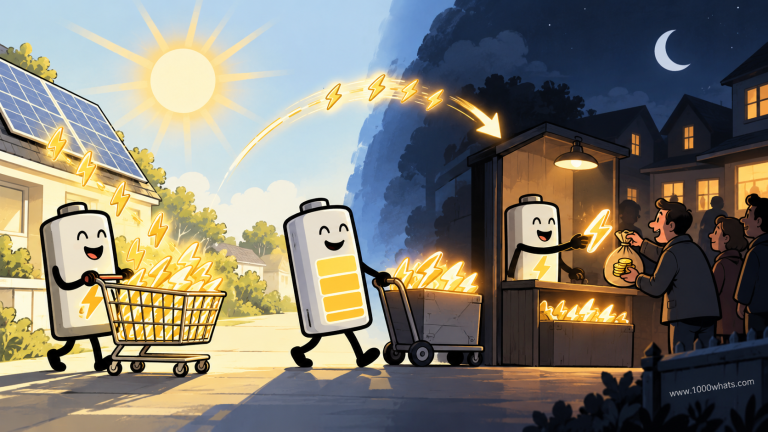
Imagine opening a bakery.
You bake too much bread.
Much too much.
The shelves are full.
The warehouse is full.
Nobody is particularly hungry.
And the bread cannot simply wait until next Tuesday.
So you put a sign outside:
Bread: – €2
Take a loaf.
Please.
We will give you two euros.
This would be a fairly alarming business model for a bakery.
In electricity markets, something remarkably similar actually happens.
Wholesale electricity prices can fall below:
€0/MWh.
At that point, a generator selling electricity into the market may effectively be:
paying someone to take its power.
Welcome to 1000whats — where today electricity becomes so abundant that the price crosses zero and keeps going.
And no:
this does not mean your electricity supplier is about to send you money for leaving the air conditioner on.
Unfortunately.
First, electricity has an annoying timing problem
Most products can wait.
Produce too much wheat?
Store it.
Too many cars?
Park them.
Too much natural gas?
Put it into storage.
Electricity is different.
The power system must keep generation and consumption balanced continuously.
My article on power explains why timing matters so much: electricity demand is happening now, so supply has to respond now too.
Suppose the system needs:
30 GW
but generators are trying to produce:
35 GW.
Something has to change.
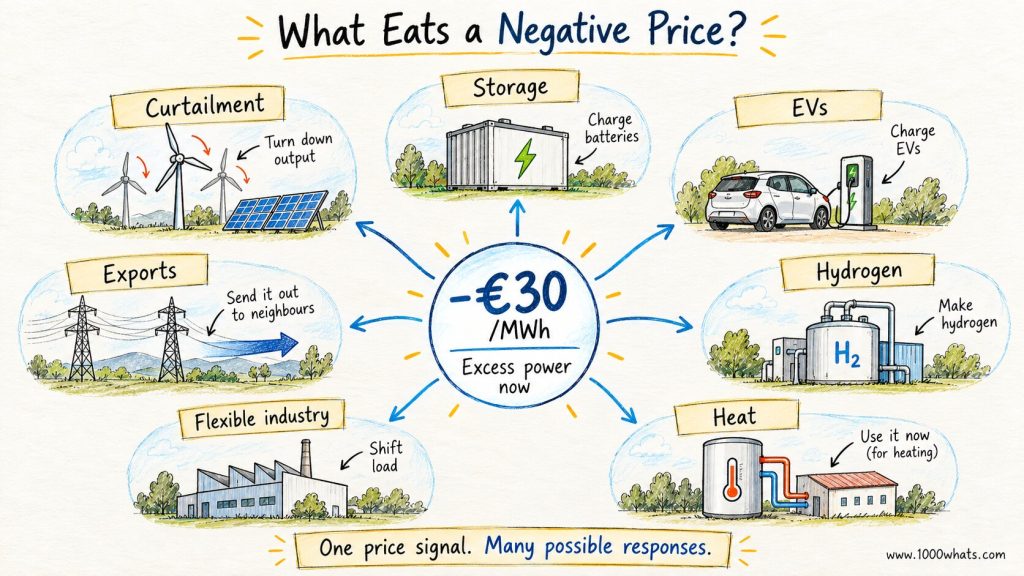
Generators can reduce output.
Consumers can increase demand.
Batteries can charge.
Electricity can be exported if neighboring markets have room.
Or some generation can be curtailed.
If those things do not happen easily enough, the market price starts sending a message.
First:
€50/MWh.
Then:
€20.
Then:
€5.
Then:
€0.
And eventually:
-€10/MWh.
At that point the market is no longer politely suggesting flexibility.
It is shouting.
⚡ “A negative electricity price is the market saying: please, somebody do something with this power.”
How can a price actually go below zero?
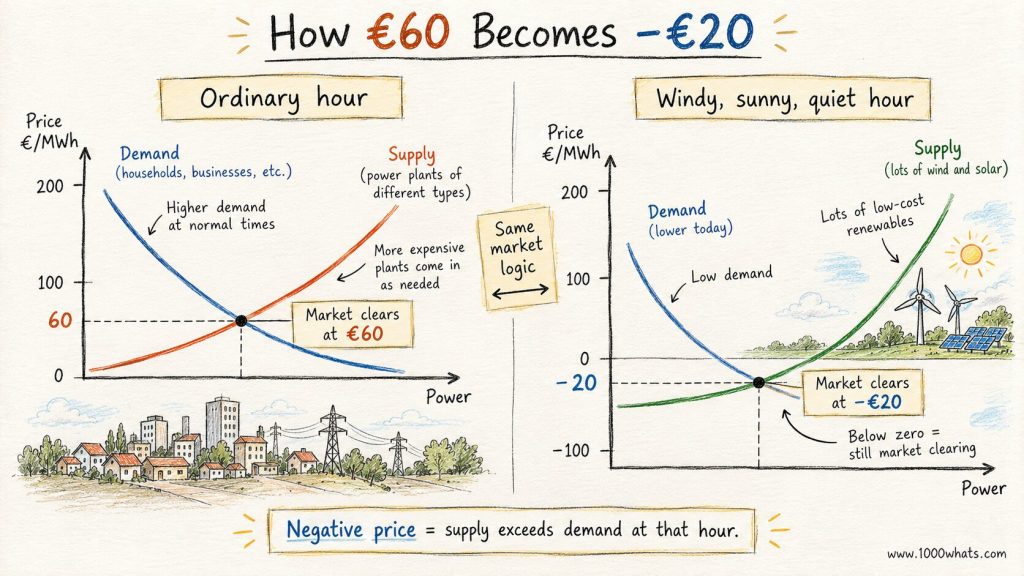
Because generators submit offers indicating the prices at which they are willing to produce.
My existing merit-order explainer covers the normal logic.
Generators with low marginal costs tend to offer low.
More expensive generators enter as demand rises.
The market clears where supply meets demand.
But there is no law of economics saying:
price must stop at zero.
On EPEX SPOT’s day-ahead and intraday markets, prices can explicitly become negative. EPEX explains that this occurs when production exceeds consumption and the system needs generation to decrease or consumption to increase.
So imagine this simplified stack:
| Generator | Offer |
|---|---|
| Solar | -€20/MWh |
| Wind | -€5/MWh |
| Nuclear | €0/MWh |
| Gas | €70/MWh |
Demand is low enough that the clearing price becomes:
-€5/MWh.
The strange part is not that the market malfunctioned.
The strange part is that some generators genuinely prefer:
producing at -€5
to:
not producing.
Why?
Now we get to the interesting bit.
Why would a generator pay to keep generating?
Several reasons.
And they are not all about renewables.
A power plant may be expensive to stop
Imagine a large thermal generator.
Reducing output may be possible.
Shutting down completely may be less attractive.
Stopping and restarting can involve:
fuel,
labor,
startup time,
wear,
technical constraints,
and lost opportunities in later hours.
Suppose staying online for one hour at a market price of:
-€10/MWh
costs less than shutting down now and restarting two hours later.
Then continuing to generate can be the economically rational choice.
Yes.
The generator is paying to sell electricity.
Because the alternative costs:
even more.
EPEX explicitly points to this behavior: thermal generators compare the cost of negative-price production with shutdown and restart costs.
Economics occasionally reaches conclusions that look completely insane until you inspect the alternative.
Nuclear plants can have similar problems
Nuclear power has very low short-run fuel costs but is not generally designed around casually switching the reactor off because Sunday afternoon became sunny.
Plants can reduce output in some systems.
But large conventional generators often have:
technical minimums,
ramping constraints,
startup costs,
and operating considerations.
So when demand is weak and renewable generation is high, some conventional output may remain online.
The system now has:
lots of supply
plus:
not much demand.
Price:
down.
But renewables have near-zero marginal cost. Why bid negative?
Excellent question.
Wind does not buy wind.
Solar does not buy sunshine.
So once the project exists, producing another MWh has very little fuel cost.
You might expect renewable generators to stop producing the moment the price reaches:
€0.
Sometimes they do.
Sometimes they do not.
Why?
Because the market price may not be their only source of revenue.
A renewable generator may receive:
a market premium,
a production tax credit,
a certificate,
or another support payment tied to generation.
Suppose the market pays:
-€10/MWh
but the generator receives another:
€40/MWh
for producing.
Net revenue:
+€30/MWh.
Stopping would mean giving up the support payment.
So the generator may rationally keep producing even while paying the wholesale market to take the electricity.
EPEX specifically identifies renewable support schemes as one reason negative prices can occur, because supported generators may remain incentivized to produce until the negative market price exceeds the value of their support.
That is not renewable electricity violating economics.
That is economics.
Just with more than one revenue stream.
And sometimes a contract changes the incentive
Now suppose a wind farm has a long-term PPA.
Depending on the contract structure, the producer may receive a fixed or protected price even when wholesale prices are negative.
Or perhaps the contract contains a clause saying payments stop after a certain number of consecutive negative-price hours.
Those details matter enormously.
The turbine does not know its PPA.
It simply sees wind and spins.
The commercial team, unfortunately, has to know the PPA.
This is why negative-price provisions have become increasingly important in renewable contracts.
At:
€70/MWh
nobody cares very much about a clause governing:
What happens if the market price is -€50?
Then one sunny Sunday arrives.
Suddenly everybody cares.
So are renewables causing negative prices?
They are a major driver of the increasing frequency of negative prices in many markets.
But saying:
renewables cause negative prices
is too simplistic.
The better statement is:
negative prices occur when supply is abundant relative to demand and the system cannot adjust enough.
High wind or solar production can create that situation.
But the price only needs to become deeply negative when other parts of the system are not flexible enough.
That can mean:
- generators cannot or will not reduce output;
- consumers do not respond to low prices;
- storage is insufficient;
- transmission cannot move the surplus elsewhere;
- exports are constrained;
- support schemes reward continued production;
- contractual arrangements discourage curtailment.
The IEA’s Electricity 2026 assessment describes negative prices broadly as a signal of insufficient flexibility caused by technical, regulatory, or contractual constraints during periods of low demand and abundant generation.
ACER reaches essentially the same conclusion for Europe: renewable growth is increasingly exposing the gap between variable generation and the system’s ability to shift supply or demand.
The solar panel is not doing anything wrong.
It is producing electricity.
The interesting question is why nobody else can:
move.
A Sunday in spring is practically designed for this
Imagine:
mild weather;
factories partly closed;
offices empty;
heating demand low;
air-conditioning demand low;
strong sunshine;
good wind.
In other words:
weak demand + strong renewable output.
This combination often appears on:
weekends,
public holidays,
and mild spring days.
Now add a power system containing generators that cannot all quickly disappear.
Wholesale prices collapse.
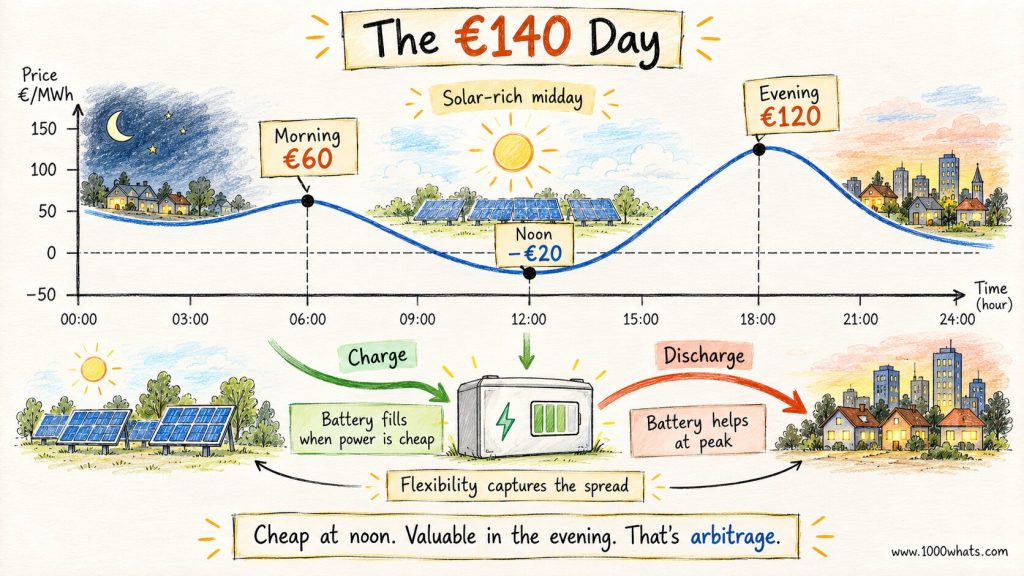
This is why solar-heavy systems can develop a recognizable daily pattern.
Morning:
prices normal.
Midday:
solar floods the market.
Prices fall.
Sometimes below zero.
Evening:
the sun disappears while people continue using electricity.
Prices rise again.
Same day.
Same power system.
Completely different economics.
The grid has developed mood swings.
Negative prices are becoming much more common
This is no longer an exotic market curiosity.
The IEA reported that negative wholesale prices occurred during roughly 6% of hours in 2025 in France, Germany, the Netherlands, and Spain.
And 2026 has made the pattern even more interesting.
In the first half of 2026, Spain experienced negative wholesale prices during about:
17% of hours.
South Australia and California were around:
20%.
But Sweden and Finland went the other direction: their share of negative-price hours fell from around 6% to roughly 2% as supply- and demand-side flexibility improved.
That last detail matters enormously.
More renewables do not automatically mean:
more and more negative prices forever.
The system can adapt.
Storage appears.
Demand becomes flexible.
Generators respond.
Transmission improves.
Market rules change.
The price signal does its job.
⚡ “Negative prices are not just a symptom of too much renewable electricity. They are a price tag on insufficient flexibility.”
Wait. Does a negative wholesale price mean I get free electricity?
Usually:
no.
Your household electricity bill contains much more than the wholesale energy price.
Depending on the country and tariff, you may also pay for:
network charges,
taxes,
levies,
supplier costs,
metering,
capacity components,
and other regulated charges.
And many customers have:
fixed-price contracts.
So a wholesale price of:
-€20/MWh
does not mean your final retail tariff suddenly becomes negative.
The wholesale electricity itself may have negative value during that hour.
The system transporting, balancing, metering, supplying, and taxing that electricity has not simultaneously decided to work for free.
Shocking, I know.
But can consumers actually get paid to use electricity?
Sometimes.
Customers exposed to dynamic wholesale-linked tariffs can occasionally see negative energy prices.
Certain industrial consumers may also respond directly to wholesale markets.
That creates a wonderful inversion of normal energy behavior.
Usually we say:
please save electricity.
During a deeply negative-price hour the market may effectively say:
Actually, could you use some now?
Charge the EV.
Heat the hot-water tank.
Run the electrolyzer.
Charge the battery.
Pre-cool the warehouse.
Shift an industrial process.
Make ice.
Pump water uphill.
Do something useful.
Just please stop leaving all these electrons standing around with nowhere economically attractive to go.
Batteries absolutely love this problem
My battery-storage article described batteries as a way of teaching electricity how to wait.
Negative prices make the value of waiting unusually obvious.
Imagine:
2 p.m.: -€20/MWh
Battery charges.
The battery effectively receives electricity with a negative wholesale value.
Then:
8 p.m.: €120/MWh
Battery discharges.
The relevant opportunity is not merely:
cheap electricity.
It is the:
€140/MWh spread
between charging and discharging hours.
Of course the battery has:
round-trip losses,
degradation,
network charges,
market fees,
and other constraints.
Energy markets remain stubbornly resistant to free-money machines.
But the underlying incentive is powerful.
Negative midday prices and expensive evening prices are basically the market placing a giant sign beside a battery:
PLEASE BUILD SOMETHING THAT MOVES ELECTRICITY SIX HOURS FORWARD.
Flexible demand gets the same invitation
Storage is not the only answer.
Suppose a factory can shift an energy-intensive process from:
6 p.m.
to:
1 p.m.
If electricity prices are dramatically lower at 1 p.m., there is now a financial incentive to do exactly that.
This is the broader idea behind demand response.
Demand response is often described as:
use less electricity when the grid is tight.
But flexibility works in both directions.
Sometimes the system needs:
less demand.
Sometimes it needs:
more demand now, please.
The IEA estimates that stronger demand flexibility can reduce system costs, improve use of existing grids, and help absorb variable renewable generation.
This can include:
EV charging,
industrial loads,
heat pumps,
electric boilers,
data centers,
water heaters,
cold storage,
and eventually millions of smaller devices coordinated automatically.
A future electricity system may not simply ask:
How much electricity do consumers need today?
It may increasingly ask:
Which parts of today’s demand actually care what time it is?
Electrolyzers enter the story here too
An electrolyzer buys electricity and turns it into hydrogen.
That makes cheap electricity extremely attractive.
Negative electricity?
Even more interesting.
If an electrolyzer can increase production during cheap renewable hours and reduce consumption during expensive hours, it becomes both:
a hydrogen factory
and:
a flexible electricity load.
But there is a catch.
Of course there is.
An electrolyzer that waits exclusively for negative-price hours may spend most of the year:
not electrolyzing.
Expensive equipment with terrible utilization can still produce expensive hydrogen.
So negative prices can help.
They are not, by themselves, a hydrogen business model.
The same principle applies across the flexibility world:
cheap energy matters, but so does using the asset enough to pay for it.
What about curtailment?
Suppose the system has too much solar generation.
One solution is:
let the price become negative until somebody changes behavior.
Another is:
reduce solar output.
That is:
curtailment.
The generator could physically produce more electricity, but the system or economics tell it not to.
Negative prices can therefore create economic curtailment even without a direct grid instruction.
Imagine a merchant solar plant receiving:
– €50/MWh.
No subsidy.
No PPA protecting its revenue.
If it can stop producing, why continue paying €50 for every MWh exported?
It may simply curtail itself.
The market has done its job.
No control-room operator needed to telephone the sun.
Congestion can make the situation much stranger
Now imagine one region has:
huge wind output,
low local demand,
and a constrained transmission line to the rest of the country.
Elsewhere, electricity may be valuable.
But the surplus cannot get there.
My article on grid congestion explains the physical problem.
This creates an important lesson:
electricity does not have one universal value.
Its value depends on:
where
and:
when.
A MWh can be worth:
-€20
in one bidding zone while electricity is expensive somewhere else.
Same product.
Same hour.
Different location.
Transmission is the difference.
This is one reason power markets become increasingly fascinating once renewables scale.
We stop asking merely:
How much electricity did we produce?
and start asking:
Where was it, when did it arrive, and could anybody use it?
Are negative prices good or bad?
Both is the annoying but correct answer.
They are useful
Negative prices reveal a real system condition.
They tell market participants:
generation should reduce;
consumption should increase;
storage would be valuable;
flexibility has value;
perhaps transmission needs strengthening.
Suppress the price signal and the underlying physical problem does not disappear.
It simply becomes less visible.
But frequent negative prices can signal a deeper problem
If they happen occasionally, fine.
Markets are supposed to move.
But if prices repeatedly collapse below zero, the system may be building variable generation faster than it builds:
storage,
flexible demand,
transmission,
interconnection,
responsive generation,
and sensible market incentives.
ACER’s 2026 monitoring report describes the rising frequency of negative prices as evidence that renewable growth is increasingly outpacing flexibility in parts of Europe.
That is not an argument against renewables.
It is an argument for finishing the energy system.
Building solar without flexibility and then complaining about midday solar prices is a little like building ten supermarkets on one street and being surprised that tomatoes become competitive.
Negative prices also change renewable economics
This is the part project developers care about.
Suppose a solar project generates:
1 MWh.
That sounds useful.
But if it repeatedly generates during the same hours as thousands of other solar plants, those hours may become:
cheap
or:
negative.
So adding more solar can reduce the market value of solar generation itself.
This is one reason the energy industry increasingly cares about:
capture prices,
capture rates,
profile risk,
storage,
hybridization,
and PPA structures.
A solar plant does not sell:
average electricity.
It sells:
solar-shaped electricity.
A wind plant sells:
wind-shaped electricity.
Those shapes have economic consequences.
The average annual wholesale price can therefore look perfectly healthy while the actual price captured by a renewable generator is much lower.
This is where energy-market analysis stops being:
MWh × average price.
And spreadsheets begin developing additional tabs.
Negative prices can actually help fix negative prices
Here is the elegant part.
Suppose negative prices become common.
What happens?
Battery developers see larger spreads.
Flexible factories see cheaper operating hours.
Electrolyzers see cheap feedstock electricity.
EV charging becomes more valuable at midday.
Thermal storage becomes more attractive.
Generators improve flexibility.
Developers start pairing solar with batteries.
PPAs change their negative-price clauses.
Investment shifts.
Demand moves.
The system begins responding to the signal.
This is exactly why Sweden and Finland’s 2026 experience is interesting: the IEA reports that negative-price frequency fell substantially as supply and demand became more flexible.
The market creates a problem.
The price exposes the problem.
The price then helps create the business case for technologies that reduce the problem.
Not always quickly.
Not always elegantly.
But that is the idea.
⚡ “The cure for negative prices is not banning negative prices. It is giving electricity somewhere useful to go.”
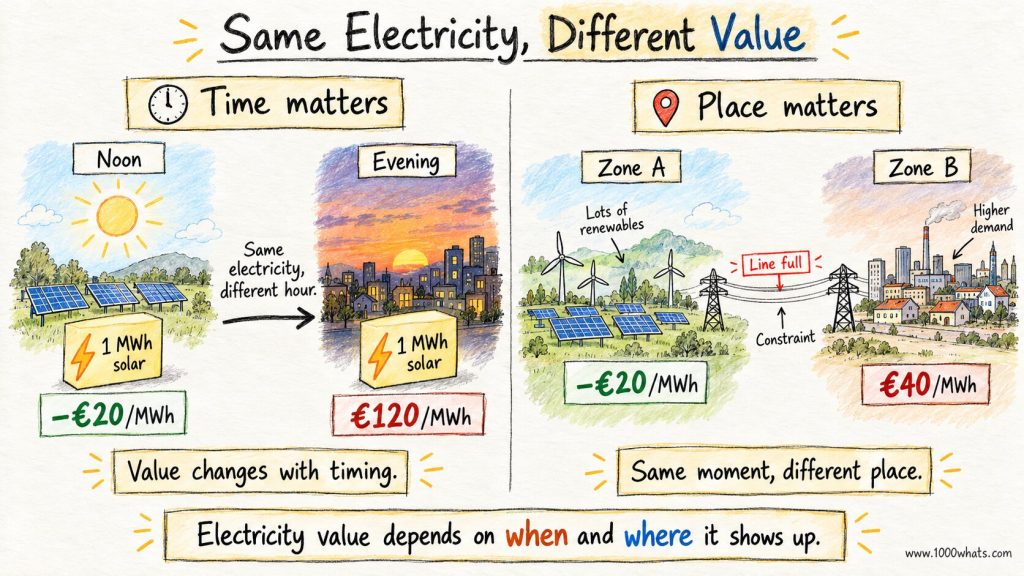
A price below zero does not mean electricity has no value
This distinction deserves one final pass.
Electricity remains useful.
Extremely useful.
The negative price applies to:
one additional unit
at:
one specific location
during:
one specific period.
That is all.
At noon, another solar MWh may be inconvenient.
At 8 p.m., the system may desperately want it.
This is why saying:
“Electricity was worth – €20 today”
is incomplete.
Which electricity?
Where?
When?
Power markets put prices on timing and location.
Negative prices simply make that fact impossible to ignore.
So, what are negative electricity prices in one sentence?
Negative electricity prices occur when wholesale supply exceeds what consumers, storage, exports, and flexible resources are willing or able to absorb, causing the market-clearing price to fall below zero.
But the better mental model is:
electricity arriving with nowhere useful enough to go.
Not forever.
Not everywhere.
Just:
here,
now.
And electricity markets care enormously about:
here
and:
now.
Final thoughts
For most of energy history, the central problem was scarcity.
Can we produce enough?
Do we have enough coal?
Enough gas?
Enough generating capacity?
Enough fuel?
Renewables introduce a strange new problem.
For some hours, in some places, we can have:
too much cheap electricity.
That sounds like a wonderful problem.
And compared with having no electricity, it certainly is.
But it is still a system problem.
Because a grid cannot run on annual averages.
It runs:
hour by hour,
line by line,
MW by MW.
Negative prices are what happens when electricity abundance collides with insufficient flexibility.
They tell batteries:
charge.
They tell consumers:
shift.
They tell generators:
move.
They tell developers:
your production profile matters.
They tell grid planners:
somewhere, the system needs another option.
And they tell the rest of us something important about the next stage of the energy transition.
Making cheap clean electricity was only the first trick.
Now we have to become much better at deciding:
what to do with it when it arrives.
Until next time, stay curious! 😎
Discover more from 1000whats
Subscribe to get the latest posts sent to your email.