
Here’s a weird fact about electricity markets:
A wind farm might be willing to sell electricity for almost nothing.
A gas plant might need €100/MWh just to make running worthwhile.
And yet, during the same hour, both can receive roughly €100/MWh.
Sounds unfair?
Maybe.
Sounds broken?
Not necessarily.
Welcome to one of the strangest—and most important—ideas in electricity economics:
the merit order.
It is the invisible queue deciding which power plants get called into action, which ones sit on the bench, and, in many wholesale markets, which generator ends up setting the electricity price.
Once you understand merit order, suddenly a lot of energy-market weirdness starts making sense.
Why gas prices can send electricity prices flying.
Why adding solar can crush midday wholesale prices.
Why electricity occasionally trades below zero.
Why a power plant with “cheap electricity” according to LCOE does not necessarily determine today’s market price.
And why batteries have suddenly become extremely interested in clocks.
Welcome to 1000whats—where energy-market jargon gets dragged into daylight and forced to explain itself.
Let’s line up some power plants.
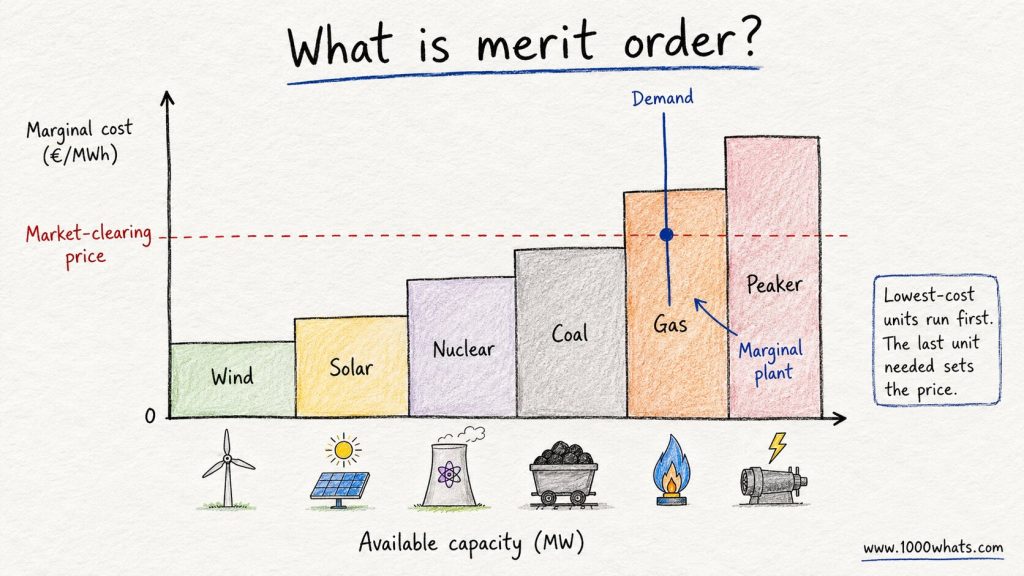
What is merit order?
The merit order is the ranking of available electricity generation from lowest to highest marginal cost—or, more precisely in a market setting, according to the offers submitted into the market.
The cheapest available generation is normally used first.
Then the next cheapest.
Then the next.
The process continues until enough electricity has been scheduled to meet demand.
And here comes the important part:
In a marginal-pricing, or pay-as-clear, market, the last accepted generator helps determine the market-clearing price.
The European Commission’s explanation of EU electricity market design describes this as a marginal-pricing system: generators submit offers, lower-cost electricity is accepted first, and once demand is satisfied, the last accepted producer establishes the price paid to successful generators.
EPEX SPOT’s power-market guide explains the same process from the exchange perspective: power plants are arranged according to marginal production cost, the system activates them in that order, and the most expensive unit required to satisfy demand sets the clearing price.
In plain English?
Imagine 1,000 MW of electricity demand standing outside a nightclub.
The cheapest generators get through the door first.
Wind? Come in.
Solar? Come in.
Nuclear? Probably come in.
Coal? Depends.
Gas?
“Hold on. We’ll call you if we need you.”
The merit order is basically the bouncer.
⚡ “The electricity price is not necessarily set by the cheapest power plant. It is often set by the last power plant the system cannot do without.”
Why does the merit order exist?
Because electricity systems have an unforgiving little habit:
Supply and demand have to match continuously.
We cannot simply tell consumers:
“Sorry, the cheap generators are sold out. Try using your refrigerator tomorrow.”
The system needs enough generation to cover demand, but economically, we would prefer not to run an expensive generator when a cheaper one can do the same job.
So the merit order asks a beautifully simple question:
What is the least-cost combination of available generation that can satisfy demand right now? 💡
This matters because power plants have wildly different operating economics.
A solar farm has already paid for its panels. Sunlight does not invoice it by the megawatt-hour.
A wind farm is similar.
A coal plant needs coal.
A gas turbine needs gas.
Fossil plants may also face carbon costs, depending on the market.
So if another 1 MWh of solar electricity costs almost nothing to produce while another 1 MWh from a gas plant costs €90, it makes economic sense to use the solar first.
That is merit-order logic.
And it is one of the foundations of competitive wholesale electricity markets.
If you’re wondering how we even ended up with generators competing against one another instead of one giant utility doing everything, my explainer on energy deregulation is the useful prequel.
And if wholesale versus retail already has your brain filing a complaint, start with electricity retail: the last mile of the power journey.
How does merit order actually work?
Let’s build the world’s smallest imaginary electricity market.
Demand for one hour is 800 MW.
Available generators submit these simplified offers:
| Generator | Available capacity | Offer |
|---|---|---|
| Wind | 300 MW | €0/MWh |
| Nuclear | 200 MW | €10/MWh |
| Coal | 200 MW | €50/MWh |
| Gas | 300 MW | €90/MWh |
Now line them up from cheapest to most expensive:
Wind → Nuclear → Coal → Gas
That is our merit order.
We need 800 MW.
So the market accepts:
- 300 MW of wind
- 200 MW of nuclear
- 200 MW of coal
- 100 MW of gas
Total:
800 MW. Demand satisfied.
The gas plant was the last generator needed.
So in this simplified pay-as-clear example:
Market price = €90/MWh
And the successful wind, nuclear, coal, and gas generators all receive the clearing price for the accepted electricity.
Yes.
The wind farm offered at €0 and gets €90.
Welcome to electricity markets. 😁
Wait. Why does the wind farm get €90 if it offered €0?
This is the point where perfectly reasonable people start throwing furniture.
“Why not just pay every generator what it asked for?”
Great question.
That alternative is called pay-as-bid.
Under pay-as-bid, our wind farm might receive €0, nuclear €10, coal €50, and gas €90.
Sounds cheaper.
Except markets contain humans.
And humans are annoyingly capable of learning.
If the wind operator expects the market to clear around €90, why would it keep bidding €0 if it knows it will only receive its own bid?
It may start bidding close to the expected clearing price instead.
The European Commission specifically notes that switching to pay-as-bid does not automatically create cheaper electricity because lower-cost producers would have an incentive to forecast the clearing price and bid accordingly.
That is one reason uniform-price auctions exist.
In theory, a competitive pay-as-clear market gives generators stronger incentives to offer power near their short-run marginal economics and lets the market discover the marginal value of electricity.
The simplicity is deceptive.
The economics underneath it are not.
So what happens to the extra money cheap generators receive?
Economists call generators sitting below the marginal unit inframarginal generators.
Suppose our wind farm has very low short-run marginal cost but receives €90/MWh.
The difference between its operating cost and the market price creates an inframarginal margin.
Looks juicy.
But do not confuse that margin with pure profit.
That revenue still helps recover:
- construction costs
- financing
- fixed operations and maintenance
- land and grid costs
- taxes
- development expenses
- periods when the plant produces nothing
- periods when wholesale prices collapse
- curtailment and other commercial risks
Power plants do not get built because someone promises to reimburse today’s fuel bill.
They get built because investors believe decades of future revenue will justify the upfront investment.
That is where short-term market economics and long-term project finance collide.
And it explains why mechanisms such as Power Purchase Agreements, Contracts for Difference, and feed-in tariffs exist.
They all attack the same uncomfortable problem from different angles:
Wholesale electricity prices move. Infrastructure investors prefer that revenue does not behave like a caffeinated squirrel.
What is the merit-order effect?
Now things get interesting.
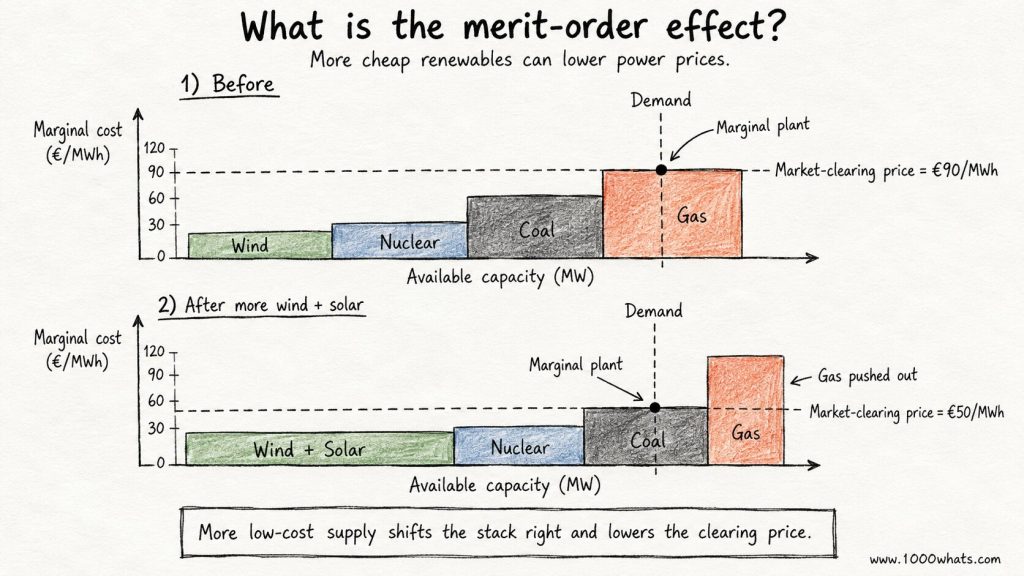
Suppose our original market looks like this:
Wind → Nuclear → Coal → Gas
Gas is needed.
Price: €90/MWh.
Then someone builds another 250 MW of wind.
That new wind enters near the front of the merit order because its marginal cost is low.
Now enough cheap generation may exist that the gas plant is no longer needed.
Maybe coal becomes the marginal generator instead.
Price:
€50/MWh.
Nothing magical happened.
No regulator pressed the “cheap electricity” button.
We simply pushed an expensive generator out of the stack.
That is the merit-order effect.
Nord Pool’s explanation of electricity price formation describes exactly this dynamic: additional wind and solar generation typically enters with low marginal costs, moves ahead of higher-cost generation, and can lower wholesale prices by pushing more expensive plants farther out of the dispatch order.
This is one of renewable energy’s most interesting economic effects.
Wind and solar do not merely add electricity.
They change which other power plants get to run.
Why can gas set the electricity price?
This became one of Europe’s favorite arguments during the energy crisis.
People looked at electricity systems containing nuclear plants, wind farms, hydro, solar, coal, and gas and asked:
“Why on Earth is the electricity price following gas?”
Because sometimes gas is sitting at the edge of the merit order.
Imagine demand is high.
Wind and solar are already producing everything they can.
Nuclear is running.
Coal is dispatched.
Still not enough.
The system needs another 1,000 MW.
Gas plants step in.
If gas is the marginal source needed to satisfy demand, then gas economics can determine the clearing price for that hour.
And if gas suddenly becomes extremely expensive?
The marginal electricity price can jump with it.
That does not mean gas always sets the electricity price.
On a windy night with low demand, gas may be nowhere near the clearing point.
On a sunny spring afternoon, solar, wind, nuclear, hydro, imports, and other resources may be enough.
But during tight hours?
The marginal plant matters enormously.
This became painfully visible in Europe in 2022. ACER reported that the surge in European gas prices following the post-pandemic recovery and Russia’s invasion of Ukraine contributed directly to the sharp rise in day-ahead electricity prices. ACER’s 2022 wholesale electricity market review documents that relationship.
Suddenly, “marginal pricing” escaped economics departments and entered political television.
Nobody looked happy about it.
Does the most expensive power plant always set the price?
No.
The most expensive available plant and the most expensive plant actually needed are different things.
Imagine a diesel generator sitting in our stack at €400/MWh.
If demand can be satisfied before reaching it, nobody cares.
It stays parked.
The market might clear at €50.
The diesel unit receives nothing because it was not accepted.
That distinction is the whole point.
The marginal plant is not the most expensive plant in existence. It is the last accepted resource required to balance supply and demand.
Can the merit order create negative electricity prices?
Absolutely.
And this is where electricity markets become wonderfully ridiculous.
Suppose it is Sunday afternoon.
Factories are quiet.
Demand is low.
Wind is roaring.
Solar is flooding the system.
Nuclear or other less-flexible plants may still be running.
Suddenly, the market has more electricity than it wants.
Some generators may be willing to submit negative offers rather than shut down because stopping and restarting can be expensive, technically awkward, or commercially unattractive.
Renewable support arrangements can also affect bidding incentives depending on how a particular scheme is designed.
So the price can fall:
€20.
€5.
€0.
Then:
–€20/MWh.
Congratulations.
Electricity has become so abundant that the market is effectively saying:
“Please, somebody use this stuff.”
Nord Pool’s market explanation even gives an example of sell orders submitted far below zero while the eventual clearing price remains positive when demand is strong enough.
Negative prices are not proof that electricity suddenly lost all economic value.
They are a giant flashing signal that the system has too much supply relative to demand at that specific time and place.
And that signal creates opportunities.
Hello, batteries.
Batteries have discovered the merit order—and they like it
Battery storage sees a market with wildly different hourly prices and thinks:
“This seems exploitable.”
When electricity is plentiful and cheap, the battery charges.
When supply tightens and prices rise, it discharges.
Buy low.
Sell high.
This is one reason battery storage has become such an important grid technology.
Storage does something generation traditionally could not:
It moves electricity economically through time.
More storage can absorb power during low-price hours and feed it back during expensive hours.
Demand response can do something similar by moving consumption.
EV charging can shift.
Industrial processes can shift.
Heat pumps can increasingly respond to price signals.
The future merit order will therefore involve more than a neat queue of coal, gas, nuclear, wind, and solar plants.
It will increasingly include flexible demand, batteries, aggregators, imports, and technologies we have not finished inventing yet.
Solar makes the merit order particularly weird
Solar has a habit of arriving all at once.
At noon on a sunny day, thousands or millions of panels generate simultaneously.
That can push expensive generators far out of the merit order and hammer wholesale prices downward.
Fantastic.
Then the sun sets.
Solar generation falls quickly just as evening demand can remain strong.
Suddenly, the system starts climbing back up the expensive end of the stack.
Gas.
Storage.
Hydro.
Imports.
Whatever can respond.
That pattern connects directly to the famous duck curve.
It also explains a brutal little irony for renewable developers:
The more solar the market gets, the more solar can depress the price during the exact hours when solar produces.
Economists call this price cannibalization.
Solar can be extraordinarily cheap technology and still face deteriorating merchant revenue if everyone produces the same cheap electricity at the same time.
That is why understanding intermittent renewable energy requires more than asking, “How much does a solar panel cost?”
Timing becomes money.
Is merit order really this simple in the real world?
No.
Thank goodness, because thousands of energy professionals need jobs.
Our little supply stack is the useful mental model.
Actual electricity markets have additional complications:
- transmission constraints
- bidding zones
- cross-border capacity
- imports and exports
- minimum generation levels
- start-up costs
- block orders
- plant ramping limits
- reserves
- balancing requirements
- storage
- demand-side bids
- hydro reservoir opportunity costs
- market coupling
- technical security constraints
So the real dispatch algorithm is not literally someone dragging power-plant names into an Excel column and pressing SORT.
In Europe’s coupled day-ahead market, supply and demand orders interact across bidding zones while available transmission capacity also matters. EPEX describes the clearing price as emerging where supply and demand meet through a broader optimization of market welfare.
And then there is the grid itself.
The cheapest generator is not particularly useful if its electricity cannot get through a constrained network.
That is why grid congestion can ruin the beautiful simplicity of the theoretical merit-order curve.
The market does not operate on a blank sheet of paper.
It operates on copper, transformers, weather, physics, and infrastructure built decades ago.
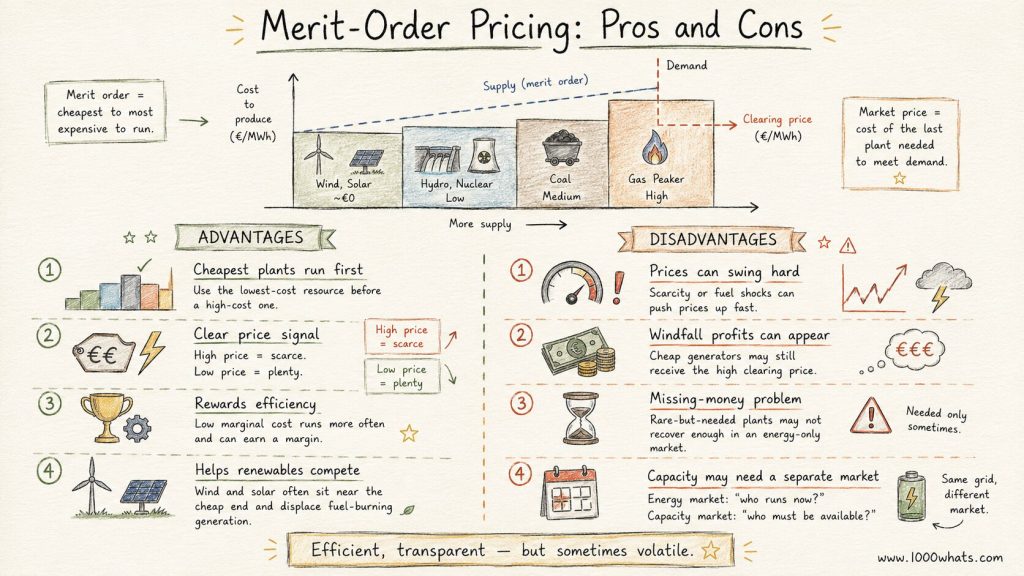
What are the advantages of merit-order pricing?
Merit order has survived plenty of criticism because it does several things extremely well.
It dispatches cheaper resources first
If a €20/MWh resource can produce instead of a €100/MWh resource, use the cheaper one.
Hard to argue with that.
It creates a clear price signal
Expensive electricity tells consumers and investors:
Something is scarce.
Cheap electricity says:
We have plenty right now. Please invent something useful to do with it.
Those signals encourage efficiency, storage, flexible demand, and new investment.
It rewards lower marginal costs
A technology that can produce electricity cheaply gets dispatched more often and can earn a margin between operating cost and market price.
That creates pressure to become more efficient.
It helps renewables enter the market
Wind and solar usually sit near the cheap end of the merit order once built.
That lets them displace fuel-burning generation when their resource is available.
From a market perspective, this is one reason renewable energy changes electricity economics even before anyone starts discussing carbon.
What are the disadvantages?
Now for the part electricity-market designers discuss calmly while politicians reach for microphones.
Prices can become brutally volatile
If the marginal plant suddenly becomes expensive because gas prices explode, scarcity hits, or generation disappears, wholesale prices can jump very quickly.
Economically useful signal?
Yes.
Pleasant electricity bill?
Less so.
Cheap generators can earn very high revenues during price spikes
When gas clears at €300/MWh, a wind farm with tiny marginal costs may also receive the clearing price for accepted production.
That creates what can look like enormous windfall profits.
Sometimes those revenues are precisely the reward for having invested in low-marginal-cost capacity.
Sometimes governments decide things have become politically intolerable.
Welcome to energy policy.
Energy-only revenue may not guarantee enough reliable capacity
Imagine a peaking power plant needed only during the worst 20 hours of the year.
Society desperately wants it available during those 20 hours.
But the owner has bills during all 8,760.
That creates the famous “missing money” problem in some electricity markets.
One response is the capacity market, where resources can receive payments for being available—not merely for the electricity they actually produce.
Energy markets answer:
Who should generate now?
Capacity markets answer:
Who needs to exist just in case?
Different question.
Different market.
Same grid.
So is merit order good or bad?
That question is irresistible.
It is also slightly wrong.
Merit order is a mechanism.
The better question is:
What job are we asking it to do?
For short-term economic dispatch, ranking generation by marginal economics is enormously sensible.
If the objective is to protect every household from wholesale-market volatility?
Merit order alone will not do that.
If the objective is to guarantee long-term investor revenue?
Again, wrong tool.
If the objective is to ensure enough backup capacity exists ten years from now?
Also not enough.
Trying to make one electricity-market mechanism solve every problem is like complaining that your smoke detector makes terrible coffee.
The smoke detector may be fine.
You bought the wrong appliance.
Why merit order matters more today than ever
Because the electricity system is undergoing a strange inversion.
Historically, much of the generation fleet had meaningful fuel costs.
Burn more coal?
Buy more coal.
Burn more gas?
Buy more gas.
Now we are rapidly adding technologies whose economics look completely different.
Solar and wind require substantial upfront capital but extremely little fuel spending.
That means more electricity is entering near the front of the merit order.
Wholesale prices can collapse during renewable-rich hours.
Expensive thermal generators run less often.
Flexible generation becomes more valuable.
Storage becomes more valuable.
Demand flexibility becomes more valuable.
Transmission becomes more valuable.
And renewable projects themselves may become increasingly reluctant to rely entirely on volatile merchant-market revenue.
What most people don’t see is that the energy transition is not merely changing what generates electricity. It is changing the economics of the queue itself.
⚡ “Renewables don’t just replace power plants. They rearrange the market around them.”
Didn’t Europe reform this system after the energy crisis?
Yes—but not by simply throwing the merit order into a dumpster.
Following the 2022 energy crisis, the EU revised its electricity-market design. The new rules entered into force in July 2024 and aim to make consumer bills and project revenues less exposed to short-term fossil-fuel-driven price volatility. The European Commission summarizes the revised electricity market design here.
The response has focused heavily on strengthening long-term contracting around the short-term market.
That includes:
- more Power Purchase Agreements
- two-way Contracts for Difference for certain publicly supported investments
- stronger consumer protection
- more fixed-price contract options
- greater recognition of capacity mechanisms
The Council of the EU’s summary of the 2024 reform specifically highlights PPAs, two-way CfDs, consumer protections, and capacity mechanisms as tools for making the system more stable while preserving efficient market operation.
That distinction matters.
Instead of saying:
“The spot market must stop producing volatile prices,”
the emerging logic is increasingly:
“Let the short-term market reveal scarcity—but do not expose every consumer and every investment to that price every hour for twenty years.”
That is a much more sophisticated idea.
And probably a healthier one.
Final thoughts
Merit order looks almost comically simple on a chart.
Put cheap generation on the left.
Expensive generation on the right.
Keep adding power plants until demand is covered.
The last one needed sets the price.
Done.
Except hidden inside that little staircase is practically the entire modern electricity debate.
Gas crises.
Renewable growth.
Negative prices.
Battery economics.
Windfall profits.
Grid congestion.
Capacity markets.
PPAs.
CfDs.
Consumer protection.
And the uncomfortable reality that the cheapest electricity to generate is not always the same thing as the cheapest electricity to deliver exactly when and where somebody needs it.
That is why merit order matters.
Not because it is a clever auction trick.
Because it shows us what electricity is worth right now.
And as solar, wind, batteries, flexible demand, and electrification reshape the power system, that “right now” price is becoming more interesting than ever.
So next time someone says:
“Why is my electricity expensive when renewable energy is cheap?”
You now know where to look.
Not just at the average cost of generation.
Look at the edge of the queue.
Who was the last power plant we needed?
That is where the story usually gets interesting.
What do you think? Is marginal pricing still the smartest way to run modern electricity markets—or are renewables changing the game faster than market design can keep up?
Drop your take in the comments.
Until next time, stay curious! 😎
Discover more from 1000whats
Subscribe to get the latest posts sent to your email.