
Imagine walking into a meeting and hearing this:
“We’re considering an off-site sleeved corporate pay-as-produced renewable PPA.”
Wonderful.
Four adjectives, three energy specialists nodding thoughtfully, and one person quietly wondering whether everybody else understands what just happened.
Here’s the secret:
They probably aren’t talking about four different PPAs.
They’re describing four characteristics of one PPA.
That is the mistake that makes Power Purchase Agreements seem much harder than they actually are. People talk about on-site PPAs, corporate PPAs, sleeved PPAs, virtual PPAs, and pay-as-produced PPAs as if they were separate species in an electricity zoo.
They’re not.
So putting them into one neat list of mutually exclusive “types” is a little like asking:
What type of car is it: German, electric, leased, red, or an SUV?
Well…
It could be all five.
One label might tell you where the power plant is. Another tells you how electricity reaches the buyer. Another describes who the buyer is. And another tells you what shape of electricity is being sold.
⚡ “A PPA doesn’t have one type. It has a personality made from several different characteristics.”
Once you understand that, the alphabet soup starts looking a lot more like lunch.
Welcome to 1000whats. Let’s decode PPA types without drowning in contract language.
PPA types at a glance: Ask questions, don’t memorize labels
Here is the entire idea before we go deeper.
| Question | Common PPA terms | What are we actually describing? |
|---|---|---|
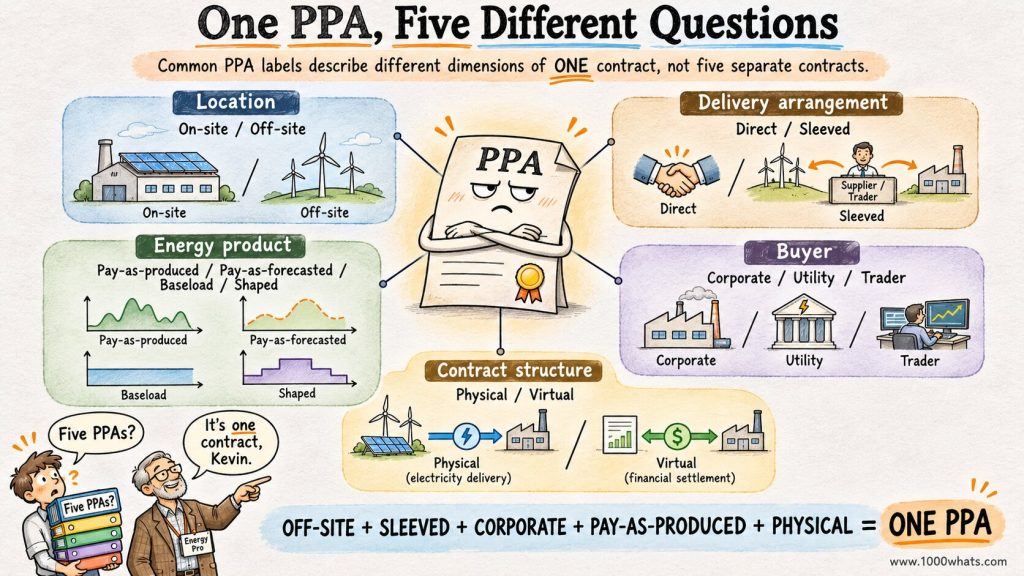
| 1. Where is the electricity produced? | On-site / Off-site | Location of the power plant |
| 2. Who organizes delivery? | Direct / Sleeved | How electricity gets into the buyer’s supply arrangement |
| 3. What electricity product is bought? | Pay-as-produced / Baseload / Shaped | Volume and generation profile |
| 4. Who is the buyer? | Corporate PPA / Utility PPA | Identity of the offtaker |
| 5. Is electricity actually delivered through the PPA? | Physical / Financial / Virtual | Physical delivery versus financial settlement |
This means a company could sign an:
off-site + sleeved + corporate + pay-as-produced + physical PPA.
That is not five PPAs.
That is one PPA described from five different angles.
Now the terminology starts behaving.
1. Where is the electricity produced?
The first question is the easiest one to visualize:
Is the power plant at the buyer’s site or somewhere else?
That gives us two familiar terms:
- On-site PPA
- Off-site PPA
What is an on-site PPA?
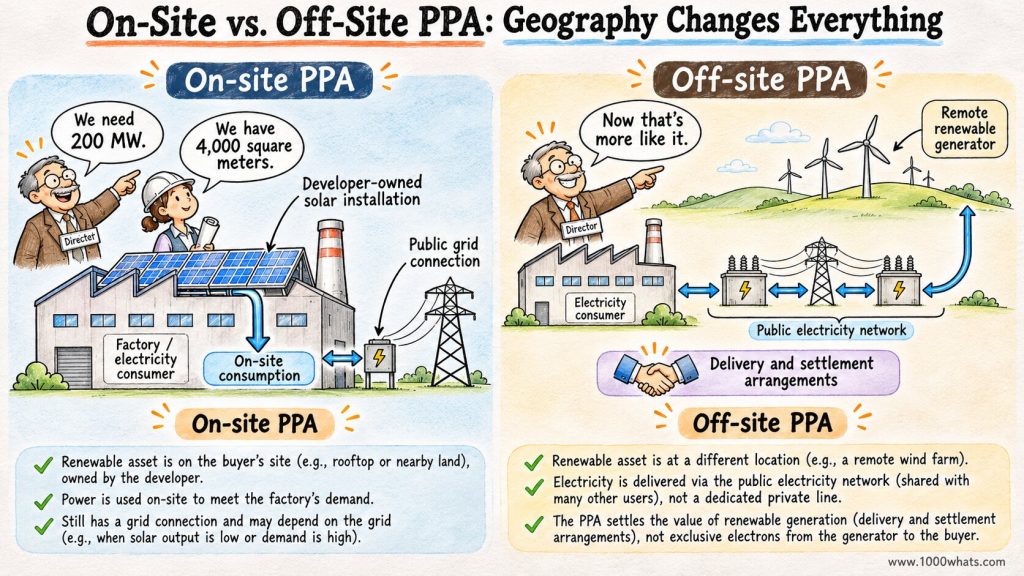
With an on-site PPA, the generating asset is located at or very close to the customer’s premises.
The classic example is solar power installed on the roof of a factory, warehouse, shopping center, data center, or office building.
A company has a giant roof.
A developer has solar panels, capital, technical knowledge, and an unusual enthusiasm for roof-loading calculations.
The developer builds and typically operates the solar system.
The company buys the electricity it produces under a PPA.
Example: On-site PPA
| Question | Example |
| Who is the buyer? | Food factory |
| Where is the project? | Factory roof |
| Technology | Solar PV |
| Who invests in the plant? | Third-party developer |
| Where is most electricity consumed? | At the factory |
| Why use it? | Renewable electricity without the factory financing and developing the project itself |
The beauty of an on-site arrangement is that the physical story is easy to understand.
Plant here. Customer here. Electricity used here.
But there is a limit.
Your electricity demand can be enormous.
Your roof stubbornly remains the size of your roof.
For a large industrial consumer, an on-site project may therefore cover only part of total consumption.
What is an off-site PPA?
An off-site PPA moves the power plant away from the customer.
Sometimes very far away.
And that makes perfect sense.
You do not build a wind farm next to corporate headquarters because procurement likes the view.
You build it where the wind is good, the land works, the grid connection is possible, and the project can actually be developed.
Same with utility-scale solar.
Example: Off-site PPA
| Question | Example |
| Buyer | Large manufacturing company |
| Project | 100 MW wind farm |
| Buyer location | Major industrial city |
| Project location | Wind-rich rural region |
| Same physical site? | No |
| Main advantage | Access to much larger renewable projects |
What most people don’t see is that moving the project away from the customer changes much more than geography.
Now the electricity system sits between the two parties.
That introduces questions around delivery points, metering, balancing, supply, settlement, and grid access.
And that opens the door to our second question.
2. Who organizes the delivery?
Imagine you have signed a PPA with a wind farm 200 miles away.
Great.
Now please deliver the electricity.
Not in a truck.
Not through a special green cable with your company logo on it.
Through the electricity system.
That means someone needs to handle the commercial machinery around that physical flow.
The question becomes:
Do the producer and buyer manage the arrangement directly, or does a supplier or trader sit between them?
This gives us terms such as:
- Direct PPA
- Sleeved PPA
What is a direct PPA?
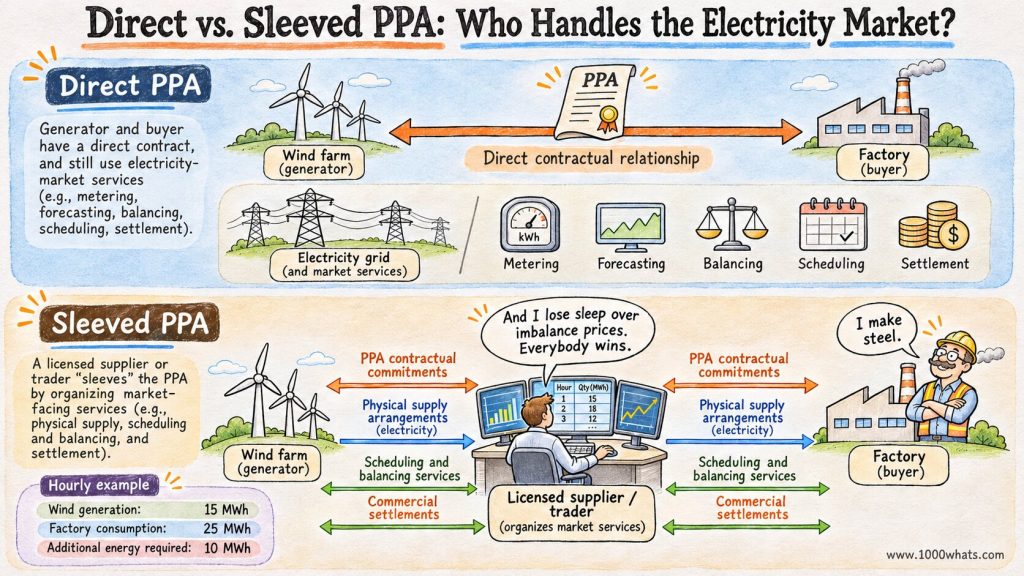
At the simplest level, a direct PPA means the core contractual relationship sits directly between the producer and the buyer.
The producer agrees to sell.
The buyer agrees to buy.
Nice.
But do not confuse direct with simple.
Electricity still needs to be measured.
Forecasts may need to be submitted.
Differences between expected and actual production need to be handled.
Someone may have to manage balancing.
Invoices need to match actual delivery and settlement.
Example: Direct PPA
| Party | Role |
| Solar producer | Generates and sells electricity |
| Factory | Buys electricity under the PPA |
| Key contractual issue | Price, volume, delivery, and risk allocation |
| Hidden question | Who handles deviations and balancing? |
The contract may be direct.
The electricity market is still electricity-market-shaped.
What is a sleeved PPA?
With a sleeved PPA, a licensed electricity supplier or trader becomes part of the arrangement.
Why?
Because a factory buying electricity from a remote renewable project still needs that power integrated into its normal electricity supply.
This is where understanding electricity retail helps.
Retail suppliers already sit between wholesale electricity markets and end consumers. In a sleeved PPA, that supplier can also help bring the PPA into the buyer’s everyday supply arrangement.
Think of the supplier as the bridge between the long-term renewable contract and the slightly chaotic reality of hourly electricity consumption.
A wind farm may produce 15 MWh in one hour.
The factory may need 25.
Someone has to deal with the missing 10.
The following hour, the wind farm might produce 30.
Welcome to electricity.
Example: Sleeved PPA
| Participant | What they do |
| Wind farm | Produces renewable electricity |
| Corporate buyer | Buys under the PPA |
| Supplier/trader | Helps manage supply, balancing, settlement, or residual electricity |
| Grid | Physically transports electricity through the system |
| PPA | Defines the long-term commercial arrangement |
In practice, sleeving is useful because most manufacturers have better things to do than become electricity traders.
They want to make steel.
Chemicals.
Servers.
Cars.
Cookies.
Whatever their actual business happens to be.
They generally do not wake up excited about imbalance positions.
⚡ “A sleeved PPA lets a company participate in a sophisticated electricity deal without turning procurement into a 24/7 trading desk.”
Direct vs. sleeved PPA
| Direct PPA | Sleeved PPA | |
| Producer and buyer contract directly | Yes | Usually |
| Supplier/trader involved | Not necessarily | Yes |
| Market functions | Must be allocated elsewhere | Supplier can handle many of them |
| Complexity | Can still be substantial | Additional contractual layer |
| Additional service cost | Potentially lower | Sleeving fee usually applies |
And now we get to one of the most commercially important questions.
3. What electricity product is actually being bought?
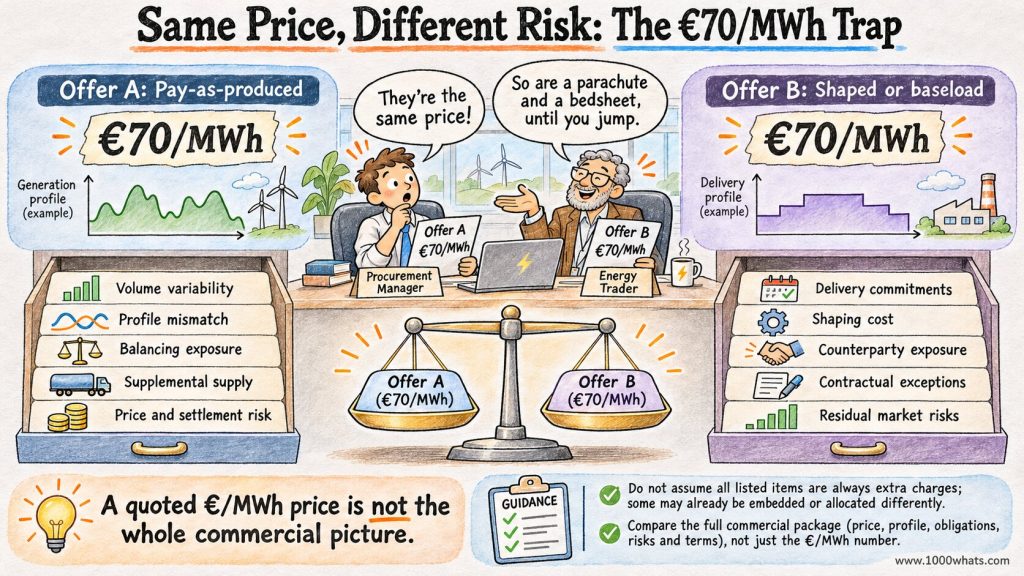
This is where two PPAs with exactly the same headline price can become completely different deals.
Suppose two renewable projects both offer:
€70/MWh.
Same price.
Same thing?
Not remotely.
One buyer might purchase whatever the renewable plant actually produces.
Another might expect exactly 10 MWh every hour.
Those are dramatically different promises.
Electricity itself may sound like one product, but electricity can be packaged commercially in very different ways. If that idea feels strange, my guide to energy products goes deeper into why classification matters.
For a PPA, the practical question is:
What generation profile has actually been contracted?
Common approaches include:
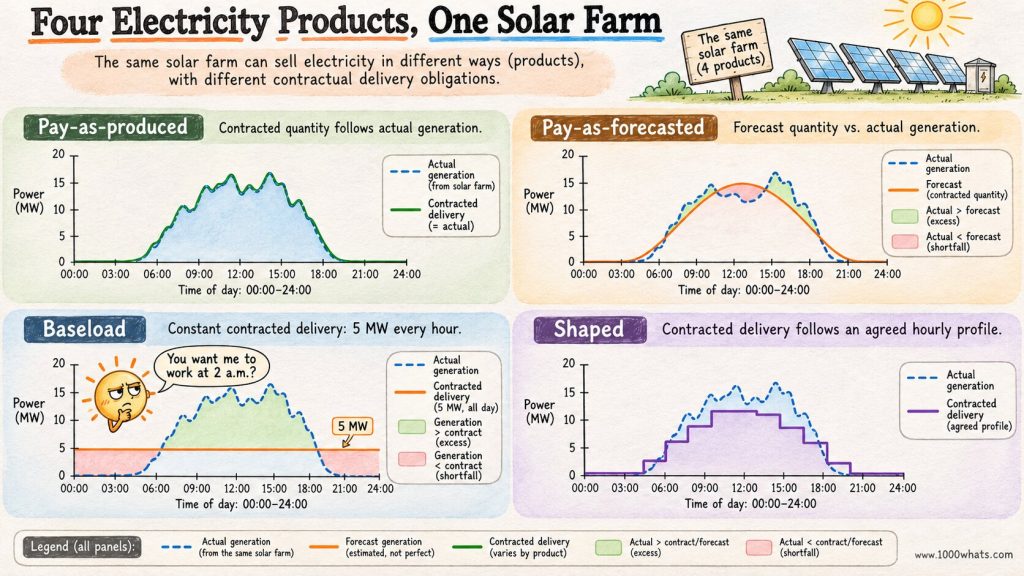
- Pay-as-produced
- Pay-as-forecasted
- Baseload
- Shaped or profiled
What is a pay-as-produced PPA?
This one means pretty much what it says.
The buyer purchases electricity as the plant actually produces it.
Sunshine?
More solar electricity.
Clouds?
Less.
Midnight?
The solar farm has left the chat.
Example: Pay-as-produced solar PPA
| Hour | Solar production | PPA volume |
| 08:00 | 5 MWh | 5 MWh |
| 10:00 | 18 MWh | 18 MWh |
| 12:00 | 30 MWh | 30 MWh |
| 16:00 | 13 MWh | 13 MWh |
| 22:00 | 0 MWh | 0 MWh |
This structure follows the physical reality of renewable generation.
And renewable generation is variable.
If you want to understand why solar and wind refuse to behave like traditional power plants, my guide to intermittent renewable energy is the useful rabbit hole.
That variability makes life easier for the generator under a pay-as-produced structure.
But it pushes an important problem toward the buyer:
What if my consumption does not look anything like the generation profile?
A factory may need electricity at midnight.
The solar plant remains emotionally unmoved.
And the total amount a renewable project generates over time also depends heavily on how often it can actually produce relative to its theoretical maximum—something captured by its capacity factor.
What is a pay-as-forecasted PPA?
Now we add prediction to the deal.
Under a pay-as-forecasted PPA, the contracted volumes are linked to an expected generation forecast rather than simply whatever turns up at the meter.
Imagine the wind farm forecasts tomorrow’s production.
Those forecast volumes become the commercial schedule.
Then tomorrow arrives.
Nature checks the spreadsheet.
Nature laughs.
Actual generation differs.
Example: Forecast vs. reality
| Hour | Forecast generation | Actual generation | Difference |
| 10:00 | 20 MWh | 18 MWh | -2 MWh |
| 11:00 | 24 MWh | 26 MWh | +2 MWh |
| 12:00 | 28 MWh | 21 MWh | -7 MWh |
Those differences matter because somebody must manage them commercially.
Suddenly, energy forecasting is not just an engineering exercise.
It is part of the financial machinery of the PPA.
What is a baseload PPA?
A baseload PPA takes a very different approach.
Instead of buying whatever the plant happens to generate, the buyer contracts a relatively flat quantity.
For example:
10 MWh every hour.
Sounds beautifully predictable.
Nature would like a word.
Example: Renewable production vs. baseload delivery
| Hour | Wind farm output | Contracted baseload | Difference to manage |
| 01:00 | 14 MWh | 10 MWh | +4 MWh |
| 02:00 | 7 MWh | 10 MWh | -3 MWh |
| 03:00 | 4 MWh | 10 MWh | -6 MWh |
| 04:00 | 16 MWh | 10 MWh | +6 MWh |
The buyer sees a nice flat product.
Behind that nice flat product, somebody is sweating.
When the renewable project produces too little, the shortfall needs to be covered.
When it produces too much, the excess needs to be sold, stored, or otherwise managed.
Turning variable generation into predictable electricity is a service—and services have prices.
What is a shaped PPA?
A shaped or profiled PPA goes one step further.
Instead of promising exactly the same quantity every hour, the contracted delivery shape can be designed to better resemble:
- expected renewable production
- the buyer’s consumption pattern
- a predefined hourly, daily, or monthly curve
Example: Shaped solar PPA
| Hour | Contracted shape |
| 07:00 | 2 MWh |
| 09:00 | 10 MWh |
| 12:00 | 25 MWh |
| 15:00 | 17 MWh |
| 18:00 | 4 MWh |
| 22:00 | 0 MWh |
That profile looks far more solar-like than baseload.
But it still raises the important question:
What happens when actual generation differs from the agreed shape?
Again, risk has not disappeared.
It has simply moved.
Storage can also become part of the solution because battery storage can move electricity from one moment to another.
And if you want a beautiful real-world demonstration of why timing matters, look at the duck curve: solar can flood the system around midday while electricity becomes much more valuable after the Sun starts disappearing.
Comparing the main volume approaches
| PPA approach | Buyer receives | Main attraction | Main challenge |
| Pay-as-produced | Actual plant output | Closely follows generation | Buyer accepts variability |
| Pay-as-forecasted | Forecast production | More predictable scheduling | Forecast deviations |
| Baseload | Relatively flat quantity | Predictability | Someone must shape variable production |
| Shaped | Agreed generation/load profile | Better match to buyer or asset | Profile risk remains |
From a market perspective, this is why comparing PPA prices without comparing products can be dangerously misleading.
€70/MWh pay-as-produced is not automatically equivalent to €70/MWh baseload.
The number is the same.
The risk package is not.
4. Who is buying the electricity?
Now we change perspective completely.
Up to this point, we have talked about location, delivery, and product.
But sometimes the name tells you none of those things.
It simply tells you who signed as buyer.
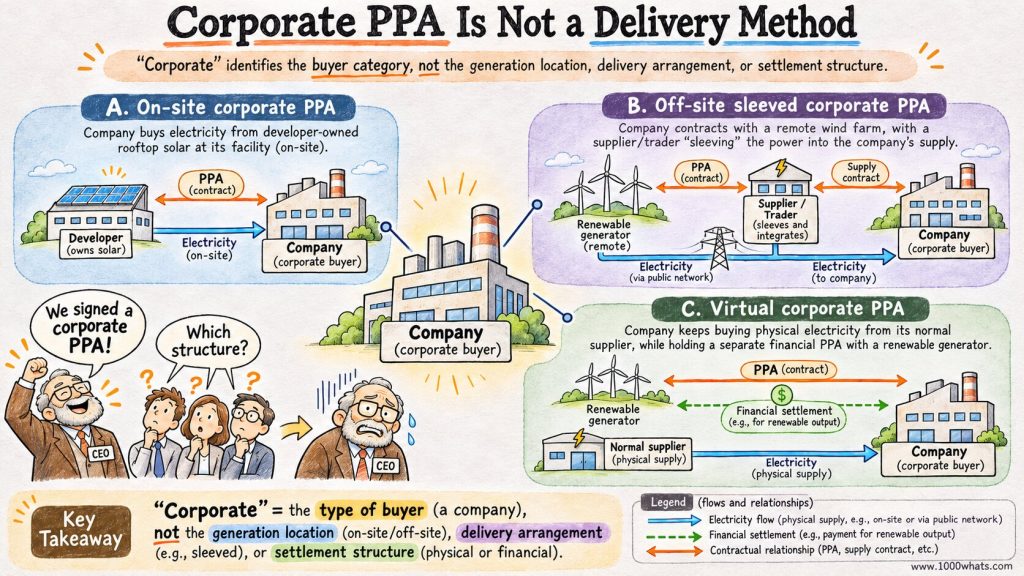
This is where the famous corporate PPA enters.
What is a corporate PPA?
A corporate PPA is a PPA where the buyer is a company purchasing electricity for its own business needs rather than primarily operating as a traditional electricity supplier.
Think:
- manufacturer
- data center
- retailer
- logistics company
- telecom operator
- mine
- commercial property group
The word corporate tells you who the buyer is.
It does not automatically tell you where the plant is.
It does not tell you whether the deal is sleeved.
It does not tell you whether the product is baseload.
And it definitely does not tell you whether the contract is physical or financial.
Three corporate PPAs that look completely different
| Deal | Corporate? | Location | Delivery | Product |
| Factory rooftop solar | Yes | On-site | Local/direct | Pay-as-produced |
| Remote wind via supplier | Yes | Off-site | Sleeved | Pay-as-produced |
| Remote renewable financial hedge | Yes | Off-site | Financial settlement | Contract-specific |
All three are corporate PPAs.
And they behave very differently.
This is perhaps the clearest example of why the usual “list of PPA types” falls apart.
Asking:
“Is this an off-site PPA or a corporate PPA?”
is the wrong question.
It can easily be both.
5. Is electricity actually delivered through the PPA?
And now we reach the model that tends to make newcomers squint at the screen.
The financial PPA, often called a Virtual PPA or VPPA.
Here the key question changes from:
“Where is my electricity?”
to:
“Is this contract actually arranging the physical supply of electricity to me?”
Sometimes the answer is no.
What is a physical PPA?
In a physical arrangement, the PPA is connected to an actual sale and delivery of electricity through the agreed supply and market structure.
That could be:
- an on-site PPA
- an off-site PPA
- a sleeved PPA
- a corporate PPA
Again:
the categories overlap.
“Physical” describes one characteristic of the deal.
It does not erase the others.
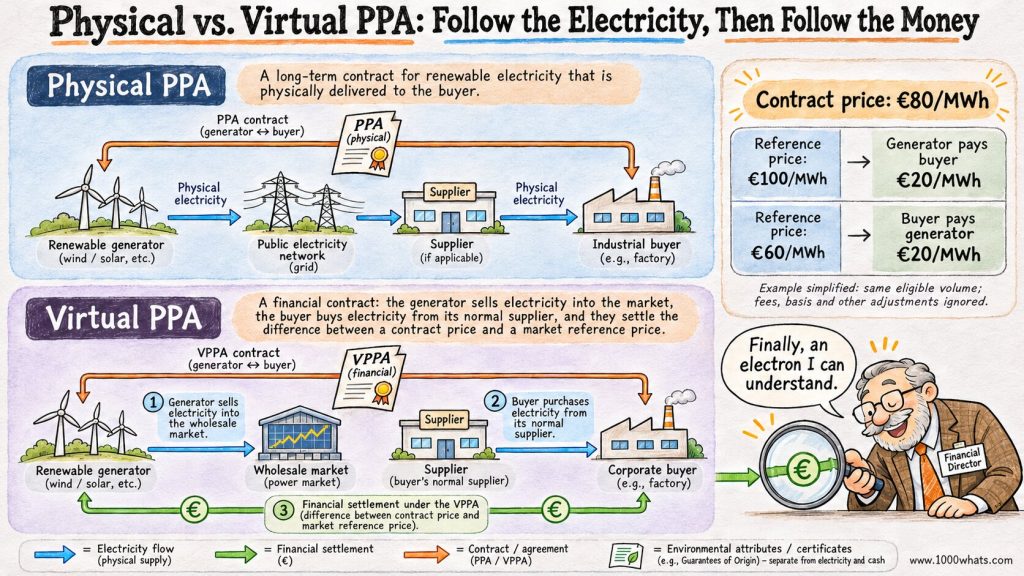
What is a virtual or financial PPA?
A Virtual PPA (VPPA) works differently.
The generator sells its electricity into the market.
The corporate buyer continues purchasing its physical electricity from its normal supplier.
The PPA between them then creates a financial settlement linked to an agreed contract price and a market reference price.
No special electrons need to find their way from turbine number seven to conference room B.
The connection is financial.
Example: Virtual PPA settlement
Assume the agreed PPA price is:
€80/MWh
| Market price | PPA price | Settlement | Basic result |
| €100/MWh | €80/MWh | Generator pays buyer €20/MWh | Market is above agreed price |
| €80/MWh | €80/MWh | No difference payment | Prices match |
| €60/MWh | €80/MWh | Buyer pays generator €20/MWh | Market is below agreed price |
Meanwhile:
Generator → sells electricity into its market
Buyer → buys physical electricity from its supplier
Generator ↔ Buyer → financially settle the PPA difference
That logic should look familiar if you have read my guide to a Contract for Difference (CFD).
The structures are not automatically identical, but the same basic idea of settling differences against a reference price helps explain why virtual PPAs feel more like financial risk instruments than ordinary electricity-supply contracts.
“In a virtual PPA, the electricity may never be delivered to the buyer through the contract. The economics are.”
Physical vs. virtual PPA
| Physical PPA | Virtual / Financial PPA | |
| Physical electricity supplied through PPA structure | Yes | No |
| Buyer may still need normal supplier | Depending on structure | Yes |
| Financial settlement | May be part of structure | Central feature |
| Project can be far from buyer | Yes | Yes |
| Key complexity | Delivery, supply, balancing | Market price and settlement risk |
So what “type” is one actual PPA?
Let’s put the pieces together.
Imagine a large data center signs a contract with a remote wind farm.
The wind farm is hundreds of miles away.
A licensed supplier integrates the electricity into the data center’s supply.
The buyer takes whatever volume the wind farm actually produces.
What type of PPA is it?
Well…
| Question | Answer | Label |
| Where is the plant? | Away from buyer | Off-site |
| Who manages delivery? | Supplier involved | Sleeved |
| What profile is bought? | Actual generation | Pay-as-produced |
| Who is buyer? | Private company | Corporate |
| Is electricity physically delivered? | Yes | Physical |
So our deal is:
an off-site, sleeved, corporate, physical, pay-as-produced PPA.
That sounds terrifying if you treat every word as a different contract.
It becomes completely logical when every word answers a different question.
Why does this distinction actually matter?
You might reasonably ask:
Who cares?
If everybody understands the deal, why argue about terminology?
Because loose terminology can hide real commercial differences.
Take these two offers:
| Offer A | Offer B |
| €65/MWh | €70/MWh |
| Pay-as-produced | Baseload |
| Buyer carries more variability | Seller carries more shaping |
| Lower headline price | Higher headline price |
Which one is cheaper?
You cannot answer from the PPA price alone.
Maybe Offer A.
Maybe Offer B.
It depends on what it costs the buyer to manage the risk that Offer A leaves behind.
The PPA structure tells you where part of the risk sits.
That is the real issue underneath all these labels.
Every PPA label is secretly a risk question
Location affects delivery and grid arrangements.
Sleeving affects who handles market operations.
The contracted shape affects volume and balancing risk.
The buyer category changes the commercial structure.
Physical versus virtual changes how the deal is settled.
And timing matters too.
PPAs are negotiated while renewable projects move through a much larger development journey. If you want that bigger picture, see the six stages of renewable energy projects.
Eventually, the project must also reach the point where commercial operations actually begin. That milestone—Commercial Operation Date (COD)—can be directly connected to when major PPA obligations, revenue streams, and delay consequences kick in.
In practice, experienced PPA teams therefore spend less time asking:
“What type of PPA is this?”
and more time asking:
- Who takes volume risk?
- Who takes imbalance risk?
- Who handles shaping?
- Who takes market-price risk?
- Where is the delivery point?
- Who manages residual consumption?
- What happens with excess generation?
- Who gets the renewable attributes?
- What happens if generation differs from forecast?
- What happens if the project is late?
That is where the contract stops being terminology and starts becoming economics.
⚡ “The best way to understand a PPA isn’t to ask what it is called. Ask what each party has promised to do.”
PPA types: The cheat sheet
If all the terminology starts blurring together, come back to this table.
| If someone says… | Ask yourself… |
| On-site PPA | Where is the project? |
| Off-site PPA | Where is the project? |
| Direct PPA | How is the producer-buyer relationship organized? |
| Sleeved PPA | Is a supplier/trader managing parts of delivery? |
| Pay-as-produced PPA | What volume does the buyer take? |
| Pay-as-forecasted PPA | Is delivery based on forecast production? |
| Baseload PPA | Has a flat quantity been promised? |
| Shaped PPA | What does the contracted delivery curve look like? |
| Corporate PPA | Who is the buyer? |
| Physical PPA | Is electricity delivered through the arrangement? |
| Virtual PPA | Is the PPA financially settled instead? |
Notice the pattern?
There was never one single list.
There were several questions hiding inside one list.
Build Your PPA in Five Questions
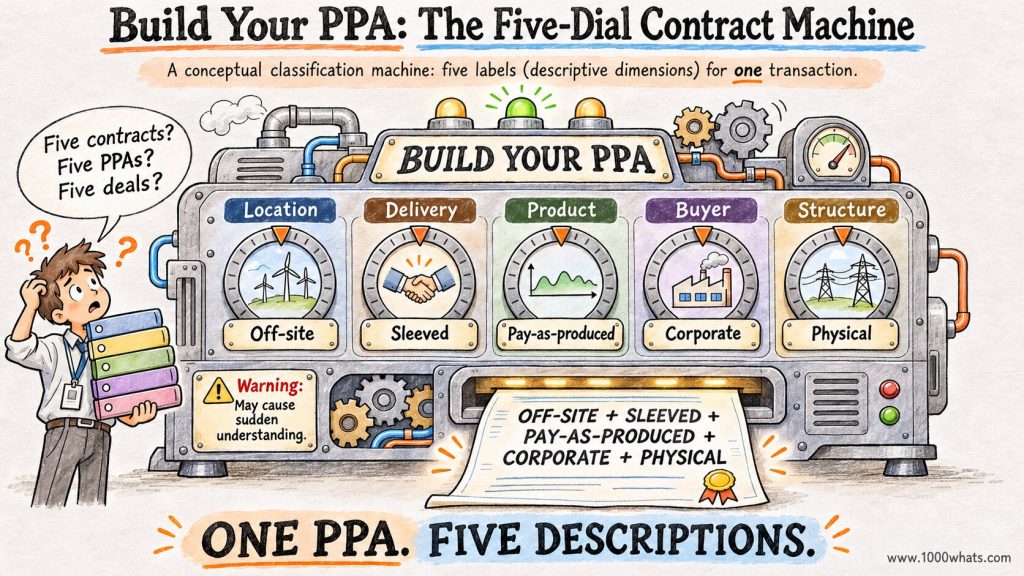
Create a vertical decision diagram:
1. Where is the plant?
→ On-site / Off-site
↓
2. Who organizes delivery?
→ Direct / Sleeved
↓
3. What product is purchased?
→ Pay-as-produced / Pay-as-forecasted / Baseload / Shaped
↓
4. Who is the buyer?
→ Corporate / Utility / Trader / Public entity
↓
5. Physical delivery or financial settlement?
→ Physical / Virtual
At the bottom:
Off-site + Sleeved + Pay-as-produced + Corporate + Physical
ONE DEAL. FIVE DESCRIPTIONS.
Why PPA types matter today
As renewable energy procurement becomes more sophisticated, simply saying:
“We signed a PPA.”
tells us less than you might think.
Two buyers can both announce renewable PPAs and have completely different exposures.
One receives raw renewable generation and carries the variability.
Another buys a neatly shaped product because somebody else has absorbed that headache.
One receives electricity through a physical supply arrangement.
Another signs a financial contract with a project hundreds of miles away.
One has solar panels on its roof.
Another has never visited the power plant it contracted.
All of them may correctly say:
“We have a PPA.”
What matters is what sits behind those three letters.
Final thoughts
So, what are the different types of PPAs?
The slightly annoying answer is:
That depends on what you are trying to describe.
And that is actually the useful answer.
Instead of memorizing on-site, off-site, corporate, sleeved, virtual, pay-as-produced, baseload, and shaped PPAs as completely separate species, ask five questions:
Where is the electricity produced?
Who organizes delivery?
What electricity product is being purchased?
Who is the buyer?
Is electricity physically supplied through the PPA or financially settled?
Once those answers are clear, the labels become almost obvious.
More importantly, you start seeing what actually matters underneath them:
who takes which risk, who performs which job, and what exactly the buyer is paying for.
That is much more useful than memorizing a list.
And the next time someone says they are negotiating an:
“off-site sleeved corporate physical pay-as-produced PPA”
you won’t need to nod mysteriously and hope the meeting ends soon.
You’ll know exactly what they mean.
Until next time, stay curious! 😎
Discover more from 1000whats
Subscribe to get the latest posts sent to your email.